Quantitative Disease Ecology and Conservation (QDEC) Lab Group, Department of Geography, University of Florida, Gainesville, Florida, United States of America.
Emerging Pathogens Institute, University of Florida, Gainesville, Florida, United States of America.
PLoS Negl Trop Dis. 2019 Apr 17;13(4):e0007322. doi: 10.1371/journal.pntd.0007322. eCollection 2019 Apr.
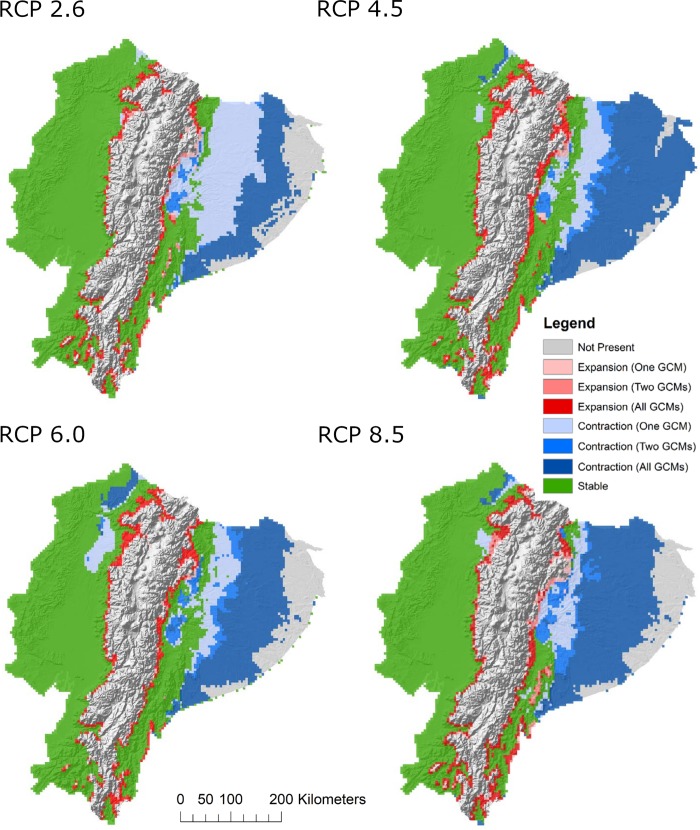
Arboviral disease transmission by Aedes mosquitoes poses a major challenge to public health systems in Ecuador, where constraints on health services and resource allocation call for spatially informed management decisions. Employing a unique dataset of larval occurrence records provided by the Ecuadorian Ministry of Health, we used ecological niche models (ENMs) to estimate the current geographic distribution of Aedes aegypti in Ecuador, using mosquito presence as a proxy for risk of disease transmission. ENMs built with the Genetic Algorithm for Rule-Set Production (GARP) algorithm and a suite of environmental variables were assessed for agreement and accuracy. The top model of larval mosquito presence was projected to the year 2050 under various combinations of greenhouse gas emissions scenarios and models of climate change. Under current climatic conditions, larval mosquitoes were not predicted in areas of high elevation in Ecuador, such as the Andes mountain range, as well as the eastern portion of the Amazon basin. However, all models projected to scenarios of future climate change demonstrated potential shifts in mosquito distribution, wherein range contractions were seen throughout most of eastern Ecuador, and areas of transitional elevation became suitable for mosquito presence. Encroachment of Ae. aegypti into mountainous terrain was estimated to affect up to 4,215 km2 under the most extreme scenario of climate change, an area which would put over 12,000 people currently living in transitional areas at risk. This distributional shift into communities at higher elevations indicates an area of concern for public health agencies, as targeted interventions may be needed to protect vulnerable populations with limited prior exposure to mosquito-borne diseases. Ultimately, the results of this study serve as a tool for informing public health policy and mosquito abatement strategies in Ecuador.
埃及伊蚊传播的虫媒病毒疾病对厄瓜多尔的公共卫生系统构成了重大挑战,该国的卫生服务和资源配置受到限制,需要根据空间信息做出管理决策。我们利用厄瓜多尔卫生部提供的独特幼虫发生记录数据集,使用生态位模型(ENM)来估计埃及伊蚊在厄瓜多尔的当前地理分布,以蚊子的存在来代表疾病传播的风险。使用遗传算法规则集生成(GARP)算法和一套环境变量构建的 ENM 模型进行了一致性和准确性评估。幼虫蚊子存在的顶级模型根据温室气体排放情景和气候变化模型的各种组合被投射到 2050 年。在当前的气候条件下,厄瓜多尔的高海拔地区(如安第斯山脉和亚马逊盆地的东部地区)没有预测到幼虫蚊子。然而,所有模型都预测到未来气候变化情景中蚊子的分布可能会发生变化,其中厄瓜多尔东部大部分地区的范围将缩小,过渡海拔地区将适合蚊子的存在。在气候变化最极端的情景下,估计埃及伊蚊侵入山区的范围将达到 4215 平方公里,这一地区将使目前生活在过渡地区的 12000 多人面临风险。蚊子分布向高海拔地区转移表明公共卫生机构需要关注这一问题,因为可能需要采取有针对性的干预措施来保护那些以前接触过蚊媒疾病的机会有限的脆弱人群。最终,这项研究的结果可以作为厄瓜多尔公共卫生政策和蚊子控制策略的工具。