
基于机制的参数化方案,用于研究 COVID-19 在平原地区的传播率与气象因素之间的关联。
A mechanism-based parameterisation scheme to investigate the association between transmission rate of COVID-19 and meteorological factors on plains in China.
机构信息
Division of Environment and Sustainability, the Hong Kong University of Science and Technology, Hong Kong, China.
Division of Environment and Sustainability, the Hong Kong University of Science and Technology, Hong Kong, China; Department of Civil and Environmental Engineering, the Hong Kong University of Science and Technology, Hong Kong, China.
出版信息
Sci Total Environ. 2020 Oct 1;737:140348. doi: 10.1016/j.scitotenv.2020.140348. Epub 2020 Jun 18.
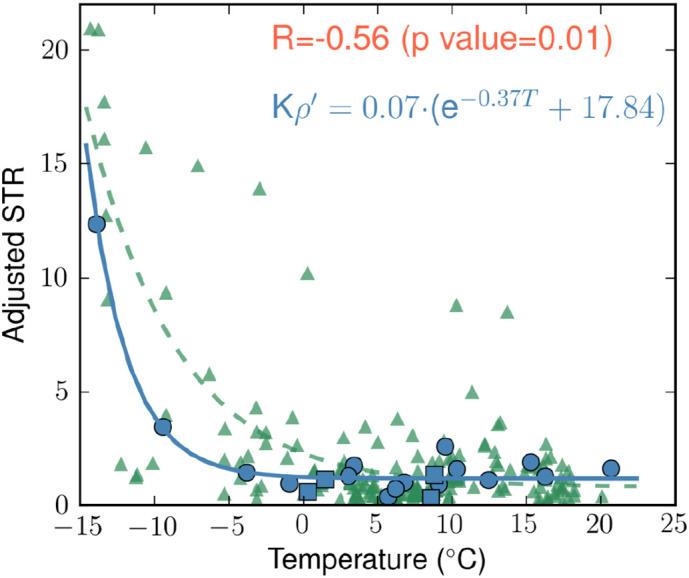
The novel coronavirus disease 2019 (COVID-19), which first emerged in Hubei province, China, has become a pandemic. However, data regarding the effects of meteorological factors on its transmission are limited and inconsistent. A mechanism-based parameterisation scheme was developed to investigate the association between the scaled transmission rate (STR) of COVID-19 and the meteorological parameters in 20 provinces/municipalities located on the plains in China. We obtained information on the scale of population migrated from Wuhan, the world epicentre of the COVID-19 outbreak, into the study provinces/municipalities using mobile-phone positioning system and big data techniques. The highest STRs were found in densely populated metropolitan areas and in cold provinces located in north-eastern China. Population density had a non-linear relationship with disease spread (linearity index, 0.9). Among various meteorological factors, only temperature was significantly associated with the STR after controlling for the effect of population density. A negative and exponential relationship was identified between the transmission rate and the temperature (correlation coefficient, -0.56; 99% confidence level). The STR increased substantially as the temperature in north-eastern China decreased below 0 °C (the STR ranged from 3.5 to 12.3 when the temperature was between -9.41 °C and -13.87 °C), whilst the STR showed less temperature dependence in the study areas with temperate weather conditions (the STR was 1.21 ± 0.57 when the temperature was above 0 °C). Therefore, a higher population density was linearly whereas a lower temperature (<0 °C) was exponentially associated with an increased transmission rate of COVID-19. These findings suggest that the mitigation of COVID-19 spread in densely populated and/or cold regions will be a great challenge.
新型冠状病毒病 2019(COVID-19)最初在中国湖北省出现,已成为一种大流行疾病。然而,有关气象因素对其传播影响的数据有限且不一致。本研究开发了一种基于机制的参数化方案,以调查 COVID-19 的标化传播率(STR)与中国 20 个平原省份/直辖市的气象参数之间的关联。我们利用移动电话定位系统和大数据技术,获得了从 COVID-19 世界疫情中心武汉迁移到研究省份/直辖市的人口规模信息。我们发现,人口密度高的大都市地区和位于中国东北部寒冷省份的 STR 最高。人口密度与疾病传播呈非线性关系(线性指数为 0.9)。在各种气象因素中,只有在控制人口密度影响后,温度才与 STR 显著相关。我们发现,传播率与温度之间呈负指数关系(相关系数为-0.56;99%置信区间)。当中国东北部的温度降至 0°C 以下时,STR 会大幅增加(当温度在-9.41°C 到-13.87°C 之间时,STR 范围在 3.5 到 12.3 之间),而在温带气候条件下的研究区域,STR 对温度的依赖性较小(当温度高于 0°C 时,STR 为 1.21±0.57)。因此,较高的人口密度与 COVID-19 的传播率呈线性关系,而较低的温度(<0°C)与传播率呈指数关系。这些发现表明,在人口密度高和/或寒冷地区,减缓 COVID-19 的传播将是一个巨大的挑战。


 Zotero 插件