• 文献检索
  • 文档翻译
  • 深度研究
  • 学术资讯
  • Suppr Zotero 插件Zotero 插件
  • 邀请有礼
  • 套餐&价格
  • 历史记录
应用&插件
Suppr Zotero 插件Zotero 插件浏览器插件Mac 客户端Windows 客户端微信小程序
定价
高级版会员购买积分包购买API积分包
服务
文献检索文档翻译深度研究API 文档MCP 服务
关于我们
关于 Suppr公司介绍联系我们用户协议隐私条款
关注我们

Suppr 超能文献

核心技术专利:CN118964589B侵权必究
粤ICP备2023148730 号-1Suppr @ 2026

文献检索

告别复杂PubMed语法,用中文像聊天一样搜索,搜遍4000万医学文献。AI智能推荐,让科研检索更轻松。

立即免费搜索

文件翻译

保留排版,准确专业,支持PDF/Word/PPT等文件格式,支持 12+语言互译。

免费翻译文档

深度研究

AI帮你快速写综述,25分钟生成高质量综述,智能提取关键信息,辅助科研写作。

立即免费体验

环境温度和人口规模对新型冠状病毒(COVID-19)在伊朗不同省份传播率的敏感性和特异性分析。

The sensitivity and specificity analyses of ambient temperature and population size on the transmission rate of the novel coronavirus (COVID-19) in different provinces of Iran.

机构信息

Department of Mechanical Engineering, Shiraz University, Shiraz, Iran.

Department of Civil and Environmental Engineering, Shiraz University of Technology, Shiraz, Iran..

出版信息

Sci Total Environ. 2020 Aug 1;728:138872. doi: 10.1016/j.scitotenv.2020.138872. Epub 2020 Apr 21.

DOI:10.1016/j.scitotenv.2020.138872
PMID:32335407
原文链接:https://pmc.ncbi.nlm.nih.gov/articles/PMC7194726/
Abstract

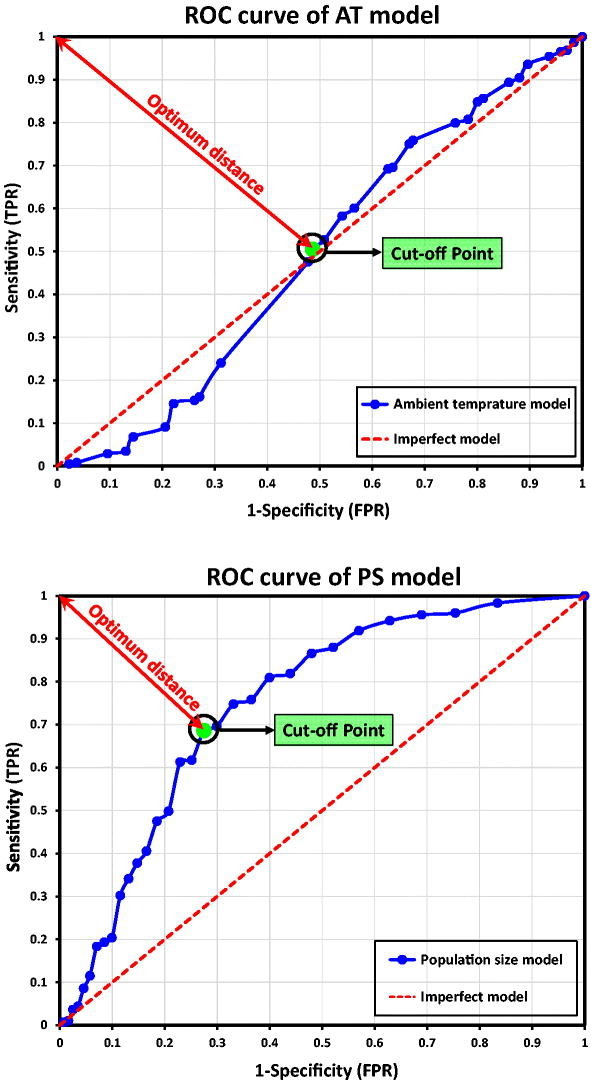
On 10 April 2020, Iran reported 68,192 COVID-19 cumulative cases including 4232 death and 35,465 recovery cases. Numerous factors could influence the transmission rate and survival of coronavirus. On this basis and according to the latest epidemiological researches, both ambient temperature (AT) and population size (PS) can be considered as significant transmissibility factors for coronavirus. The analysis of receiver operating characteristics (ROC) allows measuring the performance of a classification model using the confusion matrix. This study intends to investigate the sensitivity of AT and PS on the transmission rate of the novel coronavirus in different provinces of Iran. For this purpose, the information of each province of Iran including the annual average of AT and the number of healthy and diseased cases are categorized. Subsequently, the sensitivity and specificity analyses of both AT and PS factors are performed. The obtained results confirm that AT and PS have low sensibility and high sensitivity, respectively. Thus, there is no scientific reason to confirm that the number of COVID-19 cases in warmer climates is less than that of moderate or cold climates. Therefore, it is recommended that the cities/provinces with a population of over 1.7 million people have stricter inspections and more precise controls as their management policy.

摘要

2020 年 4 月 10 日,伊朗报告了 68192 例 COVID-19 累计病例,包括 4232 例死亡和 35465 例康复病例。许多因素可能影响冠状病毒的传播速度和存活率。在此基础上,并根据最新的流行病学研究,环境温度(AT)和人口规模(PS)都可以被认为是冠状病毒的重要传播因素。受试者工作特征(ROC)的分析可以使用混淆矩阵来衡量分类模型的性能。本研究旨在探讨 AT 和 PS 对伊朗不同省份新型冠状病毒传播率的敏感性。为此,对伊朗各省的信息进行了分类,包括年平均 AT 和健康和患病病例的数量。随后,对 AT 和 PS 因素的敏感性和特异性进行了分析。结果证实,AT 和 PS 的敏感性低,特异性高。因此,没有科学依据可以确认温暖气候下 COVID-19 病例的数量少于温和或寒冷气候下的病例数量。因此,建议人口超过 170 万的城市/省份采取更严格的检查和更精确的控制作为其管理政策。
https://cdn.ncbi.nlm.nih.gov/pmc/blobs/cc6f/7194726/2ea0eb589326/gr4_lrg.jpg
https://cdn.ncbi.nlm.nih.gov/pmc/blobs/cc6f/7194726/a66884d5a798/ga1_lrg.jpg
https://cdn.ncbi.nlm.nih.gov/pmc/blobs/cc6f/7194726/040e83208fda/gr1_lrg.jpg
https://cdn.ncbi.nlm.nih.gov/pmc/blobs/cc6f/7194726/362d94355cdd/gr2_lrg.jpg
https://cdn.ncbi.nlm.nih.gov/pmc/blobs/cc6f/7194726/2ea0eb589326/gr4_lrg.jpg
https://cdn.ncbi.nlm.nih.gov/pmc/blobs/cc6f/7194726/a66884d5a798/ga1_lrg.jpg
https://cdn.ncbi.nlm.nih.gov/pmc/blobs/cc6f/7194726/040e83208fda/gr1_lrg.jpg
https://cdn.ncbi.nlm.nih.gov/pmc/blobs/cc6f/7194726/362d94355cdd/gr2_lrg.jpg
https://cdn.ncbi.nlm.nih.gov/pmc/blobs/cc6f/7194726/2ea0eb589326/gr4_lrg.jpg

相似文献

1
The sensitivity and specificity analyses of ambient temperature and population size on the transmission rate of the novel coronavirus (COVID-19) in different provinces of Iran.环境温度和人口规模对新型冠状病毒(COVID-19)在伊朗不同省份传播率的敏感性和特异性分析。
Sci Total Environ. 2020 Aug 1;728:138872. doi: 10.1016/j.scitotenv.2020.138872. Epub 2020 Apr 21.
2
The association between the incidence of COVID-19 and the distance from the virus epicenter in Iran.伊朗新冠病毒发病率与病毒中心距离的关系。
Arch Virol. 2020 Nov;165(11):2555-2560. doi: 10.1007/s00705-020-04774-5. Epub 2020 Sep 2.
3
No association of COVID-19 transmission with temperature or UV radiation in Chinese cities.中国城市的新冠病毒传播与温度或紫外线辐射无关。
Eur Respir J. 2020 May 7;55(5). doi: 10.1183/13993003.00517-2020. Print 2020 May.
4
Severe Acute Respiratory Syndrome Coronavirus 2 Transmission Potential, Iran, 2020.严重急性呼吸综合征冠状病毒 2 传播潜力,伊朗,2020 年。
Emerg Infect Dis. 2020 Aug;26(8):1915-1917. doi: 10.3201/eid2608.200536. Epub 2020 Apr 22.
5
A Model for COVID-19 Prediction in Iran Based on China Parameters.基于中国参数的伊朗 COVID-19 预测模型。
Arch Iran Med. 2020 Apr 1;23(4):244-248. doi: 10.34172/aim.2020.05.
6
Preliminary estimation of the novel coronavirus disease (COVID-19) cases in Iran: A modelling analysis based on overseas cases and air travel data.伊朗新型冠状病毒病(COVID-19)病例的初步估计:基于海外病例和航空旅行数据的建模分析。
Int J Infect Dis. 2020 May;94:29-31. doi: 10.1016/j.ijid.2020.03.019. Epub 2020 Apr 14.
7
Epidemiology of 2019 novel coronavirus in Jiangsu Province, China after wartime control measures: A population-level retrospective study.江苏省实施战时控制措施后 2019 年新型冠状病毒的流行病学:一项基于人群的回顾性研究。
Travel Med Infect Dis. 2020 May-Jun;35:101654. doi: 10.1016/j.tmaid.2020.101654. Epub 2020 Apr 5.
8
Air conditioning system usage and SARS-CoV-2 transmission dynamics in Iran.伊朗的空调系统使用情况与新型冠状病毒传播动态
Med Hypotheses. 2020 Oct;143:110164. doi: 10.1016/j.mehy.2020.110164. Epub 2020 Aug 5.
9
SARS-CoV-2 antibody seroprevalence in the general population and high-risk occupational groups across 18 cities in Iran: a population-based cross-sectional study.伊朗 18 个城市一般人群和高风险职业人群中 SARS-CoV-2 抗体血清流行率:一项基于人群的横断面研究。
Lancet Infect Dis. 2021 Apr;21(4):473-481. doi: 10.1016/S1473-3099(20)30858-6. Epub 2020 Dec 15.
10
Correlation of ambient temperature and COVID-19 incidence in Canada.加拿大环境温度与 COVID-19 发病率的相关性。
Sci Total Environ. 2021 Jan 1;750:141484. doi: 10.1016/j.scitotenv.2020.141484. Epub 2020 Aug 4.

引用本文的文献

1
Weather Conditions and COVID-19 Cases: Insights from the GCC Countries.天气状况与新冠疫情病例:来自海湾合作委员会国家的见解
Intell Syst Appl. 2022 Sep;15:200093. doi: 10.1016/j.iswa.2022.200093. Epub 2022 Jun 18.
2
COVID-19 and environment: a poignant reminder of sustainability in the new normal.新冠疫情与环境:新常态下对可持续性的深刻警示。
Environ Sustain (Singap). 2021;4(4):649-670. doi: 10.1007/s42398-021-00207-4. Epub 2021 Sep 24.
3
Multi-feature SEIR model for epidemic analysis and vaccine prioritization.多特征 SEIR 模型在传染病分析和疫苗优先级排序中的应用。

本文引用的文献

1
Transmissibility of COVID-19 in 11 major cities in China and its association with temperature and humidity in Beijing, Shanghai, Guangzhou, and Chengdu.中国 11 个主要城市的 COVID-19 传播性及其与北京、上海、广州和成都的温度和湿度的关系。
Infect Dis Poverty. 2020 Jul 10;9(1):87. doi: 10.1186/s40249-020-00708-0.
2
Effects of temperature variation and humidity on the death of COVID-19 in Wuhan, China.温度变化和湿度对中国武汉 COVID-19 死亡的影响。
Sci Total Environ. 2020 Jul 1;724:138226. doi: 10.1016/j.scitotenv.2020.138226. Epub 2020 Mar 26.
3
Association between ambient temperature and COVID-19 infection in 122 cities from China.
PLoS One. 2024 Mar 1;19(3):e0298932. doi: 10.1371/journal.pone.0298932. eCollection 2024.
4
Impact of geographical, meteorological, demographic, and economic indicators on the trend of COVID-19: A global evidence from 202 affected countries.地理、气象、人口和经济指标对新冠疫情趋势的影响:来自202个受影响国家的全球证据
Heliyon. 2023 Aug 28;9(9):e19365. doi: 10.1016/j.heliyon.2023.e19365. eCollection 2023 Sep.
5
What are the Effects of Climate Variables on COVID-19 Pandemic? A Systematic Review and Current Update.气候变量对新冠疫情有何影响?系统综述与最新进展
Adv Biomed Res. 2023 Feb 25;12:33. doi: 10.4103/abr.abr_145_21. eCollection 2023.
6
Predictors of receiving COVID-19 vaccine among adult population in Iran: an observational study.伊朗成年人接种 COVID-19 疫苗的预测因素:一项观察性研究。
BMC Public Health. 2023 Mar 14;23(1):490. doi: 10.1186/s12889-023-15409-0.
7
Influences of climatic and non-climatic factors on COVID-19 outbreak: A review of existing literature.气候和非气候因素对新冠疫情的影响:现有文献综述
Environ Chall (Amst). 2021 Dec;5:100255. doi: 10.1016/j.envc.2021.100255. Epub 2021 Aug 24.
8
Flow and access: Driving forces of COVID-19 spreading in the first stage around Hubei, China.流动与接触:中国湖北周边地区 COVID-19 传播的第一阶段的推动因素。
PLoS One. 2023 Jan 20;18(1):e0280323. doi: 10.1371/journal.pone.0280323. eCollection 2023.
9
Assessment of variations of air pollutant concentrations during the COVID-19 lockdown and impact on urban air quality in South Asia.评估新冠疫情封锁期间空气污染物浓度变化及其对南亚城市空气质量的影响。
Urban Clim. 2021 Jul;38:100908. doi: 10.1016/j.uclim.2021.100908. Epub 2021 Jul 7.
10
Impact of COVID-19 pandemic on socio-economic, energy-environment and transport sector globally and sustainable development goal (SDG).新冠疫情对全球社会经济、能源环境及交通领域的影响以及可持续发展目标
J Clean Prod. 2021 Aug 20;312:127705. doi: 10.1016/j.jclepro.2021.127705. Epub 2021 May 31.
中国 122 个城市的环境温度与 COVID-19 感染的关联。
Sci Total Environ. 2020 Jul 1;724:138201. doi: 10.1016/j.scitotenv.2020.138201. Epub 2020 Mar 30.
4
Real-time estimation and prediction of mortality caused by COVID-19 with patient information based algorithm.基于患者信息算法的实时估计和预测 COVID-19 死亡率。
Sci Total Environ. 2020 Jul 20;727:138394. doi: 10.1016/j.scitotenv.2020.138394. Epub 2020 Apr 8.
5
Correlation between weather and Covid-19 pandemic in Jakarta, Indonesia.印度尼西亚雅加达的天气与新冠疫情的相关性
Sci Total Environ. 2020 Jul 10;725:138436. doi: 10.1016/j.scitotenv.2020.138436. Epub 2020 Apr 4.
6
A field indoor air measurement of SARS-CoV-2 in the patient rooms of the largest hospital in Iran.伊朗最大医院的病房内 SARS-CoV-2 的现场室内空气测量。
Sci Total Environ. 2020 Jul 10;725:138401. doi: 10.1016/j.scitotenv.2020.138401. Epub 2020 Apr 6.
7
Coronavirus disease 2019 (COVID-19) outbreak in Iran: Actions and problems.伊朗2019冠状病毒病(COVID-19)疫情:行动与问题
Infect Control Hosp Epidemiol. 2020 Jun;41(6):754-755. doi: 10.1017/ice.2020.86.
8
Preliminary estimation of the novel coronavirus disease (COVID-19) cases in Iran: A modelling analysis based on overseas cases and air travel data.伊朗新型冠状病毒病(COVID-19)病例的初步估计:基于海外病例和航空旅行数据的建模分析。
Int J Infect Dis. 2020 May;94:29-31. doi: 10.1016/j.ijid.2020.03.019. Epub 2020 Apr 14.
9
New coronavirus outbreak: Framing questions for pandemic prevention.新型冠状病毒爆发:为预防大流行提出问题。
Sci Transl Med. 2020 Mar 11;12(534). doi: 10.1126/scitranslmed.abb1469.
10
The deadly coronaviruses: The 2003 SARS pandemic and the 2020 novel coronavirus epidemic in China.致命的冠状病毒:2003 年 SARS 大流行和 2020 年中国新型冠状病毒疫情。
J Autoimmun. 2020 May;109:102434. doi: 10.1016/j.jaut.2020.102434. Epub 2020 Mar 3.