Department of Medicine, Weill Cornell Medicine, Doha, Qatar.
Manchester Metropolitan University, Manchester, Greater Manchester, UK.
BMJ Open Diabetes Res Care. 2020 Jun;8(1). doi: 10.1136/bmjdrc-2020-001420.
To assess the effect of exenatide and pioglitazone or basal-bolus insulin on diabetic peripheral neuropathy (DPN) in patients with poorly controlled type 2 diabetes (T2D).
This is a substudy of the Qatar Study, an open-label, randomized controlled trial. 38 subjects with poorly controlled T2D were studied at baseline and 1-year follow-up and 18 control subjects were assessed at baseline only. A combination of exenatide (2 mg/week) and pioglitazone (30 mg/day) or glargine with aspart insulin were randomly assigned to patients to achieve an HbA1c <53 mmol/mol (<7%). DPN was assessed with corneal confocal microscopy (CCM), DN4, vibration perception and sudomotor function.
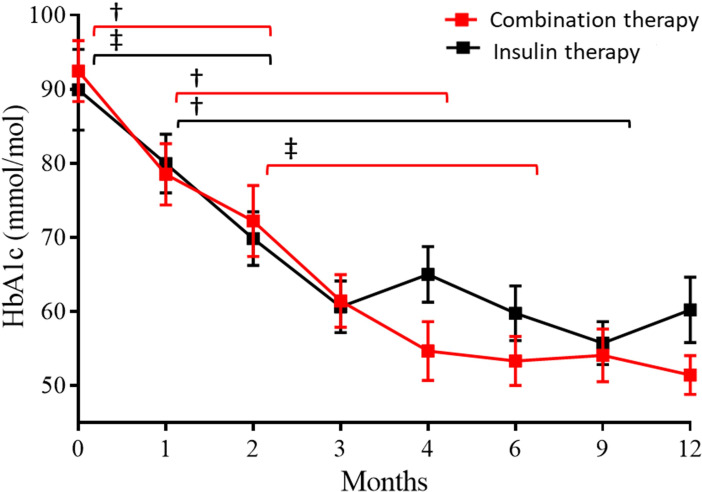
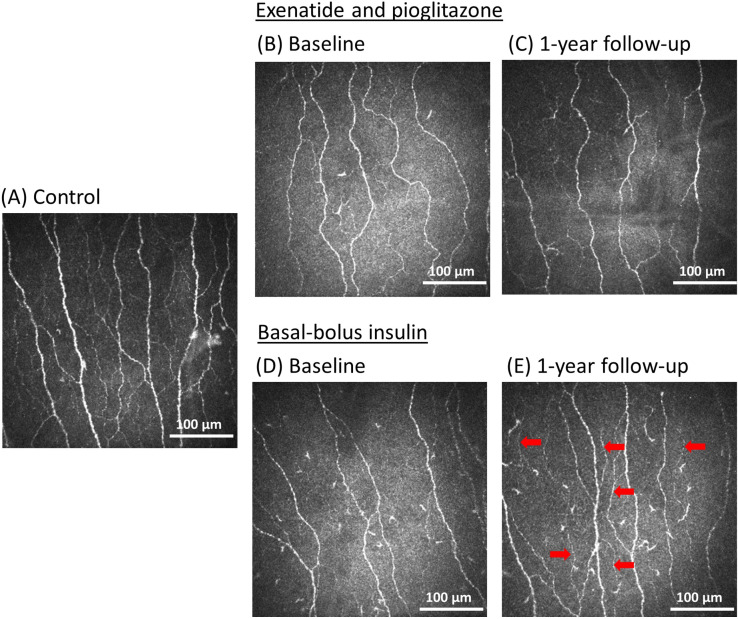
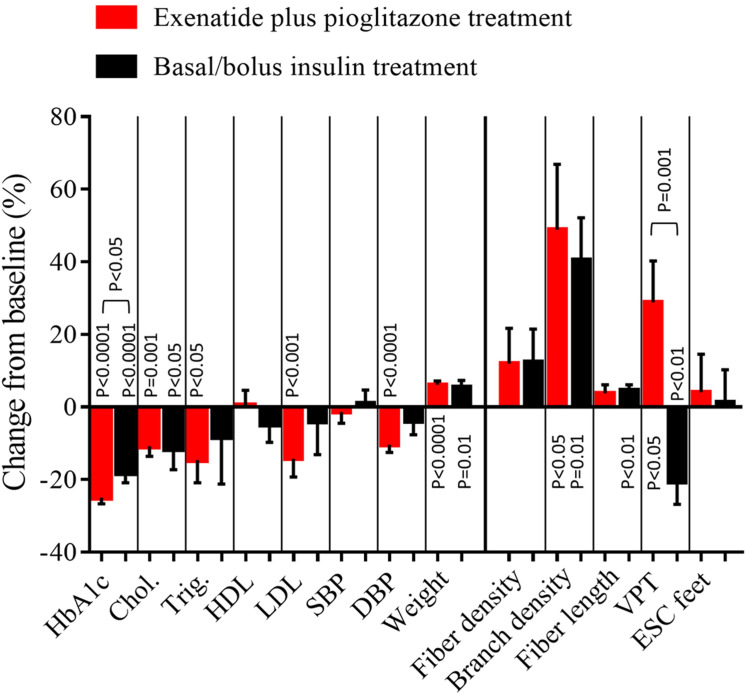
Subjects with T2D had reduced corneal nerves, but other DPN measures were comparable with the control group. In the combination treatment arm (n=21), HbA1c decreased by 35.2 mmol/mol (3.8 %) (p<0.0001), body weight increased by 5.6 kg (p<0.0001), corneal nerve branch density increased (p<0.05), vibration perception worsened (p<0.05), and DN4 and sudomotor function showed no change. In the insulin treatment arm, HbA1c decreased by 28.7 mmol/mol (2.7 %) (p<0.0001), body weight increased by 4.6 kg (p<0.01), corneal nerve branch density and fiber length increased (p≤0.01), vibration perception improved (p<0.01), and DN4 and sudomotor function showed no change. There was no association between the change in CCM measures with change in HbA1c, weight or lipids.
Treatment with exenatide and pioglitazone or basal-bolus insulin results in corneal nerve regeneration, but no change in neuropathic symptoms or sudomotor function over 1 year.
评估艾塞那肽和吡格列酮或基础-餐时胰岛素对血糖控制不佳的 2 型糖尿病(T2D)患者糖尿病周围神经病变(DPN)的影响。
这是卡塔尔研究的一项子研究,是一项开放标签、随机对照试验。38 例血糖控制不佳的 T2D 患者在基线和 1 年随访时进行研究,18 例对照患者仅在基线时进行评估。将艾塞那肽(2mg/周)和吡格列酮(30mg/天)或甘精胰岛素与门冬胰岛素的联合治疗随机分配给患者,以实现 HbA1c<53mmol/mol(<7%)。通过角膜共聚焦显微镜(CCM)、DN4、振动感知和出汗功能评估 DPN。
T2D 患者的角膜神经减少,但其他 DPN 测量与对照组相当。在联合治疗组(n=21)中,HbA1c 降低了 35.2mmol/mol(3.8%)(p<0.0001),体重增加了 5.6kg(p<0.0001),角膜神经分支密度增加(p<0.05),振动感知恶化(p<0.05),DN4 和出汗功能无变化。在胰岛素治疗组中,HbA1c 降低了 28.7mmol/mol(2.7%)(p<0.0001),体重增加了 4.6kg(p<0.01),角膜神经分支密度和纤维长度增加(p≤0.01),振动感知改善(p<0.01),DN4 和出汗功能无变化。CCM 测量的变化与 HbA1c、体重或血脂的变化之间没有关联。
艾塞那肽和吡格列酮或基础-餐时胰岛素治疗可导致角膜神经再生,但在 1 年内,神经症状或出汗功能无变化。