Giallonardo Vincenzo, Sampogna Gaia, Del Vecchio Valeria, Luciano Mario, Albert Umberto, Carmassi Claudia, Carrà Giuseppe, Cirulli Francesca, Dell'Osso Bernardo, Nanni Maria Giulia, Pompili Maurizio, Sani Gabriele, Tortorella Alfonso, Volpe Umberto, Fiorillo Andrea
Department of Psychiatry, University of Campania "L. Vanvitelli", Naples, Italy.
Department of Medicine, Surgery and Health Sciences, University of Trieste, Trieste, Italy.
Front Psychiatry. 2020 Jun 5;11:533. doi: 10.3389/fpsyt.2020.00533. eCollection 2020.
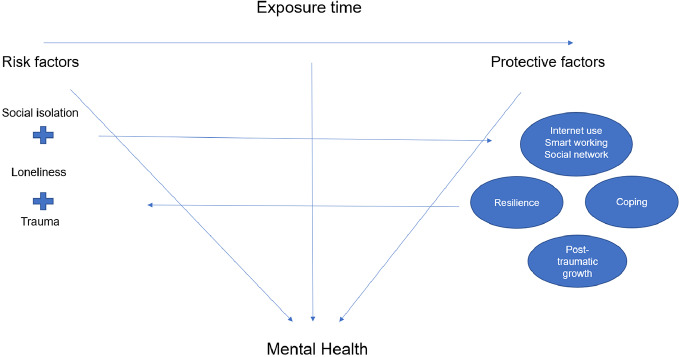
The COVID-19 pandemic and its related containment measures-mainly physical distancing and isolation-are having detrimental consequences on the mental health of the general population worldwide. In particular, frustration, loneliness, and worries about the future are common reactions and represent well-known risk factors for several mental disorders, including anxiety, affective, and post-traumatic stress disorders. The vast majority of available studies have been conducted in China, where the pandemic started. Italy has been severely hit by the pandemic, and the socio-cultural context is completely different from Eastern countries. Therefore, there is the need for methodologically rigorous studies aiming to evaluate the impact of COVID-19 and quarantine measures on the mental health of the Italian population. In fact, our results will help us to develop appropriate interventions for managing the psychosocial consequences of pandemic. The "COVID-IT-mental health trial" is a no-profit, not-funded, national, multicentric, cross-sectional population-based trial which has the following aims: a) to evaluate the impact of COVID-19 pandemic and its containment measures on mental health of the Italian population; b) to identify the main areas to be targeted by supportive long-term interventions for the different categories of people exposed to the pandemic. Data will be collected through a web-platform using validated assessment tools. Participants will be subdivided into four groups: a) Group 1-COVID-19 quarantine group. This group includes the general population which are quarantined but not isolated, i.e., those not directly exposed to contagion nor in contact with COVID-19+ individuals; b) Group 2-COVID-19+ group, which includes isolated people directly/indirectly exposed to the virus; c) Group 3-COVID-19 healthcare staff group, which includes first- and second-line healthcare professionals; d) Group 4-COVID-19 mental health, which includes users of mental health services and all those who had already been diagnosed with a mental disorder. Mental health services worldwide are not prepared yet to manage the short- and long-term consequences of the pandemic. It is necessary to have a clear picture of the impact that this new stressor will have on mental health and well-being in order to develop and disseminate appropriate interventions for the general population and for the other at-risk groups.
新冠疫情及其相关防控措施——主要是保持社交距离和隔离——正在对全球普通民众的心理健康产生不利影响。特别是,沮丧、孤独以及对未来的担忧是常见反应,也是包括焦虑症、情感障碍和创伤后应激障碍在内的几种精神障碍的众所周知的风险因素。绝大多数现有研究是在中国开展的,疫情正是从那里开始的。意大利受到疫情的严重打击,其社会文化背景与东方国家完全不同。因此,有必要开展方法严谨的研究,以评估新冠疫情和隔离措施对意大利民众心理健康的影响。事实上,我们的研究结果将有助于我们制定适当的干预措施,以应对疫情的心理社会后果。“COVID-IT-心理健康试验”是一项非营利性、无资金支持、全国性、多中心、基于人群的横断面试验,其目标如下:a)评估新冠疫情及其防控措施对意大利民众心理健康的影响;b)确定针对不同类别的受疫情影响人群的长期支持性干预措施的主要目标领域。数据将通过网络平台使用经过验证的评估工具进行收集。参与者将被分为四组:a)第一组——新冠疫情隔离组。该组包括被隔离但未被单独隔离的普通民众,即那些既未直接接触传染源也未与新冠病毒阳性个体接触的人;b)第二组——新冠病毒阳性组,包括直接/间接接触过病毒的被隔离人员;c)第三组——新冠疫情医护人员组,包括一线和二线医护专业人员;d)第四组——新冠疫情心理健康组,包括心理健康服务使用者以及所有已被诊断患有精神障碍的人。全球的心理健康服务尚未准备好应对疫情的短期和长期后果。有必要清楚了解这一新的压力源将对心理健康和幸福产生的影响,以便为普通民众和其他高危群体制定并推广适当的干预措施。