Imperial Clinical Trials Unit, Imperial College London, Stadium House, 68 Wood Lane, London, W12 7RH, UK.
Children's Allergy, Guy's and St Thomas' NHS Foundation Trust, London, United Kingdom, London, SE1 7EH, UK.
BMC Med Res Methodol. 2020 Mar 23;20(1):70. doi: 10.1186/s12874-020-00947-7.
It is important to estimate the treatment effect of interest accurately and precisely within the analysis of randomised controlled trials. One way to increase precision in the estimate and thus improve the power for randomised trials with continuous outcomes is through adjustment for pre-specified prognostic baseline covariates. Typically covariate adjustment is conducted using regression analysis, however recently, Inverse Probability of Treatment Weighting (IPTW) using the propensity score has been proposed as an alternative method. For a continuous outcome it has been shown that the IPTW estimator has the same large sample statistical properties as that obtained via analysis of covariance. However the performance of IPTW has not been explored for smaller population trials (< 100 participants), where precise estimation of the treatment effect has potential for greater impact than in larger samples.
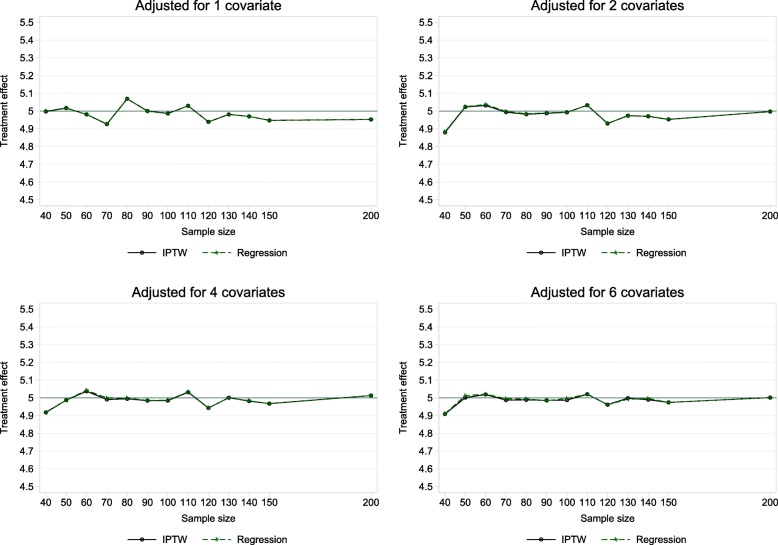
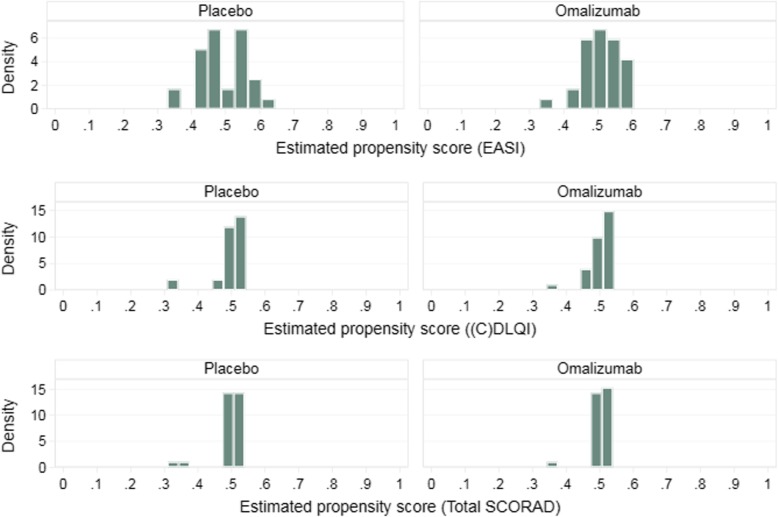
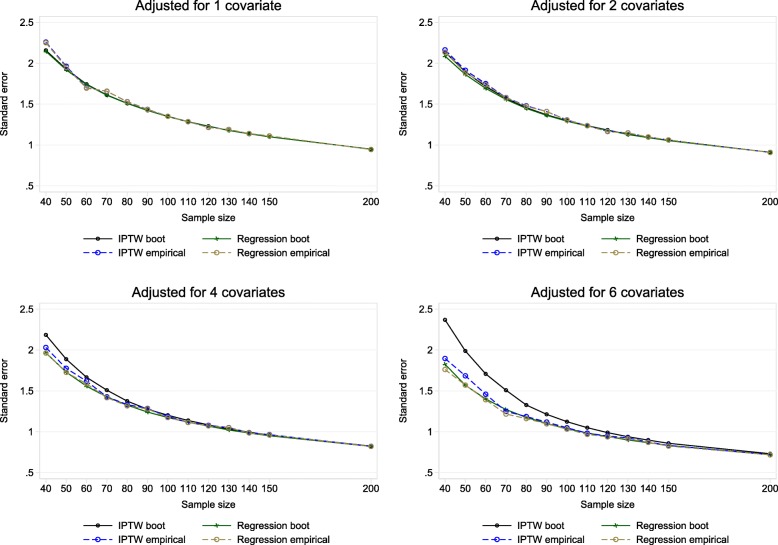
In this paper we explore the performance of the baseline adjusted treatment effect estimated using IPTW in smaller population trial settings. To do so we present a simulation study including a number of different trial scenarios with sample sizes ranging from 40 to 200 and adjustment for up to 6 covariates. We also re-analyse a paediatric eczema trial that includes 60 children.
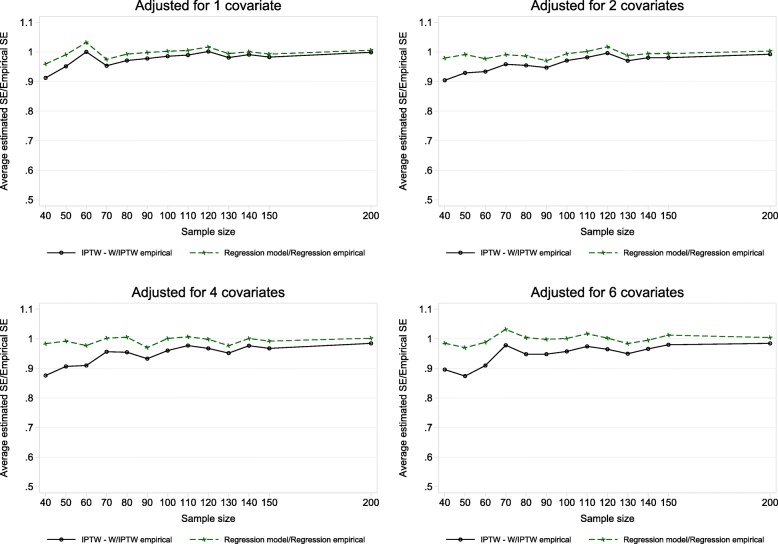
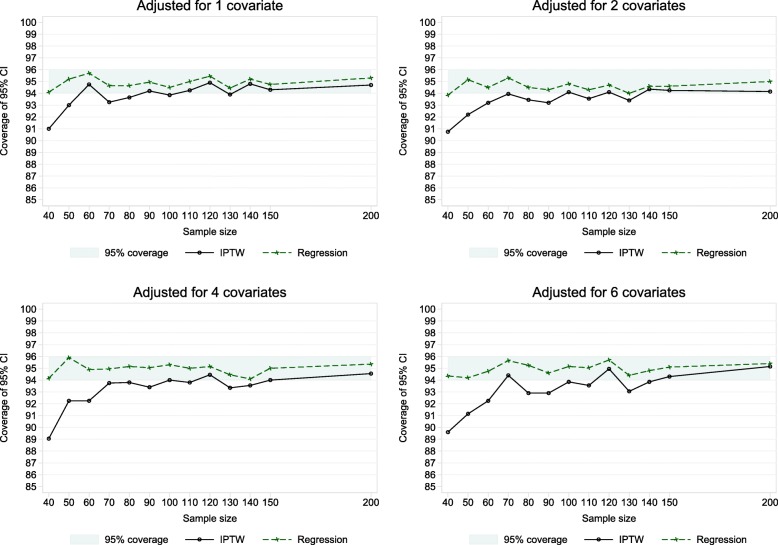
In the simulation study the performance of the IPTW variance estimator was sub-optimal with smaller sample sizes. The coverage of 95% CI's was marginally below 95% for sample sizes < 150 and ≥ 100. For sample sizes < 100 the coverage of 95% CI's was always significantly below 95% for all covariate settings. The minimum coverage obtained with IPTW was 89% with n = 40. In comparison, regression adjustment always resulted in 95% coverage. The analysis of the eczema trial confirmed discrepancies between the IPTW and regression estimators in a real life small population setting.
The IPTW variance estimator does not perform so well with small samples. Thus we caution against the use of IPTW in small sample settings when the sample size is less than 150 and particularly when sample size < 100.
在随机对照试验的分析中,准确而精确地估计感兴趣的治疗效果非常重要。提高估计精度的一种方法是通过调整预先指定的预后基线协变量,从而提高具有连续结局的随机试验的功效。通常使用回归分析进行协变量调整,但最近,使用倾向评分的逆概率治疗加权 (Inverse Probability of Treatment Weighting, IPTW) 已被提议作为替代方法。对于连续结局,已经表明 IPTW 估计量具有与通过协方差分析获得的相同大样本统计特性。然而,对于较小的人群试验(<100 名参与者),尚未探讨 IPTW 的性能,在这些试验中,治疗效果的精确估计比在较大样本中更具影响力。
在本文中,我们探讨了在较小的人群试验环境中使用 IPTW 估计的基线调整治疗效果的性能。为此,我们进行了一项模拟研究,包括具有从 40 到 200 不等的样本量的许多不同试验场景,并调整了多达 6 个协变量。我们还重新分析了一项包括 60 名儿童的儿科湿疹试验。
在模拟研究中,较小的样本量导致 IPTW 方差估计器的性能不理想。对于样本量<150 和≥100 的情况,95%CI 的覆盖率略低于 95%。对于样本量<100 的情况,对于所有协变量设置,95%CI 的覆盖率始终显著低于 95%。使用 n=40 时,IPTW 获得的最小覆盖率为 89%。相比之下,回归调整始终导致 95%的覆盖率。湿疹试验的分析证实了 IPTW 和回归估计器在现实小人群环境中的差异。
IPTW 方差估计器在小样本中表现不佳。因此,当样本量小于 150 时,特别是当样本量<100 时,我们警告不要在小样本环境中使用 IPTW。