Kitpanit Sarin, Lee Anna, Pitter Ken L, Fan Dan, Chow James C H, Neal Brian, Han Zhiqiang, Fox Pamela, Sine Kevin, Mah Dennis, Dunn Lara A, Sherman Eric J, Michel Loren, Ganly Ian, Wong Richard J, Boyle Jay O, Cohen Marc A, Singh Bhuvanesh, Brennan Cameron W, Gavrilovic Igor T, Hatzoglou Vaios, O'Malley Bernard, Zakeri Kaveh, Yu Yao, Chen Linda, Gelblum Daphna Y, Kang Jung Julie, McBride Sean M, Tsai Chiaojung J, Riaz Nadeem, Lee Nancy Y
Department of Radiation Oncology, Memorial Sloan Kettering Cancer Center, New York, NY, USA.
Division of Radiation Oncology, Department of Radiology, Faculty of Medicine, Chulalongkorn University, King Chulalongkorn Memorial Hospital, Thai Red Cross Society, Bangkok, Thailand.
Int J Part Ther. 2020 Spring;6(4):17-28. doi: 10.14338/IJPT-20-00014.1. Epub 2020 May 28.
To demonstrate temporal lobe necrosis (TLN) rate and clinical/dose-volume factors associated with TLN in radiation-naïve patients with head and neck cancer treated with proton therapy where the field of radiation involved the skull base.
Medical records and dosimetric data for radiation-naïve patients with head and neck cancer receiving proton therapy to the skull base were retrospectively reviewed. Patients with <3 months of follow-up, receiving <45 GyRBE or nonconventional fractionation, and/or no follow-up magnetic resonance imaging (MRI) were excluded. TLN was determined using MRI and graded using Common Terminology Criteria for Adverse Events (CTCAE) v5.0. Clinical (gender, age, comorbidities, concurrent chemotherapy, smoking, radiation techniques) and dose-volume parameters were analyzed for TLN correlation. The receiver operating characteristic curve and area under the curve (AUC) were performed to determine the cutoff points of significant dose-volume parameters.
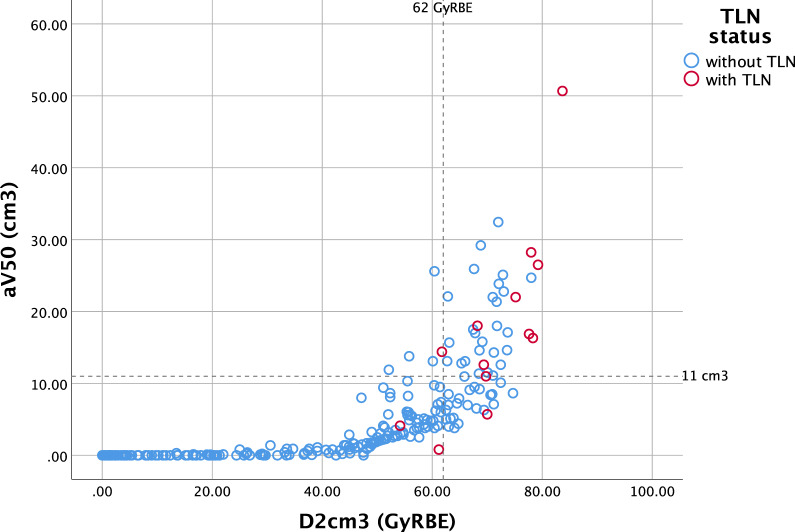
Between 2013 and 2019, 234 patients were included. The median follow-up time was 22.5 months (range = 3.2-69.3). Overall TLN rates of any grade, ≥ grade 2, and ≥ grade 3 were 5.6% (N = 13), 2.1%, and 0.9%, respectively. The estimated 2-year TLN rate was 4.6%, and the 2-year rate of any brain necrosis was 6.8%. The median time to TLN was 20.9 months from proton completion. Absolute volume receiving 40, 50, 60, and 70 GyRBE (absolute volume [aV]); mean and maximum dose received by the temporal lobe; and dose to the 0.5, 1, and 2 cm volume receiving the maximum dose (D0.5cm, D1cm, and D2cm, respectively) of the temporal lobe were associated with greater TLN risk while clinical parameters showed no correlation. Among volume parameters, aV50 gave maximum AUC (0.921), and D2cm gave the highest AUC (0.935) among dose parameters. The 11-cm cutoff value for aV50 and 62 GyRBE for D2cm showed maximum specificity and sensitivity.
The estimated 2-year TLN rate was 4.6% with a low rate of toxicities ≥grade 3; aV50 ≤11 cm, D2cm ≤62 GyRBE and other cutoff values are suggested as constraints in proton therapy planning to minimize the risk of any grade TLN. Patients whose temporal lobe(s) unavoidably receive higher doses than these thresholds should be carefully followed with MRI after proton therapy.
在接受质子治疗且放射野累及颅底的初治头颈癌患者中,阐明颞叶坏死(TLN)发生率以及与TLN相关的临床/剂量体积因素。
回顾性分析接受颅底质子治疗的初治头颈癌患者的病历和剂量学数据。排除随访时间<3个月、接受<45 GyRBE或非常规分割放疗以及/或者未进行随访磁共振成像(MRI)的患者。使用MRI确定TLN,并根据不良事件通用术语标准(CTCAE)v5.0进行分级。分析临床因素(性别、年龄、合并症、同步化疗、吸烟、放疗技术)和剂量体积参数与TLN的相关性。绘制受试者操作特征曲线及曲线下面积(AUC),以确定显著剂量体积参数的截断点。
2013年至2019年期间,共纳入234例患者。中位随访时间为22.5个月(范围=3.2 - 69.3个月)。任何级别的总体TLN发生率、≥2级和≥3级的发生率分别为5.6%(N = 13)、2.1%和0.9%。估计2年TLN发生率为4.6%,2年任何脑坏死发生率为6.8%。从质子治疗结束到发生TLN的中位时间为20.9个月。接受40、50、60和70 GyRBE的绝对体积(绝对体积[aV]);颞叶接受的平均剂量和最大剂量;以及颞叶接受最大剂量的0.5、1和2 cm体积的剂量(分别为D0.5cm、D1cm和D2cm)与更高的TLN风险相关,而临床参数无相关性。在体积参数中,aV50的AUC最大(0.921),在剂量参数中,D2cm的AUC最高(0.935)。aV50的11 cm截断值和D2cm的62 GyRBE显示出最大的特异性和敏感性。
估计2年TLN发生率为4.6%,≥3级毒性发生率较低;建议将aV50≤11 cm、D2cm≤62 GyRBE及其他截断值作为质子治疗计划中的限制条件,以尽量降低任何级别的TLN风险。颞叶不可避免地接受高于这些阈值剂量的患者,质子治疗后应通过MRI进行密切随访。