Madan Emily M, Frongillo Edward A, Unisa Sayeed, Dwivedi Laxmikant, Johnston Robert, Daniel Abner, Agrawal Praween K, Deb Sila, Khera Ajay, Menon Purnima, Nguyen Phuong H
Division of Nutritional Sciences, Cornell University, Ithaca, NY, USA.
University of South Carolina, Columbia, SC, USA.
Curr Dev Nutr. 2020 May 23;4(6):nzaa092. doi: 10.1093/cdn/nzaa092. eCollection 2020 Jun.
Child undernutrition in India remains widespread. Data from the National Family Health Survey 3 and 4 (NFHS-3 and NFHS-4) suggest that wasting prevalence has increased while stunting prevalence has declined.
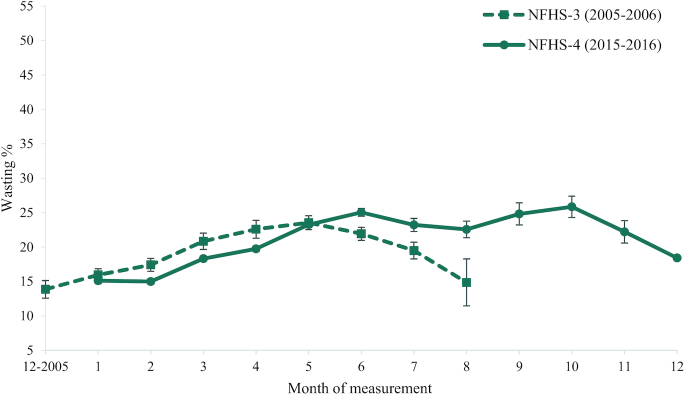
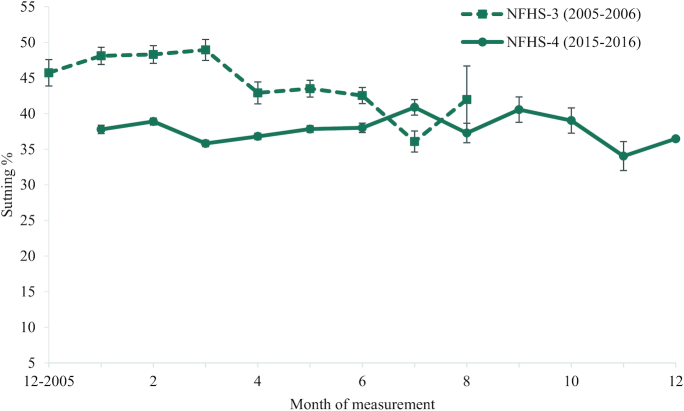
The objectives of this study were to do the following: ) describe wasting and stunting by month of measurement in India in children <5 y of age in NFHS-3 and NFHS-4 surveys, and ) test whether differences in the timing of anthropometric data collection and in states between survey years introduced bias in the comparison of estimates of wasting and stunting between NFHS-3 and NFHS-4.
Data on wasting and stunting for 42,608 and 232,744 children aged >5 y in the NFHS-3 and NFHS-4 survey rounds were analyzed. Differences in the prevalence of wasting and stunting by month of year and by state of residence were examined descriptively. Regression analyses were conducted to test the sensitivity of the estimate of differences in wasting and stunting prevalence across survey years to both state differences and seasonality.
Examination of the patterns of wasting and stunting by month of measurement and by state across survey years reveal marked variability. When both state and month were adjusted, regardless of the method used to account for sample size, there was a small negative difference from 2005-2006 to 2015-2016 in the prevalence of wasting (-0.8 ± 0.6 percentage points; = 0.2) and a negative difference in stunting prevalence (-8.3 ± 0.7 percentage points; < 0.001), indicating a small bias for wasting but not for stunting in unadjusted analyses.
State and seasonal differences may have introduced bias to the estimated difference in prevalence of wasting between the survey years but did not do so for stunting. Future data collection should be designed to maximize consistency in coverage of both time and place.
印度儿童营养不良现象仍然普遍存在。第三次和第四次全国家庭健康调查(NFHS - 3和NFHS - 4)的数据表明,消瘦患病率上升而发育迟缓患病率下降。
本研究的目的如下:(1)在NFHS - 3和NFHS - 4调查中描述印度5岁以下儿童按测量月份划分的消瘦和发育迟缓情况,以及(2)检验调查年份之间人体测量数据收集时间和邦别差异是否会在NFHS - 3和NFHS - 4的消瘦和发育迟缓估计值比较中引入偏差。
分析了NFHS - 3和NFHS - 4调查轮次中42,608名和232,744名5岁以上儿童的消瘦和发育迟缓数据。按年份月份和居住邦别对消瘦和发育迟缓患病率差异进行描述性分析。进行回归分析以检验跨调查年份消瘦和发育迟缓患病率差异估计值对邦别差异和季节性的敏感性。
按测量月份和邦别对各调查年份的消瘦和发育迟缓模式进行检查发现存在显著差异。在对邦别和月份进行调整后,无论用于考虑样本量的方法如何,从2005 - 2006年到2015 - 2016年,消瘦患病率存在小的负差异(-0.8±0.6个百分点;P = 0.2),发育迟缓患病率存在负差异(-8.3±0.7个百分点;P < 0.001),表明在未调整分析中消瘦存在小偏差而发育迟缓不存在偏差。
邦别和季节差异可能在调查年份间消瘦患病率估计差异中引入了偏差,但对发育迟缓未产生这种情况。未来的数据收集设计应旨在最大限度地提高时间和地点覆盖的一致性。