Department of Internal Medicine, The Catholic University of Korea, Incheon St. Mary's Hospital, Incheon, South Korea.
Division of Hepatology, Department of Internal Medicine, College of Medicine, The Catholic University of Korea, Seoul, South Korea.
Cancer Control. 2020 Apr-Jun;27(2):1073274820935843. doi: 10.1177/1073274820935843.
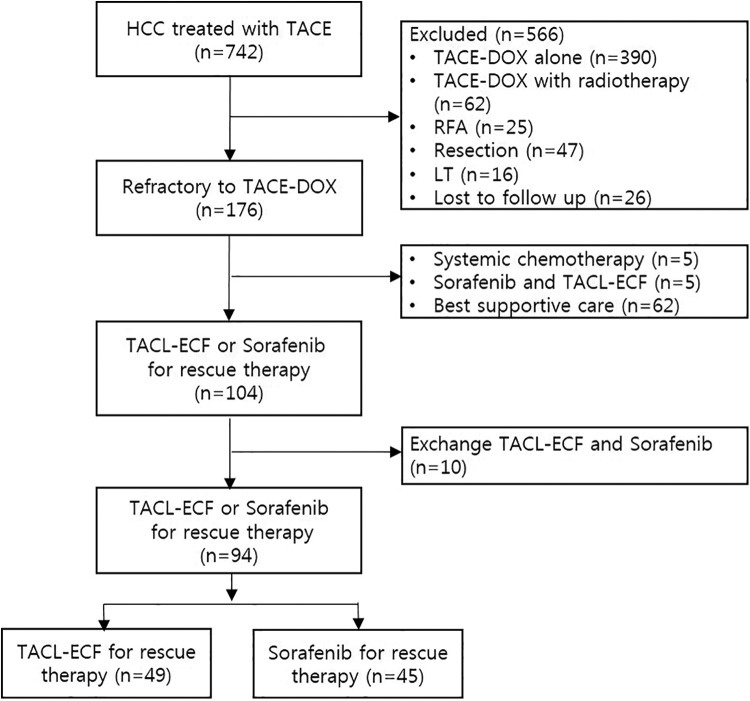
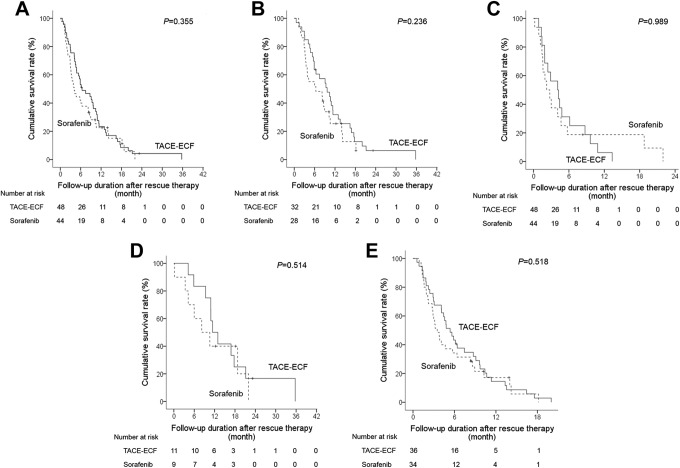
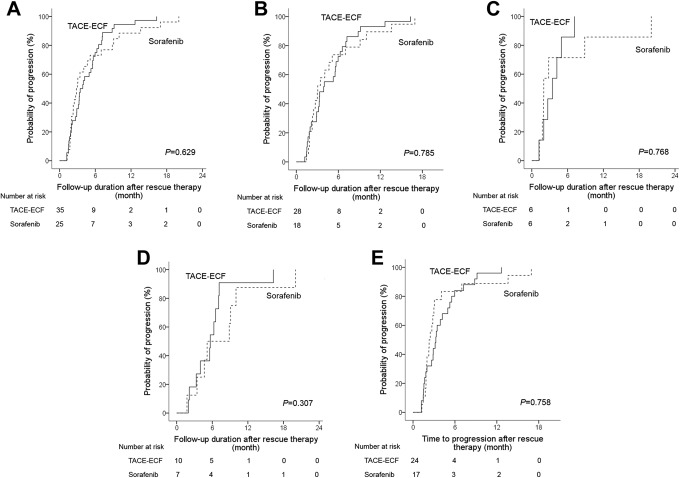
Transarterial chemoembolization using doxorubicin (TACE-DOX) is an effective therapy for advanced hepatocellular carcinoma (HCC). However, there are limited options for patients with TACE refractoriness. We compared the effectiveness between sorafenib and transarterial chemolipiodolization using epirubicin and cisplatin combined with systemic infusion of 5-fluorouracil (5-FU; TACL-ECF) in patients with previous TACE-DOX refractoriness. We retrospectively analyzed 742 consecutively enrolled cohort patients who received TACE-DOX as the first-line therapy for HCC. Among the 94 patients who failed with TACE-DOX, 49 patients were treated with TACL-ECF and 45 patients were treated with sorafenib as a rescue therapy. The TACL-ECF regimen comprised transarterial infusion of epirubicin and cisplatin combined with systemic infusion of 5-FU. Of the 94 patients, 22 and 72 patients were in Barcelona Clinic Liver Cancer stages B and C, respectively; 66% patients were classified as having Child-Pugh class A (CPC A). Overall survival (OS) after rescue therapy did not differ between the sorafenib and TACL-ECF groups (4.1 months vs 6.4 months, = .355). Progression-free survival (PFS) did not differ between the sorafenib and TACL-ECF groups (2.8 months vs 3.5 months, = .629). Adverse events of CTC grade 3/4 occurred more frequently in the sorafenib group than in the TACL-ECF group ( = .024). The present study showed that the OS and PFS did not differ between patients given rescue TACL-ECF therapy and those given sorafenib therapy. The TACL-ECF treatment was better tolerated than sorafenib. The TACL-ECF might be considered as an alternative therapy for the patients with TACE-DOX refractoriness, especially CPC B and sorafenib-intolerant patients.
经多柔比星动脉化疗栓塞术(TACE-DOX)是治疗晚期肝细胞癌(HCC)的有效方法。然而,对于 TACE 抵抗的患者,选择有限。我们比较了索拉非尼与经多柔比星动脉化学脂质体碘化油并用顺铂联合氟尿嘧啶全身输注(TACL-ECF)在 TACE-DOX 耐药患者中的疗效。我们回顾性分析了 742 例连续入组的接受 TACE-DOX 作为 HCC 一线治疗的患者。在 94 例 TACE-DOX 耐药的患者中,49 例患者接受 TACL-ECF 治疗,45 例患者接受索拉非尼作为挽救治疗。TACL-ECF 方案包括经动脉输注多柔比星和顺铂联合氟尿嘧啶全身输注。94 例患者中,22 例和 72 例分别为巴塞罗那临床肝癌分期 B 和 C;66%的患者为 Child-Pugh 分级 A(CPC A)。挽救治疗后总生存期(OS)在索拉非尼组和 TACL-ECF 组之间无差异(4.1 个月 vs. 6.4 个月, =.355)。无进展生存期(PFS)在索拉非尼组和 TACL-ECF 组之间无差异(2.8 个月 vs. 3.5 个月, =.629)。索拉非尼组发生 CTCAE 3/4 级不良事件的频率高于 TACL-ECF 组( =.024)。本研究表明,接受挽救性 TACL-ECF 治疗的患者与接受索拉非尼治疗的患者的 OS 和 PFS 无差异。TACL-ECF 治疗的耐受性优于索拉非尼。对于 TACE-DOX 耐药的患者,特别是 CPC B 和不耐受索拉非尼的患者,TACL-ECF 可作为替代治疗方法。