Zhang Shen, Wang Wan-Sheng, Zhong Bin-Yan, Ni Cai-Fang
Department of Interventional Radiology, The First Affiliated Hospital of Soochow University, Suzhou, Jiangsu, China.
J Clin Transl Hepatol. 2022 Aug 28;10(4):740-747. doi: 10.14218/JCTH.2021.00336. Epub 2022 Jan 4.
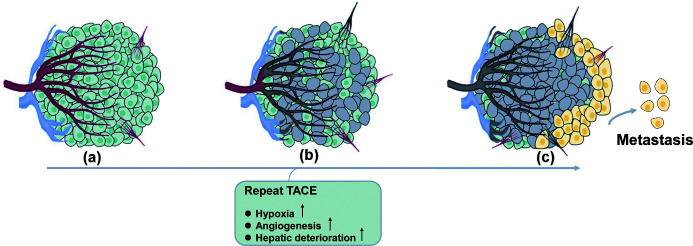
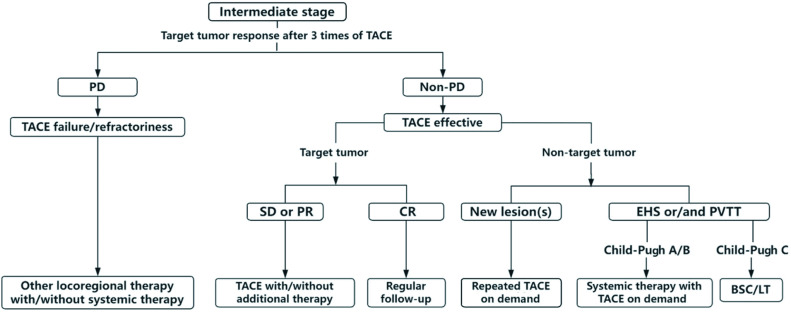
Transarterial chemoembolization (TACE) is widely applied for the treatment of hepatocellular carcinoma. Repeat TACE is often required in clinical practice because a satisfactory tumor response may not be achieved with a single session. However, repeated TACE procedures can impair liver function and increase treatment-related adverse events, all of which prompted the introduction of the concept of "TACE failure/refractoriness". Mainly based on evidence from two retrospective studies conducted in Japan, sorafenib is recommended as the first choice for subsequent treatment after TACE failure/refractoriness. Several studies have investigated the outcomes of other subsequent treatments, including locoregional, other molecular targeted, anti-programmed death-1/anti-programed death ligand-1 therapies, and combination therapies after TACE failure/refractoriness. In this review, we summarize the up-to-date information about the outcomes of several subsequent treatment modalities after TACE failure/refractoriness.
经动脉化疗栓塞术(TACE)广泛应用于肝细胞癌的治疗。在临床实践中,常常需要重复进行TACE,因为单次治疗可能无法获得满意的肿瘤反应。然而,重复的TACE操作会损害肝功能并增加治疗相关不良事件,所有这些促使了“TACE失败/难治性”概念的提出。主要基于在日本进行的两项回顾性研究的证据,索拉非尼被推荐为TACE失败/难治性后后续治疗的首选。多项研究调查了其他后续治疗的结果,包括局部区域治疗、其他分子靶向治疗、抗程序性死亡蛋白1/抗程序性死亡配体1疗法以及TACE失败/难治性后的联合治疗。在本综述中,我们总结了TACE失败/难治性后几种后续治疗方式结果的最新信息。