Big Data Institute, University of Oxford, Oxford, United Kingdom.
Department of Vector Biology, Liverpool School of Tropical Medicine, Liverpool, United Kingdom.
PLoS Biol. 2020 Jun 25;18(6):e3000633. doi: 10.1371/journal.pbio.3000633. eCollection 2020 Jun.
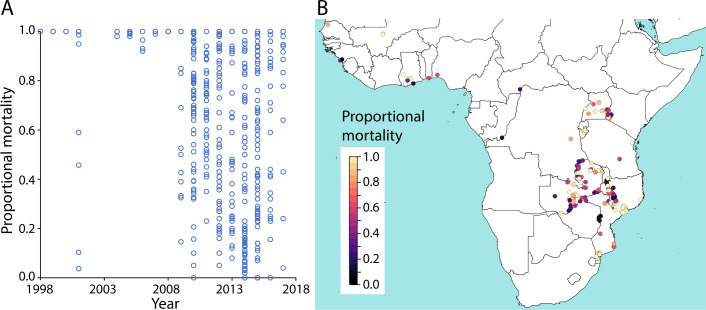
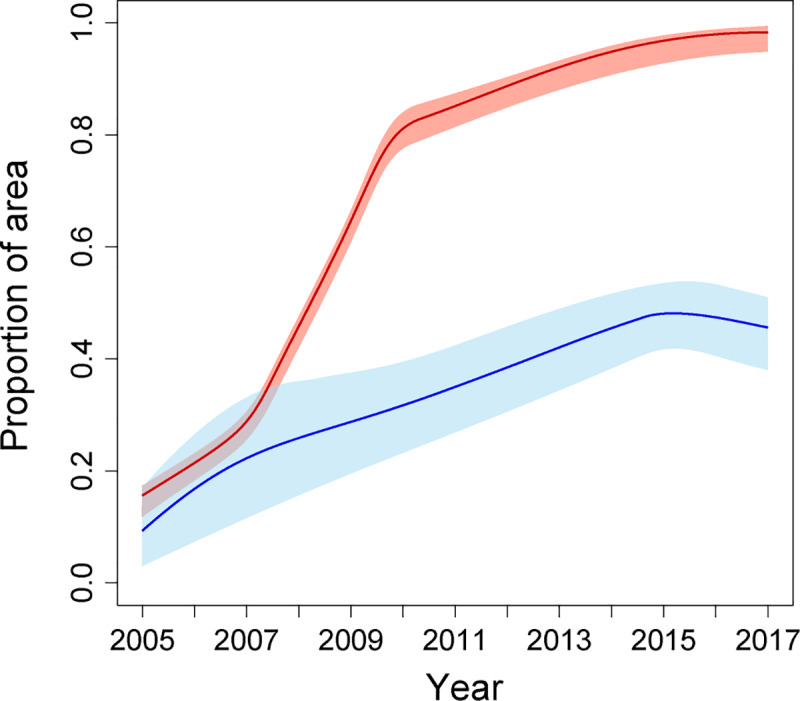
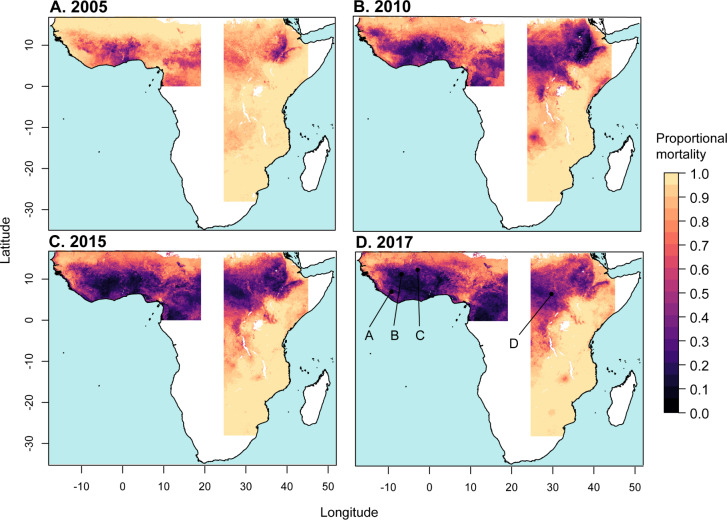
Mitigating the threat of insecticide resistance in African malaria vector populations requires comprehensive information about where resistance occurs, to what degree, and how this has changed over time. Estimating these trends is complicated by the sparse, heterogeneous distribution of observations of resistance phenotypes in field populations. We use 6,423 observations of the prevalence of resistance to the most important vector control insecticides to inform a Bayesian geostatistical ensemble modelling approach, generating fine-scale predictive maps of resistance phenotypes in mosquitoes from the Anopheles gambiae complex across Africa. Our models are informed by a suite of 111 predictor variables describing potential drivers of selection for resistance. Our maps show alarming increases in the prevalence of resistance to pyrethroids and DDT across sub-Saharan Africa from 2005 to 2017, with mean mortality following insecticide exposure declining from almost 100% to less than 30% in some areas, as well as substantial spatial variation in resistance trends.
减轻非洲疟疾传播媒介种群对杀虫剂产生抗药性的威胁,需要全面了解抗药性发生的地点、程度以及随时间的变化情况。由于实地种群中对抗药性表型的观察结果分布稀疏且不均匀,因此估计这些趋势变得复杂。我们利用 6423 个对最重要的病媒控制杀虫剂的抗药性流行率的观察结果,为贝叶斯地统计学集合建模方法提供信息,从而生成了来自非洲冈比亚按蚊复合体的蚊子抗药性表型的精细尺度预测图。我们的模型由 111 个描述抗药性选择潜在驱动因素的预测变量提供信息。我们的地图显示,从 2005 年到 2017 年,撒哈拉以南非洲对拟除虫菊酯和滴滴涕的抗药性流行率惊人增加,一些地区接触杀虫剂后的死亡率从几乎 100%下降到不到 30%,抗药性趋势也存在很大的空间差异。