Institut de Recherche de Yaoundé (IRY), Organisation de Coordination pour la lutte contre les Endémies en Afrique Centrale (OCEAC), Yaoundé, Cameroon.
Laboratory of General Biology, University of Yaounde I, Yaounde, Cameroon.
PLoS One. 2019 Feb 19;14(2):e0212024. doi: 10.1371/journal.pone.0212024. eCollection 2019.
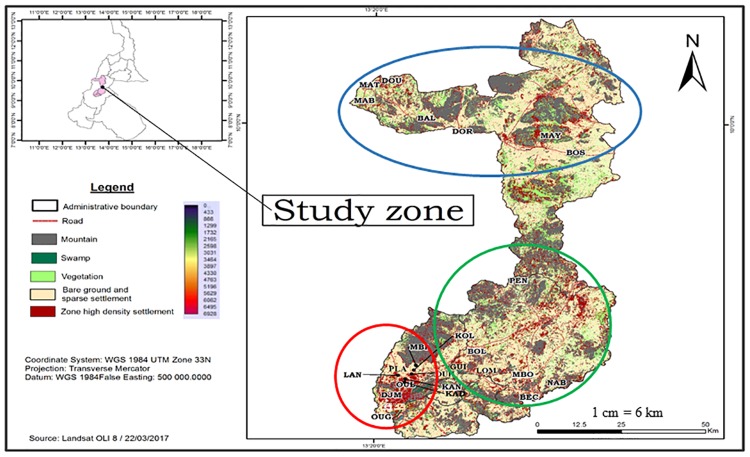
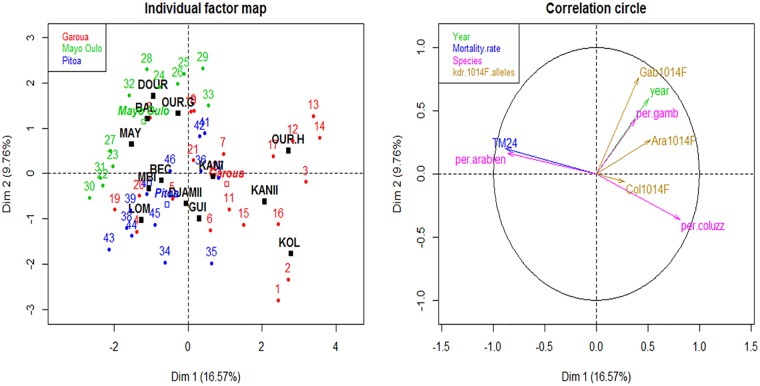
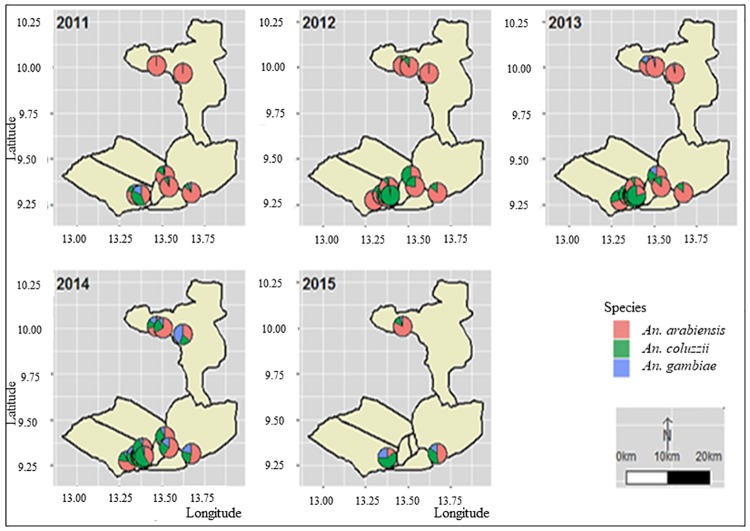
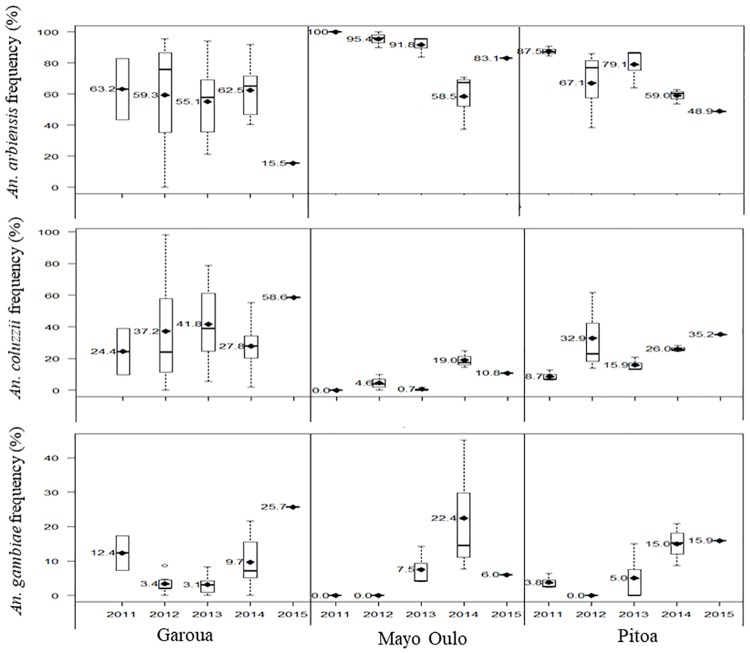
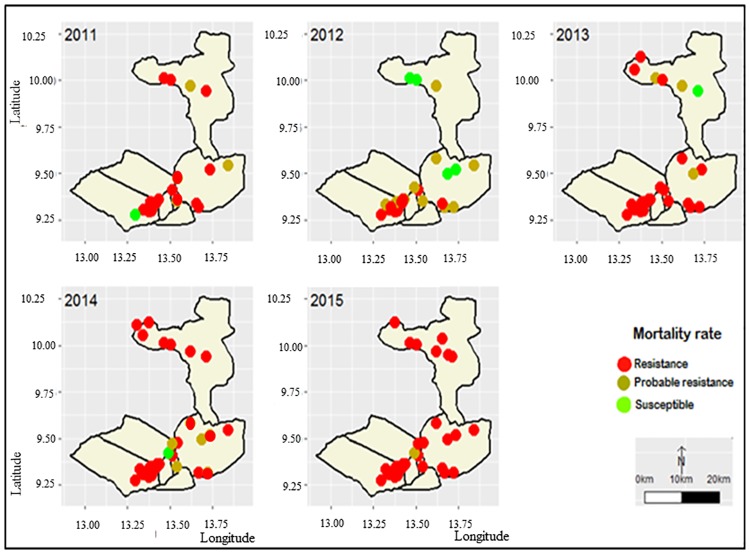
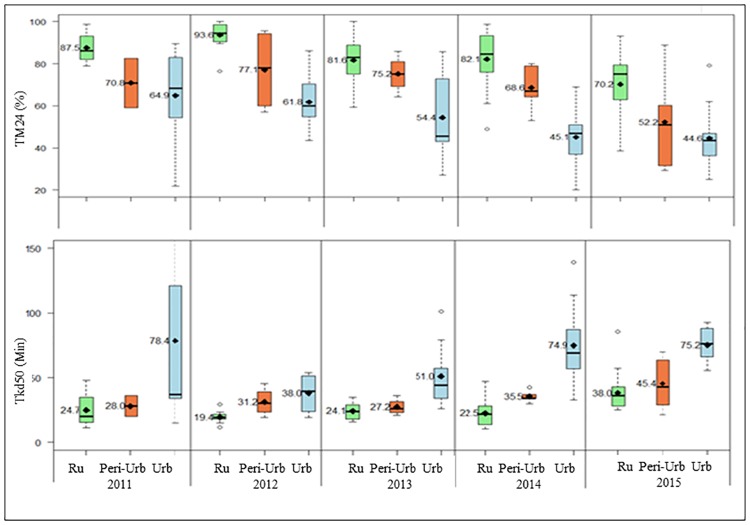
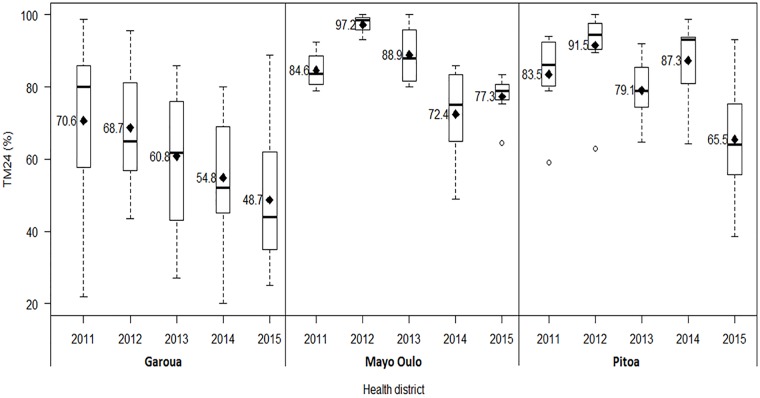
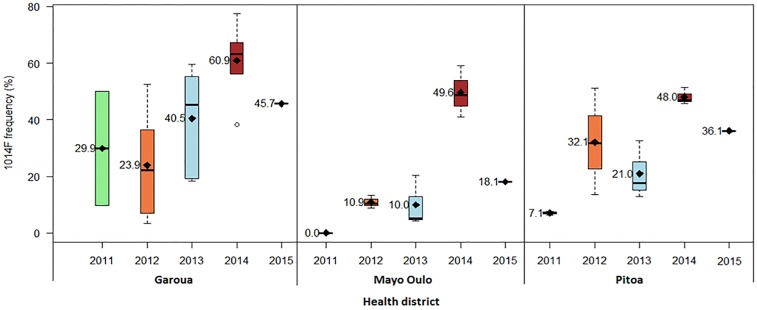
The effectiveness of insecticide-based malaria vector control interventions in Africa is threatened by the spread and intensification of pyrethroid resistance in targeted mosquito populations. The present study aimed at investigating the temporal and spatial dynamics of deltamethrin resistance in An. gambiae s.l. populations from North Cameroon. Mosquito larvae were collected from 24 settings of the Garoua, Pitoa and Mayo Oulo Health Districts (HDs) from 2011 to 2015. Two to five days old female An. gambiae s.l. emerging from larval collections were tested for deltamethrin resistance using the World Health Organization's (WHO) standard protocol. Sub samples of test mosquitoes were identified to species using PCR-RFLP and genotyped for knockdown resistance alleles (Kdr 1014F and 1014S) using Hot Ligation Oligonucleotide Assay (HOLA). All the tested mosquitoes were identified as belonging to the An. gambiae complex, including 3 sibling species mostly represented by Anopheles arabiensis (67.6%), followed by Anopheles coluzzii (25.4%) and Anopheles gambiae (7%). Deltamethrin resistance frequencies increased significantly between 2011 and 2015, with mosquito mortality rates declining from 70-85% to 49-73% in the three HDs (Jonckheere-Terstra test statistic (JT) = 5638, P< 0.001), although a temporary increase of mortality rates (91-97%) was seen in the Pitoa and Mayo Oulo HDs in 2012. Overall, confirmed resistance emerged in 10 An. gambiae s.l. populations over the 24 field populations monitored during the study period, from 2011 to 2015. Phenotypic resistance was mostly found in urban settings compared with semi-urban and rural settings (JT = 5282, P< 0.0001), with a spatial autocorrelation between neighboring localities. The Kdr 1014F allelic frequencies in study HDs increased from 0-30% in 2011 to 18-61% in 2014-2015 (JT = 620, P <0.001), especially in An. coluzzii samples. The overall frequency of the Kdr 1014S allele was 0.1%. This study revealed a rapid increase and widespread deltamethrin resistance frequency as well as Kdr 1014F allelic frequencies in An. gambiae s.l. populations over time, emphasizing the urgent need for vector surveillance and insecticide resistance management strategies in Cameroon.
在非洲,基于杀虫剂的疟疾媒介控制干预措施的有效性受到目标蚊虫种群中拟除虫菊酯抗性的传播和加剧的威胁。本研究旨在调查来自喀麦隆北部的冈比亚按蚊复合体种群中溴氰菊酯抗性的时间和空间动态。从 2011 年至 2015 年,从加鲁阿、皮托亚和马约奥卢卫生区(HD)的 24 个地点采集蚊虫幼虫。用世界卫生组织(WHO)的标准方案测试从幼虫收集物中出现的 2-5 天龄雌性冈比亚按蚊复合体对溴氰菊酯的抗性。使用聚合酶链反应-限制性片段长度多态性(PCR-RFLP)对测试蚊虫的亚样本进行鉴定,并使用热连接寡核苷酸分析(HOLA)对击倒抗性等位基因(Kdr 1014F 和 1014S)进行基因分型。所有测试的蚊子都被鉴定为属于冈比亚按蚊复合体,包括 3 种主要由阿拉伯按蚊(67.6%)组成的姐妹种,其次是库蚊(25.4%)和冈比亚按蚊(7%)。2011 年至 2015 年间,溴氰菊酯抗性频率显著增加,三个 HD 中的蚊虫死亡率从 70-85%降至 49-73%(Jonckheere-Terstra 检验统计量(JT)=5638,P<0.001),尽管 2012 年在皮托亚和马约奥卢 HD 中观察到死亡率的暂时增加(91-97%)。总体而言,在研究期间监测的 24 个实地种群中,有 10 个冈比亚按蚊复合体种群出现确认的抗性,从 2011 年至 2015 年。表型抗性主要在城市环境中发现,而在半城市和农村环境中发现较少(JT=5282,P<0.0001),相邻地点之间存在空间自相关。研究 HD 中的 Kdr 1014F 等位基因频率从 2011 年的 0-30%增加到 2014-2015 年的 18-61%(JT=620,P<0.001),尤其是在库蚊样本中。Kdr 1014S 等位基因的总频率为 0.1%。本研究揭示了冈比亚按蚊复合体种群中溴氰菊酯抗性频率以及 Kdr 1014F 等位基因频率的快速增加和广泛分布,强调了喀麦隆急需进行媒介监测和杀虫剂抗性管理策略。