Center for Vaccine Research, University of Pittsburgh, Pittsburgh, Pennsylvania, United States of America.
Department of Immunology, University of Pittsburgh School of Medicine, Pittsburgh, Pennsylvania, United States of America.
PLoS One. 2020 Jun 25;15(6):e0232381. doi: 10.1371/journal.pone.0232381. eCollection 2020.
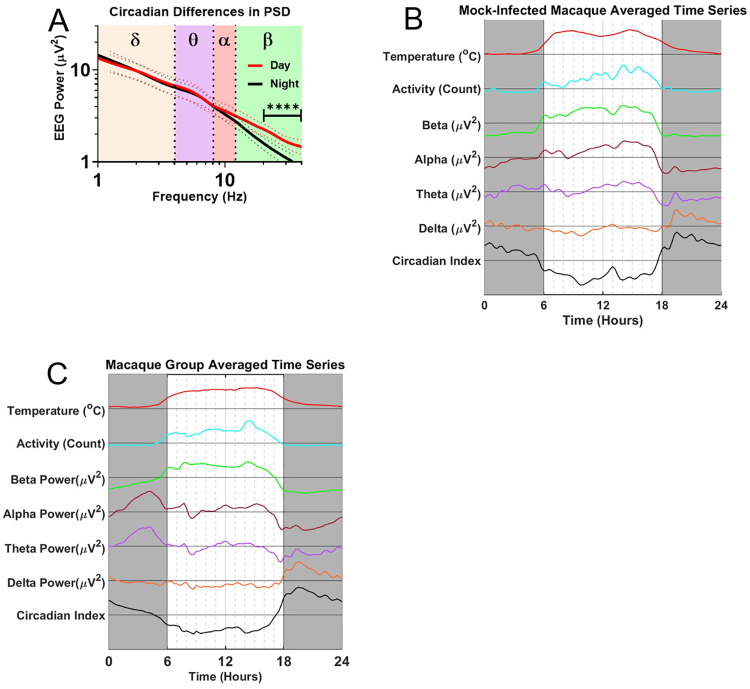
Alphaviruses such as Venezuelan equine encephalitis virus (VEEV) and Eastern equine encephalitis virus (EEEV) are arboviruses that can cause severe zoonotic disease in humans. Both VEEV and EEEV are highly infectious when aerosolized and can be used as biological weapons. Vaccines and therapeutics are urgently needed, but efficacy determination requires animal models. The cynomolgus macaque (Macaca fascicularis) provides a relevant model of human disease, but questions remain whether vaccines or therapeutics can mitigate CNS infection or disease in this model. The documentation of alphavirus encephalitis in animals relies on traditional physiological biomarkers and behavioral/neurological observations by veterinary staff; quantitative measurements such as electroencephalography (EEG) and intracranial pressure (ICP) can recapitulate underlying encephalitic processes. We detail a telemetry implantation method suitable for continuous monitoring of both EEG and ICP in awake macaques, as well as methods for collection and analysis of such data. We sought to evaluate whether changes in EEG/ICP suggestive of CNS penetration by virus would be seen after aerosol exposure of naïve macaques to VEEV IC INH9813 or EEEV V105 strains compared to mock-infection in a cohort of twelve adult cynomolgus macaques. Data collection ran continuously from at least four days preceding aerosol exposure and up to 50 days thereafter. EEG signals were processed into frequency spectrum bands (delta: [0.4 - 4Hz); theta: [4 - 8Hz); alpha: [8-12Hz); beta: [12-30] Hz) and assessed for viral encephalitis-associated changes against robust background circadian variation while ICP data was assessed for signal fidelity, circadian variability, and for meaningful differences during encephalitis. Results indicated differences in delta, alpha, and beta band magnitude in infected macaques, disrupted circadian rhythm, and proportional increases in ICP in response to alphavirus infection. This novel enhancement of the cynomolgus macaque model offers utility for timely determination of onset, severity, and resolution of encephalitic disease and for the evaluation of vaccine and therapeutic candidates.
甲病毒,如委内瑞拉马脑炎病毒(VEEV)和东部马脑炎病毒(EEEV),是可以在人类中引起严重人畜共患病的虫媒病毒。当气溶胶化时,VEEV 和 EEEV 都具有高度传染性,可被用作生物武器。目前迫切需要疫苗和疗法,但需要动物模型来确定疗效。食蟹猴(Macaca fascicularis)为人类疾病提供了一个相关的模型,但仍存在疑问,即疫苗或疗法是否可以减轻该模型中的中枢神经系统感染或疾病。动物中甲病毒脑炎的记录依赖于兽医人员的传统生理生物标志物和行为/神经学观察;脑电图(EEG)和颅内压(ICP)等定量测量可以重现潜在的脑炎过程。我们详细介绍了一种适用于清醒猕猴的 EEG 和 ICP 连续监测的遥测植入方法,以及此类数据的收集和分析方法。我们试图评估在 12 只成年食蟹猴中,与模拟感染相比,VEEV IC INH9813 或 EEEV V105 株的病毒气溶胶暴露后,EEG/ICP 是否会发生变化,这些变化提示病毒穿透中枢神经系统。数据采集从气溶胶暴露前至少四天开始,持续到之后的 50 天。EEG 信号被处理成频带(delta:[0.4-4Hz];theta:[4-8Hz];alpha:[8-12Hz];beta:[12-30]Hz),并根据强大的背景昼夜节律变化评估与病毒性脑炎相关的变化,同时评估 ICP 数据的信号保真度、昼夜节律变异性以及脑炎期间的有意义差异。结果表明,感染猕猴的 delta、alpha 和 beta 波段幅度存在差异,昼夜节律受到干扰,以及对甲病毒感染的 ICP 呈比例增加。这种食蟹猴模型的新增强为及时确定脑炎疾病的发作、严重程度和缓解以及评估疫苗和治疗候选物提供了效用。