Department of Psychology, Faculty of Psychology, University of Almería, Almería, Spain.
Department of Psychology, Faculty of Psychology, Universidad Politécnica y Artística del Paraguay, Asunción, Paraguay.
PLoS One. 2020 Jun 25;15(6):e0235305. doi: 10.1371/journal.pone.0235305. eCollection 2020.
The objective of this study was therefore to analyze the effect of exceptionally stressful situations, such as the current health risk, on the cognitive and emotive state of the individual, that is, perceived threat and emotional state on affect and mood.
This was a cross-sectional study with snowball sampling. The sample came to 1014 Spanish adults (67.2% women and 32.8% men). The Perception of Threat from COVID-19 questionnaire, the Affective Balance Scale and the Mood Evaluation Scale were used.
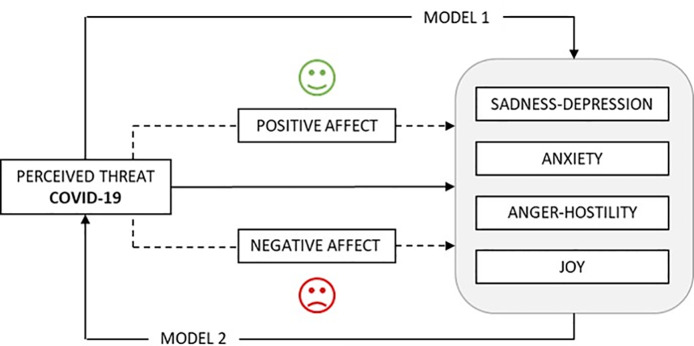
The results showed that the perception of threat from COVID-19 was related positively to negative affect and emotional signs, that is, sadness-depression, anxiety and anger-hostility. There was a direct positive effect of perceived threat from COVID-19 on sadness-depression, anxiety and anger-hostility moods, while anxiety and anger-hostility had a direct positive effect on perception of threat from the virus. Thus, there was a circular relationship, in which perceived threat influenced the presence of negative mood, and negative mood, in turn, linked to emotions of irritation and agitation from a present situation, promoted the feeling of threat.
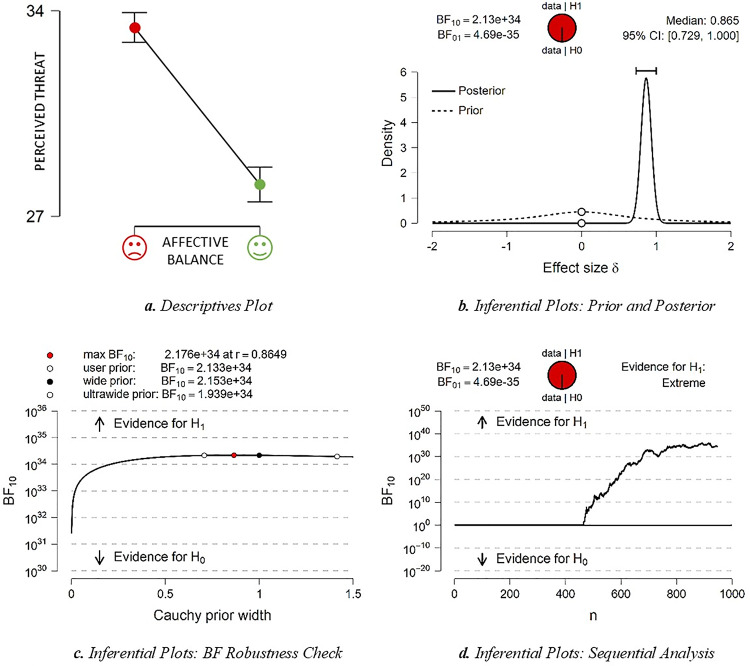
A negative affective balance increases both one's perception of threat from COVID-19 and negative mood. Thus, knowing the emotional and cognitive effects on the population would enable measures to be put into service to facilitate their effective coping.
本研究旨在分析异常紧张的情况(如当前的健康风险)对个体认知和情绪状态的影响,即感知威胁和情绪状态对情感和心境的影响。
这是一项横断面研究,采用雪球抽样。样本包括 1014 名西班牙成年人(67.2%为女性,32.8%为男性)。采用 COVID-19 感知威胁问卷、情感平衡量表和心境评价量表进行评估。
结果表明,COVID-19 的感知威胁与负性情感和情绪表现呈正相关,即悲伤-抑郁、焦虑和愤怒-敌意。COVID-19 的感知威胁对悲伤-抑郁、焦虑和愤怒-敌意情绪有直接的正向影响,而焦虑和愤怒-敌意对病毒的感知威胁有直接的正向影响。因此,存在一个循环关系,即感知威胁影响负面情绪的出现,而负面情绪反过来又与当前情况下的烦躁和激动情绪相关联,从而增强了威胁感。
消极的情感平衡会增加个体对 COVID-19 的感知威胁和负面情绪。因此,了解对人群的情绪和认知影响将有助于采取措施促进他们的有效应对。