Food and Nutrition Program, Department of Public and Allied Health, Bowling Green State University, Bowling Green, OH 43403, USA.
Center for Food and Culture, 550 West Wooster St, Bowling Green, OH 43402, USA.
Nutrients. 2020 Sep 4;12(9):2712. doi: 10.3390/nu12092712.
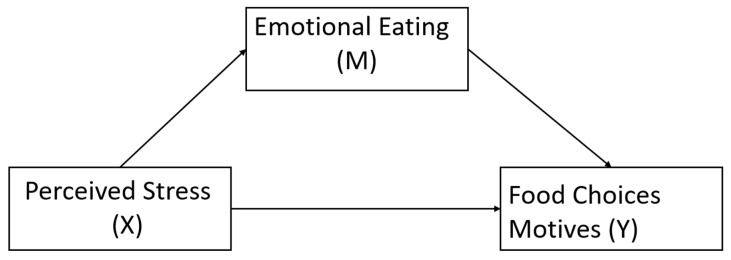
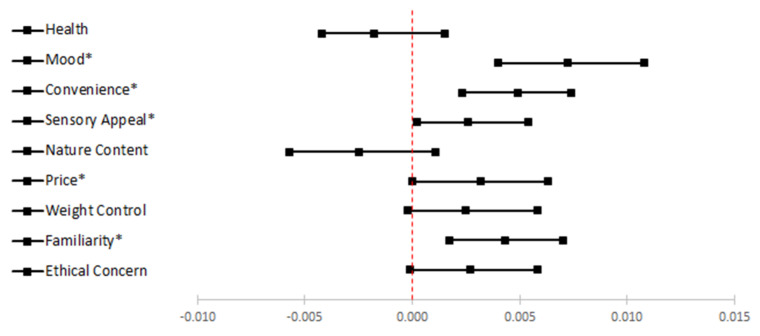
Perceived stress affects emotional eating and food choices. However, the extent to which stress associates with food choice motives is not completely understood. This study assessed whether emotional eating mediates the associations between perceived stress levels and food choice motives (i.e., health, mood, convenience, natural content, price, sensory appeal, familiarities, weight control, and ethical concerns) during the Coronavirus Disease 2019 pandemic. A total of 800 respondents were surveyed in the United States in June 2020. Their perceived stress, emotional eating, and food choice motives were assessed by the Perceived Stress Scale, Dutch Eating Behavior Questionnaire, and Food Choice Questionnaire, respectively. Moderate to high levels of perceived stress were experienced by the majority (73.6%) of respondents. Perceived stress was significantly correlated with emotional eating ( = 0.26) as well as five out of nine food choice motives: mood ( = 0.32), convenience ( = 0.28), natural content ( = -0.14), price ( = 0.27), and familiarity ( = 0.15). Emotional eating was significantly correlated with four out of nine food choice motives: mood ( = 0.27), convenience ( = 0.23), price ( = 0.16), and familiarity ( = 0.16). The mediation analyses showed that emotional eating mediates the associations between perceived stress and five food choices motives: mood, convenience, sensory appeal, price, and familiarity. Findings were interpreted using theories and concepts from the humanities, specifically, folklore studies, ritual studies, and symbolic anthropology.
压力知觉会影响情绪化进食和食物选择。然而,压力与食物选择动机之间的关联程度尚不完全清楚。本研究评估了在 2019 冠状病毒病大流行期间,情绪性进食是否在压力知觉水平与食物选择动机(即健康、情绪、方便、自然成分、价格、感官吸引力、熟悉度、体重控制和道德关注)之间起中介作用。2020 年 6 月,在美国共调查了 800 名受访者。他们的压力知觉、情绪性进食和食物选择动机分别通过压力知觉量表、荷兰饮食行为问卷和食物选择问卷进行评估。大多数(73.6%)受访者经历了中度至高度的压力知觉。压力知觉与情绪性进食显著相关(r = 0.26),与九个食物选择动机中的五个也显著相关:情绪(r = 0.32)、方便(r = 0.28)、自然成分(r = -0.14)、价格(r = 0.27)和熟悉度(r = 0.15)。情绪性进食与九个食物选择动机中的四个也显著相关:情绪(r = 0.27)、方便(r = 0.23)、价格(r = 0.16)和熟悉度(r = 0.16)。中介分析表明,情绪性进食在压力知觉和五种食物选择动机之间起中介作用:情绪、方便、感官吸引力、价格和熟悉度。研究结果根据人文科学,特别是民俗学研究、仪式研究和象征人类学的理论和概念进行了解释。