Papangelo Pamela, Pinzino Martina, Pelagatti Susanna, Fabbri-Destro Maddalena, Narzisi Antonio
Institute of Neuroscience, National Research Council (CNR), Via Volturno 39/E, 43125 Parma, Italy.
Department of Informatics, University of Pisa, 56126 Pisa, Italy.
Brain Sci. 2020 Jun 23;10(6):398. doi: 10.3390/brainsci10060398.
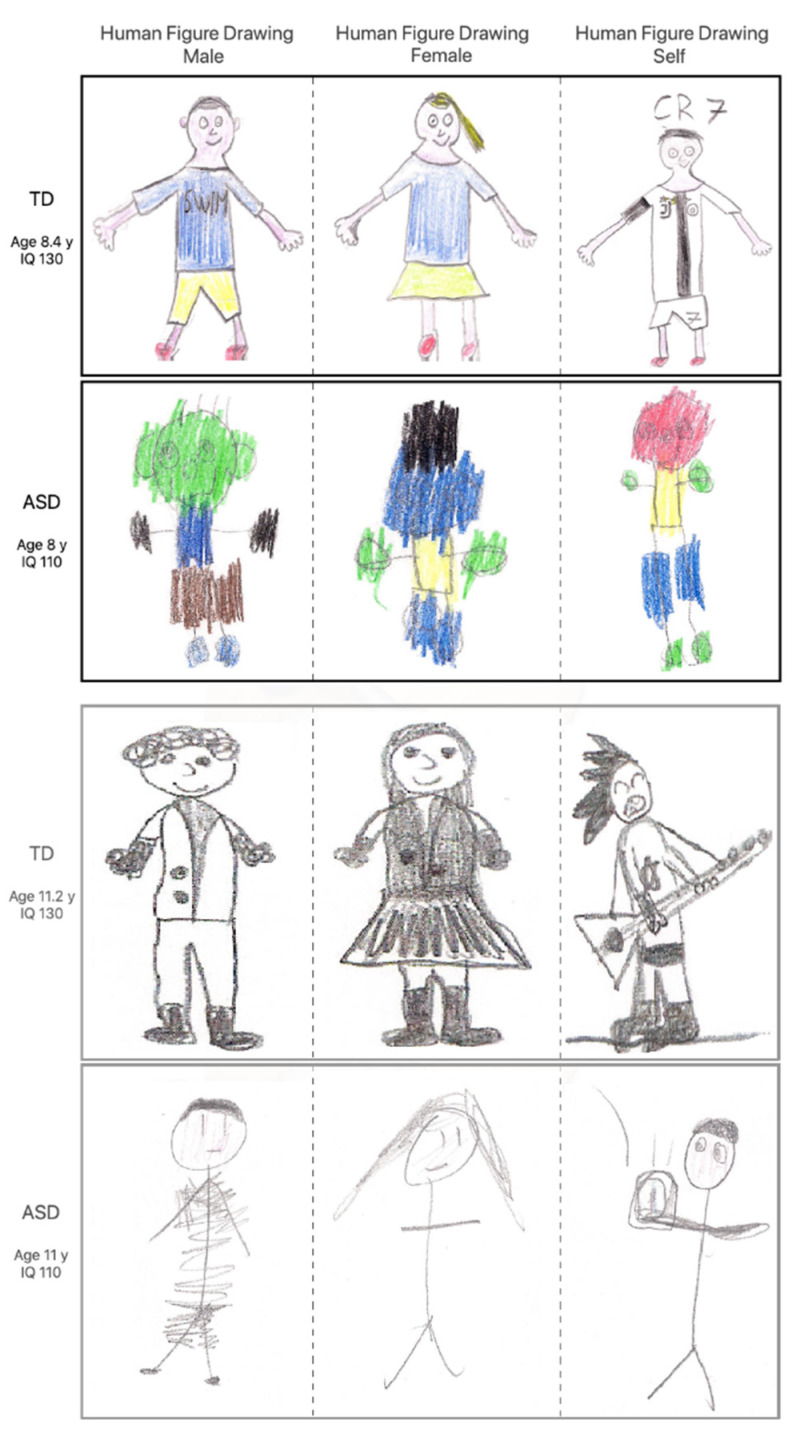
Tests based on human figure drawings (HFD) have captured the attention of clinicians and psychologists for a long time. The aim of the present study was to evaluate the performance of HFD of children with autism spectrum disorders (ASDs) relative to typically developing (TD) controls.
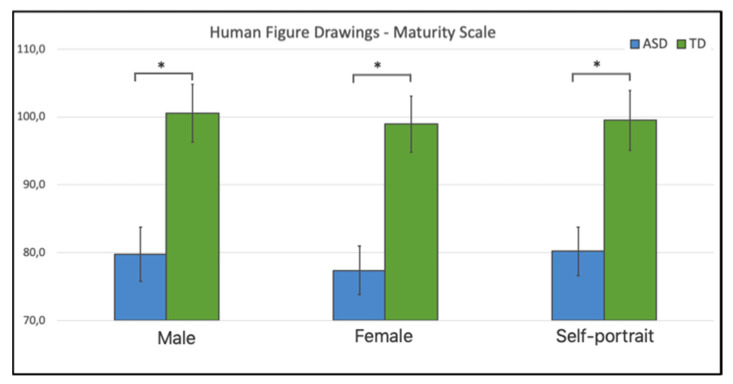
All children were asked to draw three human figures (man, woman, self-portrait) and were evaluated with a neuropsychological battery. HFD were scored according to the Maturity Scale, and correlative approaches testing maturity against neuropsychological scores were applied.
ASDs presented marked deficits in maturity. No significant correlation emerged for both groups between maturity and the theory of mind test. On the contrary, positive and significant correlations between maturity and the affect recognition test (AR) were found, with group-specific patterns. In TD, this result regarded drawings of others, but not self-portraits, while an opposite pattern emerged for ASD, whose sole maturity in self-portraits significantly correlated with the AR scores.
These findings suggest that the use of HFD tests with individuals with autism may not be used in clinical practices. However, in basic research, HFDs could be used to highlight dependencies between drawing performance and neuropsychological features, thus possibly providing hints on the functioning of autism.
基于人体图画(HFD)的测试长期以来一直吸引着临床医生和心理学家的关注。本研究的目的是评估自闭症谱系障碍(ASD)儿童相对于正常发育(TD)对照组的人体图画表现。
所有儿童被要求画三幅人体图画(男性、女性、自画像),并接受一套神经心理学测试。根据成熟度量表对人体图画进行评分,并应用将成熟度与神经心理学分数进行对比的相关方法。
自闭症谱系障碍儿童在成熟度方面存在明显缺陷。两组的成熟度与心理理论测试之间均未出现显著相关性。相反,发现成熟度与情感识别测试(AR)之间存在正向且显著的相关性,且具有特定组的模式。在正常发育儿童中,这一结果适用于他人的图画,而非自画像,而自闭症谱系障碍儿童则呈现相反的模式,其自画像的唯一成熟度与情感识别测试分数显著相关。
这些发现表明,自闭症患者使用人体图画测试可能不适用于临床实践。然而,在基础研究中,人体图画可用于突出绘画表现与神经心理学特征之间的相关性,从而可能为自闭症的功能提供线索。