Harjai Kishore J, Agarwal Shikhar, Bauch Terry, Bernardi Mark, Casale Alfred S, Green Sandy, Harostock Michael, Ierovante Nicholas, Mascarenhas Vernon, Matsumura Martin, Nawaz Yassir, Scott Thomas, Singh Deepak, Stella Joseph J, Vijayaraman Pugazhendi, Yost Gregory, Blankenship James C
Geisinger Wyoming Valley Hospital, Wilkes-Barre, PA, United States of America.
Geisinger Medical Center, Danville, PA, United States of America.
Cardiovasc Revasc Med. 2020 Aug;21(8):939-945. doi: 10.1016/j.carrev.2020.06.013. Epub 2020 Jun 10.
Because of the COVID-19 pandemic, cath labs have had to modify their workflow for elective and urgent patients.
We surveyed 16 physicians across 3 hospitals in our healthcare system to address COVID-19 related concerns in the management of interventional and structural heart disease patients, and to formulate system wide criteria for deferring cases till after the pandemic.
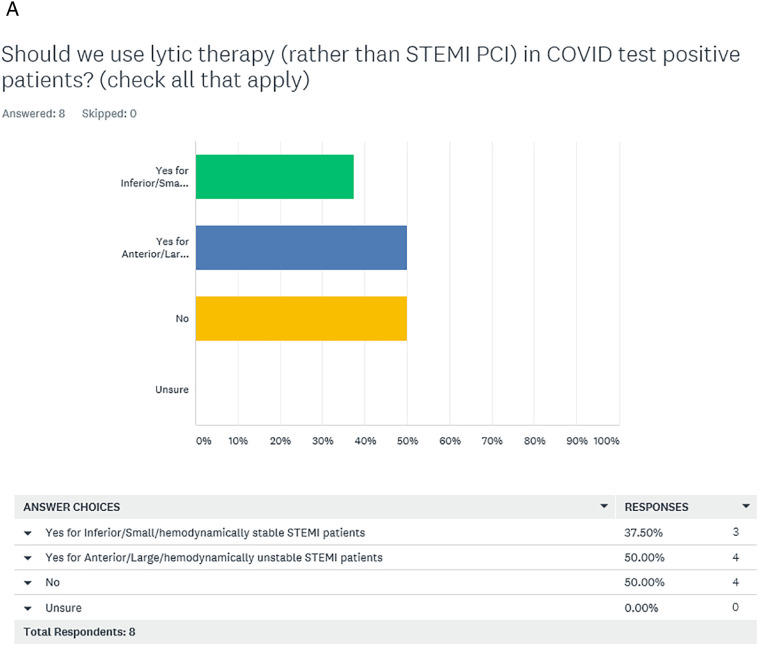
Our survey yielded common concerns centered on the need to protect patients, cath lab staff and physicians from unnecessary exposure to COVID-19; for COVID-19 testing prior to arrival to the cath lab; for clear communication between the referring physician and the interventionalist; but there was initial uncertainty among physicians regarding the optimal management of ST elevation myocardial infarction (STEMI; percutaneous coronary intervention versus thrombolytics). Patients with stable angina and hemodynamically stable acute coronary syndromes were deemed suitable for initial medical management, except when they had large ischemic burden. Most transcatheter aortic valve implantations (TAVI) were felt appropriate for postponement except in symptomatic patients with aortic valve area <0.5 cm or recent hospitalization for heart failure (HF). Most percutaneous mitral valve repair (pMVR) procedures were felt appropriate for postponement except in patients with HF. All left atrial appendage closure (LAAC) and patent foramen ovale (PFO)/atrial septal defect (ASD) closure procedures were felt appropriate for postponement.
Our survey of an experienced team of clinicians yielded concise guidelines to direct the management of CAD and structural heart disease patients during the initial phases of the COVID-19 pandemic.
由于新冠疫情,导管室不得不调整针对择期和急症患者的工作流程。
我们对医疗系统内3家医院的16名医生进行了调查,以解决介入性和结构性心脏病患者管理中与新冠相关的问题,并制定全系统范围内将病例推迟到大流行结束后的标准。
我们的调查得出了一些共同关注的问题,主要集中在需要保护患者、导管室工作人员和医生免受不必要的新冠病毒暴露;患者到达导管室之前进行新冠病毒检测;转诊医生和介入医生之间进行清晰的沟通;但医生们最初对于ST段抬高型心肌梗死(STEMI;经皮冠状动脉介入治疗与溶栓治疗)的最佳管理存在不确定性。稳定型心绞痛和血流动力学稳定的急性冠状动脉综合征患者被认为适合进行初始药物治疗,除非他们有大面积缺血负担。除了主动脉瓣面积<0.5平方厘米的有症状患者或近期因心力衰竭(HF)住院的患者外,大多数经导管主动脉瓣植入术(TAVI)被认为适合推迟。除了心力衰竭患者外,大多数经皮二尖瓣修复(pMVR)手术被认为适合推迟。所有左心耳封堵(LAAC)和卵圆孔未闭(PFO)/房间隔缺损(ASD)封堵手术都被认为适合推迟。
我们对一组经验丰富的临床医生进行的调查得出了简明指南,以指导新冠疫情初期冠心病和结构性心脏病患者的管理。