Department of Behavioural Science and Health, University College London, London, UK
Department of Epidemiology and Public Health, University College London, London, UK.
J Epidemiol Community Health. 2020 Oct;74(10):824-830. doi: 10.1136/jech-2019-213175. Epub 2020 Jun 25.
Attrition, the loss of participants as a study progresses, is a considerable challenge in longitudinal studies. This study examined whether two forms of attrition, 'withdrawal' (formal discontinued participation) and 'non-response' (non-response among participants continuing in the study), have different associations with mortality and whether these associations differed across time in a multi-wave longitudinal study.
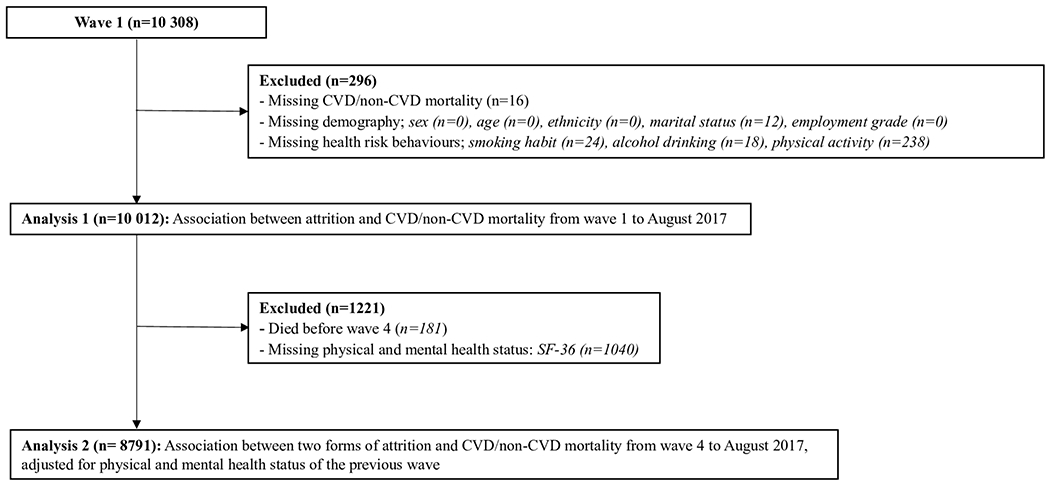
Participants were 10 012 civil servants who participated at the baseline of the Whitehall II cohort study with 11 data waves over an average follow-up of 28 years. We performed competing-risks analyses to estimate sub-distribution HRs and 95% CIs, and likelihood ratio tests to examine whether hazards differed between the two forms of attrition. We then applied linear regression to examine any trend of hazards against time.
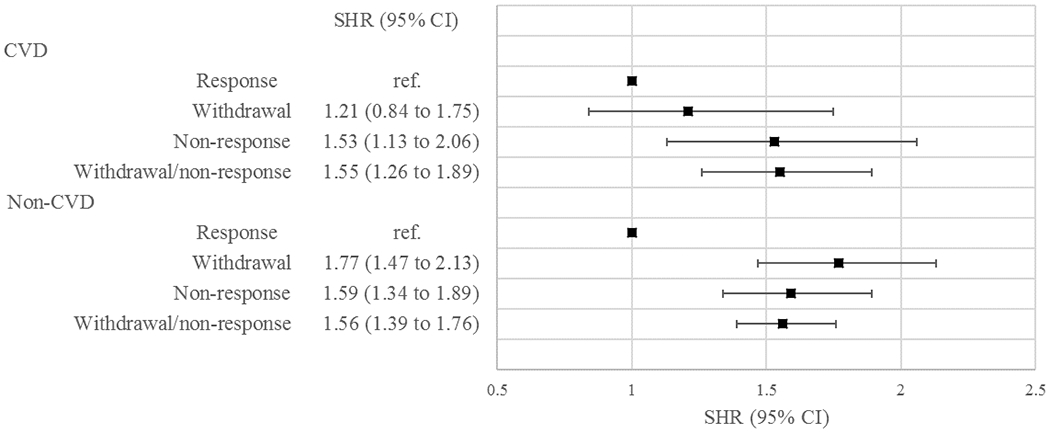
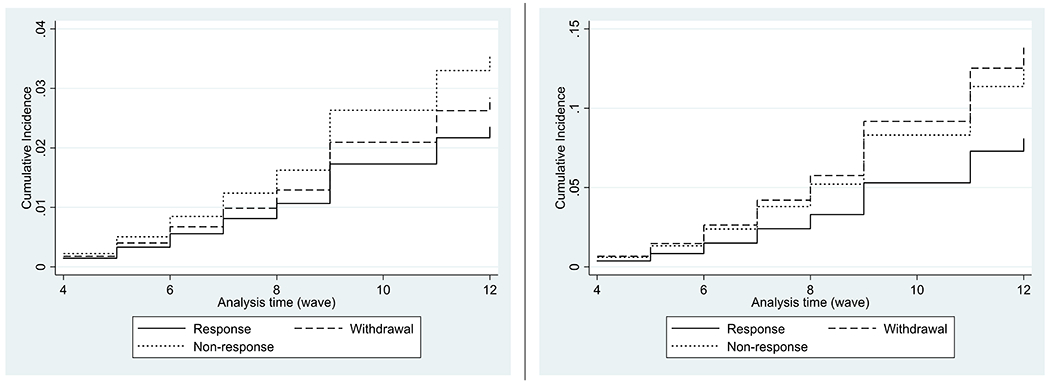
Attrition rate at data collections ranged between 13% and 34%. There were 495 deaths recorded from cardiovascular disease and 1367 deaths from other causes. Study participants lost due to attrition had 1.55 (95% CI 1.26 to 1.89) and 1.56 (1.39 to 1.76) times higher hazard of cardiovascular and non-cardiovascular mortality than responders, respectively. Hazards for withdrawal and non-response did not differ for either cardiovascular (p value =0.28) or non-cardiovascular mortality (p value =0.38). There was no linear trend in hazards over the 11 waves (cardiovascular mortality p value =0.11, non-cardiovascular mortality p value =0.61).
Attrition can be a problem in longitudinal studies resulting in selection bias. Researchers should examine the possibility of selection bias and consider applying statistical approaches that minimise this bias.
在纵向研究中,参与者随研究进展而流失(即退出)是一个相当大的挑战。本研究旨在探讨两种流失形式(“退出”(正式停止参与)和“无应答”(继续参与研究的参与者中无应答))与死亡率的关联是否不同,以及这些关联在多波纵向研究中随时间的变化是否不同。
参与者为 10012 名公务员,他们在 Whitehall II 队列研究的基线时参与研究,在平均 28 年的随访中进行了 11 次数据采集。我们进行竞争风险分析来估计亚分布 HR 和 95%CI,并进行似然比检验以检查两种流失形式的风险是否不同。然后,我们应用线性回归来检查任何时间与风险的趋势。
数据采集时的流失率在 13%至 34%之间。记录到心血管疾病导致的 495 例死亡和其他原因导致的 1367 例死亡。由于流失而失去的研究参与者,心血管和非心血管死亡率的风险分别是应答者的 1.55(95%CI 1.26 至 1.89)和 1.56(1.39 至 1.76)倍。对于心血管(p 值=0.28)或非心血管死亡率(p 值=0.38),退出和无应答的风险没有差异。在 11 波次中,风险没有线性趋势(心血管死亡率 p 值=0.11,非心血管死亡率 p 值=0.61)。
纵向研究中可能会出现因流失而导致的选择偏差。研究人员应检查选择偏差的可能性,并考虑应用可最小化这种偏差的统计方法。