Division of Psychiatry, University College London, London, United Kingdom.
Camden and Islington NHS Foundation Trust, London, United Kingdom.
PLoS Med. 2019 Aug 2;16(8):e1002862. doi: 10.1371/journal.pmed.1002862. eCollection 2019 Aug.
There is need to identify targets for preventing or delaying dementia. Social contact is a potential target for clinical and public health studies, but previous observational studies had short follow-up, making findings susceptible to reverse causation bias. We therefore examined the association of social contact with subsequent incident dementia and cognition with 28 years' follow-up.
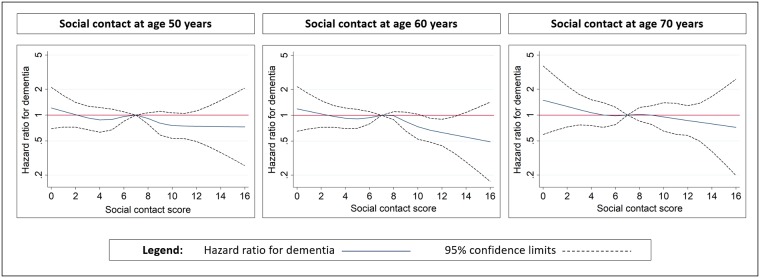
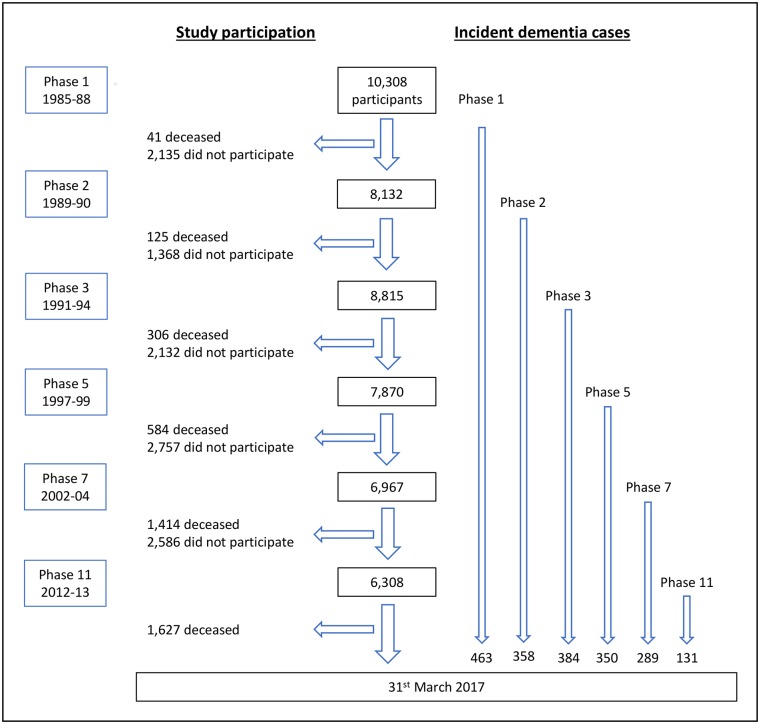
We conducted a retrospective analysis of the Whitehall II longitudinal prospective cohort study of employees of London civil service departments, aged 35-55 at baseline assessment in 1985-1988 and followed to 2017. Social contact was measured six times through a self-report questionnaire about frequency of contact with non-cohabiting relatives and friends. Dementia status was ascertained from three linked clinical and mortality databases, and cognition was assessed five times using tests of verbal memory, verbal fluency, and reasoning. Cox regression models with inverse probability weighting to account for attrition and missingness examined the association between social contact at age 50, 60, and 70 years and subsequent incident dementia. Mixed linear models examined the association of midlife social contact between 45 and 55 years and cognitive trajectory during the subsequent 14 years. Analyses were adjusted for age, sex, ethnicity, socioeconomic status, education, health behaviours, employment status, and marital status. Of 10,308 Whitehall II study participants, 10,228 provided social contact data (mean age 44.9 years [standard deviation (SD) 6.1 years] at baseline; 33.1% female; 89.1% white ethnicity). More frequent social contact at age 60 years was associated with lower dementia risk (hazard ratio [HR] for each SD higher social contact frequency = 0.88 [95% CI 0.79, 0.98], p = 0.02); effect size of the association of social contact at 50 or 70 years with dementia was similar (0.92 [95% CI 0.83, 1.02], p = 0.13 and 0.91 [95% CI 0.78, 1.06], p = 0.23, respectively) but not statistically significant. The association between social contact and incident dementia was driven by contact with friends (HR = 0.90 [95% CI 0.81, 1.00], p = 0.05), but no association was found for contact with relatives. More frequent social contact during midlife was associated with better subsequent cognitive trajectory: global cognitive function was 0.07 (95% CI 0.03, 0.11), p = 0.002 SDs higher for those with the highest versus lowest tertile of social contact frequency, and this difference was maintained over 14 years follow-up. Results were consistent in a series of post hoc analyses, designed to assess potential biases. A limitation of our study is ascertainment of dementia status from electronic health records rather than in-person assessment of diagnostic status, with the possibility that milder dementia cases were more likely to be missed.
Findings from this study suggest a protective effect of social contact against dementia and that more frequent contact confers higher cognitive reserve, although it is possible that the ability to maintain more social contact may be a marker of cognitive reserve. Future intervention studies should seek to examine whether improving social contact frequency is feasible, acceptable, and efficacious in changing cognitive outcomes.
需要确定预防或延缓痴呆的目标。社会接触是临床和公共卫生研究的潜在目标,但以前的观察性研究随访时间短,容易受到反向因果关系偏差的影响。因此,我们研究了社会接触与随后的痴呆和认知事件之间的关系,随访时间为 28 年。
我们对伦敦公务员部门员工进行了白厅 II 纵向前瞻性队列研究的回顾性分析,参与者在基线评估(1985-1988 年)时年龄为 35-55 岁,随访至 2017 年。社会接触通过自我报告问卷来衡量,问卷询问与非同居的亲戚和朋友的接触频率。痴呆状态通过三个相关的临床和死亡率数据库来确定,认知通过五次语言记忆、语言流畅性和推理测试来评估。为了考虑到失访和缺失,使用逆概率加权的 Cox 回归模型来检验 50 岁、60 岁和 70 岁时的社会接触与随后发生的痴呆之间的关联。混合线性模型用于检验中年(45-55 岁)的社会接触与随后 14 年认知轨迹之间的关联。分析调整了年龄、性别、种族、社会经济地位、教育、健康行为、就业状况和婚姻状况。在 10308 名白厅 II 研究参与者中,有 10228 人提供了社会接触数据(基线时的平均年龄为 44.9 岁[标准差 6.1 岁];33.1%为女性;89.1%为白人种族)。60 岁时更频繁的社会接触与痴呆风险较低相关(每增加一个标准差的社会接触频率的 HR 为 0.88[95%CI 0.79,0.98],p = 0.02);50 岁或 70 岁时社会接触与痴呆的关联效应大小相似(0.92[95%CI 0.83,1.02],p = 0.13 和 0.91[95%CI 0.78,1.06],p = 0.23),但没有统计学意义。社会接触与痴呆之间的关联主要由与朋友的接触驱动(HR = 0.90[95%CI 0.81,1.00],p = 0.05),但与亲戚的接触没有关联。中年时更频繁的社会接触与随后的认知轨迹更好相关:整体认知功能高 0.07(95%CI 0.03,0.11),p = 0.002,与社会接触频率最高与最低三分位相比,差异持续了 14 年的随访。在一系列事后分析中,结果一致,这些分析旨在评估潜在的偏差。我们研究的一个局限性是从电子健康记录中确定痴呆状态,而不是亲自评估诊断状态,因此可能更容易错过更轻微的痴呆病例。
这项研究的结果表明,社会接触对痴呆有保护作用,而且更频繁的接触会带来更高的认知储备,尽管保持更多社会接触的能力可能是认知储备的一个标志。未来的干预研究应探讨提高社会接触频率是否可行、可接受和有效,是否能改变认知结果。