Zhou Yimo, Pan Yuesong, Yan Hongyi, Wang Yilong, Li Zixiao, Zhao Xingquan, Li Hao, Meng Xia, Wang Chunxue, Liu Liping, Wang Yongjun
Department of Neurology, Beijing Tiantan Hospital, Capital Medical University, Beijing, China.
China National Clinical Research Center for Neurological Diseases, Beijing, China.
Front Neurol. 2020 Jun 10;11:456. doi: 10.3389/fneur.2020.00456. eCollection 2020.
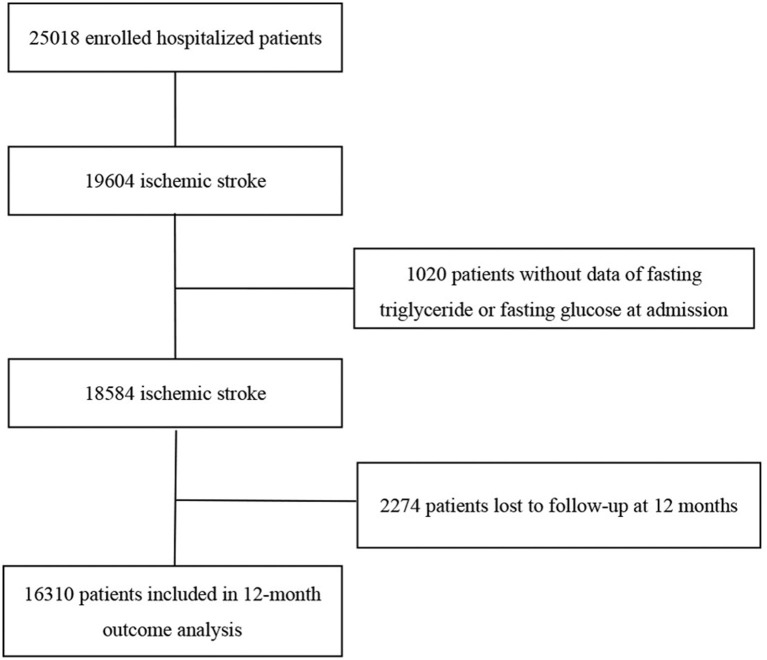
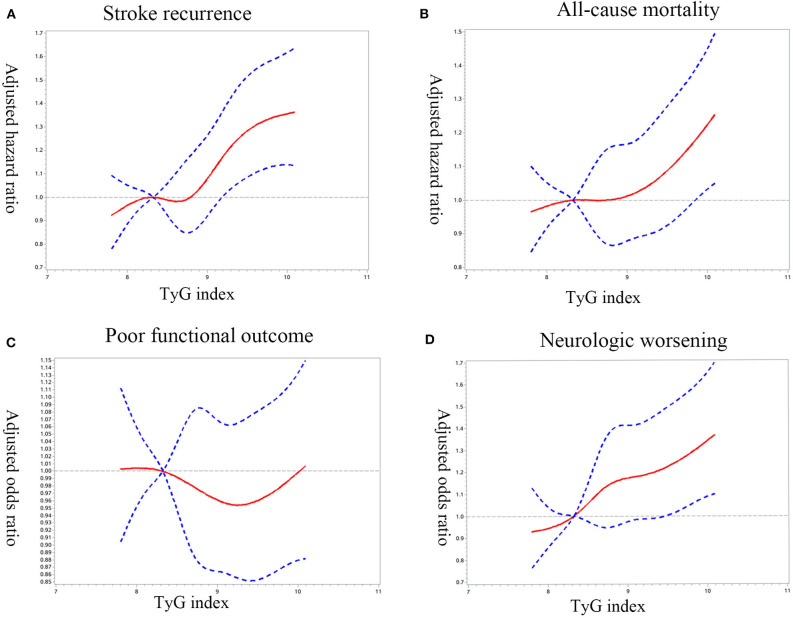
The triglyceride glucose index (TyG index) has been proposed as a simple and credible surrogate marker of insulin resistance. However, it is unclear whether TyG index correlates with adverse clinical outcomes in patients with ischemic stroke. Accordingly, this study aimed to explore the relationship between baseline TyG index and clinical outcomes of ischemic stroke individuals. We included eligible subjects with ischemic stroke from the China National Stroke Registry II for the current analysis. TyG index was calculated and divided into quartiles to explore the relationship with the outcomes of ischemic stroke. Outcomes included stroke recurrence, all-cause mortality, poor functional outcome at 12 months, and neurologic worsening at discharge. Multivariable Cox regression and logistic regression models were performed to explore the correlation of baseline TyG index with the outcomes. Among the 16,310 patients enrolled in the study, the average age was 64.83 ± 11.9 years, and 63.48% were men. The median TyG index was 8.73 (interquartile range, 8.33-9.21). After adjustment for multiple potential covariates, the fourth quartile of TyG index was associated with an increased risk of stroke recurrence (adjusted HR, 1.32; 95% CI, 1.11-1.57; = 0.002), all-cause mortality (adjusted HR, 1.25; 95%CI, 1.06-1.47; = 0.01) at 12-month follow-up, and neurological worsening (adjusted OR, 1.26; 95% CI, 1.02-1.55; = 0.03) at discharge, but not poor functional outcome compared with the first quartile. TyG index representing insulin resistance was associated with an increased risk of stroke recurrence, all-cause mortality, and neurologic worsening in patients with ischemic stroke.
甘油三酯葡萄糖指数(TyG指数)已被提议作为胰岛素抵抗的一种简单且可靠的替代标志物。然而,尚不清楚TyG指数与缺血性脑卒中患者的不良临床结局是否相关。因此,本研究旨在探讨基线TyG指数与缺血性脑卒中患者临床结局之间的关系。我们纳入了来自中国国家脑卒中登记二期的符合条件的缺血性脑卒中受试者进行当前分析。计算TyG指数并将其分为四分位数,以探讨与缺血性脑卒中结局的关系。结局包括脑卒中复发、全因死亡率、12个月时功能预后不良以及出院时神经功能恶化。采用多变量Cox回归和逻辑回归模型来探讨基线TyG指数与结局的相关性。在该研究纳入的16310例患者中,平均年龄为64.83±11.9岁,男性占63.48%。TyG指数的中位数为8.73(四分位间距,8.33 - 9.21)。在对多个潜在协变量进行调整后,TyG指数的第四四分位数与脑卒中复发风险增加相关(调整后HR,1.32;95%CI,1.11 - 1.57;P = 0.002),12个月随访时的全因死亡率(调整后HR,1.25;95%CI,1.06 - 1.47;P = 0.01),以及出院时的神经功能恶化(调整后OR,1.26;95%CI,1.02 - 1.55;P = 0.03),但与第一四分位数相比,与功能预后不良无关。代表胰岛素抵抗的TyG指数与缺血性脑卒中患者的脑卒中复发、全因死亡率和神经功能恶化风险增加相关。