Zhao Wenhao, Wu Shuhua, Barton Elizabeth, Fan Yongjian, Ji Yinghua, Wang Xiaofeng, Zhou Yijun
Institute of Plant Protection, Jiangsu Academy of Agricultural Sciences, Key Lab of Food Quality and Safety of Jiangsu Province-State Key Laboratory Breeding Base, Nanjing, China.
School of Plant and Environmental Sciences, Virginia Tech, Blacksburg, VA, United States.
Front Microbiol. 2020 Jun 10;11:1243. doi: 10.3389/fmicb.2020.01243. eCollection 2020.
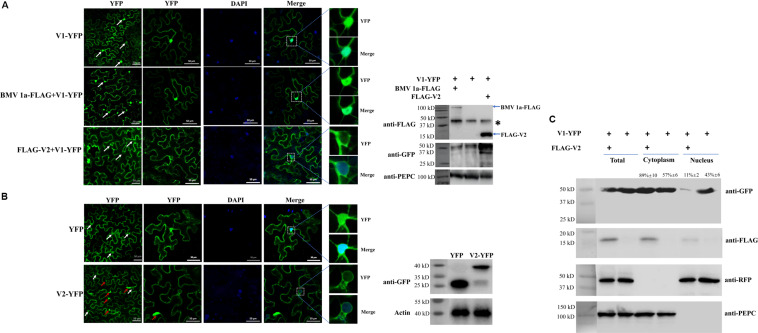
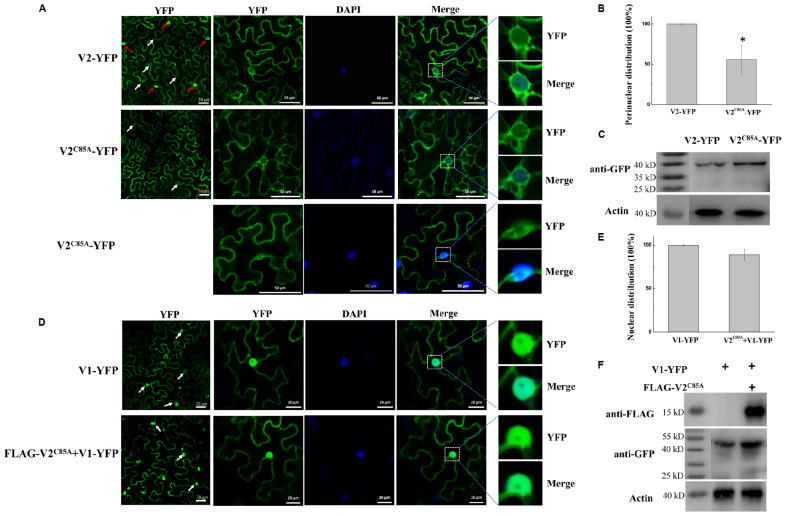
Geminiviruses are an important group of circular, single-stranded DNA viruses that cause devastating diseases in crops. Geminiviruses replicate their genomic DNA in the nucleus and the newly synthesized viral DNA is subsequently transported to the cytoplasm for further cell-to-cell and long-distance movement to establish systemic infection. Thus, nucleocytoplasmic transportation is crucial for successful infection by geminiviruses. For (TYLCV), the V1 protein is known to bind and shuttle viral genomic DNA, however, the role of the V2 protein in this process is still unclear. Here, we report that the V1 protein is primarily localized in the nucleus when expressed but the nucleus-localized V1 protein dramatically decreases when co-expressed with V2 protein. Moreover, the V2-facilitated nuclear export of V1 protein depends on host exportin-α and a specific V1-V2 interaction. Chemical inhibition of exportin-α or a substitution at cysteine 85 of the V2 protein, which abolishes the V1-V2 interaction, blocks redistribution of the V1 protein to the perinuclear region and the cytoplasm. When the V2 mutation is incorporated into a TYLCV infectious clone, the TYLCV-C85S causes delayed onset of very mild symptoms compared to wild-type TYLCV, suggesting that the V1-V2 interaction and, thus, the V2-mediated nuclear export of the V1 protein is crucial for viral spread and systemic infection. Our data point to a critical role of the V2 protein in promoting the nuclear export of the V1 protein and viral systemic infection, likely by promoting V1 protein-mediated nucleocytoplasmic transportation of TYLCV genomic DNA.
双生病毒是一类重要的环状单链DNA病毒,可在作物中引发毁灭性病害。双生病毒在细胞核中复制其基因组DNA,新合成的病毒DNA随后被转运至细胞质,以进行进一步的细胞间和长距离移动,从而建立系统感染。因此,核质运输对于双生病毒的成功感染至关重要。对于番茄黄化曲叶病毒(TYLCV),已知V1蛋白可结合并转运病毒基因组DNA,然而,V2蛋白在此过程中的作用仍不清楚。在此,我们报告,V1蛋白在表达时主要定位于细胞核,但与V2蛋白共表达时,定位于细胞核的V1蛋白会显著减少。此外,V2促进的V1蛋白核输出依赖于宿主输出蛋白α和特定的V1-V2相互作用。对输出蛋白α的化学抑制或V2蛋白第85位半胱氨酸的取代(这会消除V1-V2相互作用)会阻止V1蛋白重新分布至核周区域和细胞质。当将V2突变引入TYLCV感染性克隆时,与野生型TYLCV相比,TYLCV-C85S导致非常轻微症状的发病延迟,这表明V1-V2相互作用以及因此V2介导的V1蛋白核输出对于病毒传播和系统感染至关重要。我们的数据表明,V2蛋白在促进V1蛋白核输出和病毒系统感染中起关键作用,可能是通过促进V1蛋白介导的TYLCV基因组DNA的核质运输来实现的。