Department of Life Sciences, 9306University of Modena and Reggio Emilia, Modena, Italy.
Department of Surgery, Medicine, Dentistry and Morphological Sciences with Transplant Surgery, Oncology and Regenerative Medicine Relevance, 9306University of Modena and Reggio Emilia, Modena, Italy.
Cephalalgia. 2020 Oct;40(12):1355-1362. doi: 10.1177/0333102420937742. Epub 2020 Jun 26.
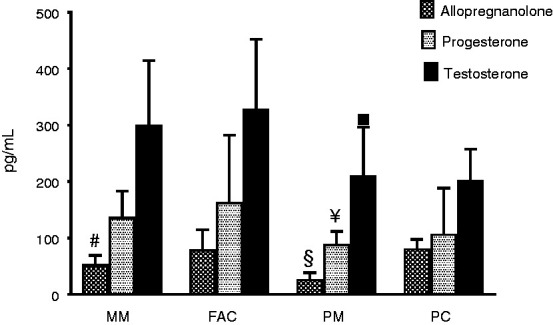
Reduced blood or cerebrospinal fluid levels of allopregnanolone are involved in menstrual cycle-linked CNS disorders, such as catamenial epilepsy. This condition, like menstrually-related migraine, is characterized by severe, treatment-resistant attacks. We explored whether there were differences in allopregnanolone, progesterone and testosterone serum levels between women with menstrually-related migraine (MM, n = 30) or postmenopausal migraine without aura who had suffered from menstrually-related migraine during their fertile age (PM, n = 30) and non-headache control women in fertile age (FAC, n = 30) or post-menopause (PC, n = 30).
Participants were women with migraine afferent to a headache centre; controls were female patients' acquaintances. Serum samples obtained were analyzed by HPLC-ESI-MS/MS.
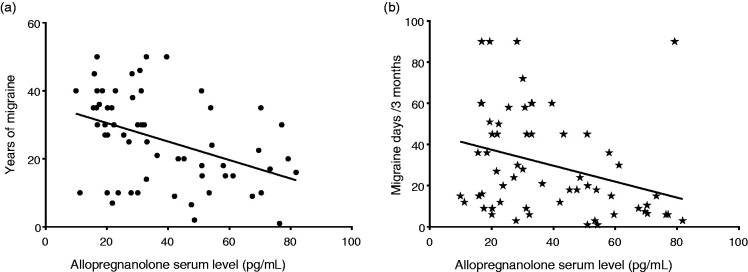
In menstrually-related migraine and postmenopausal migraine groups, allopregnanolone levels were lower than in the respective control groups (fertile age and post-menopause) ( < 0.001, one-way analysis of variance followed by Tukey-Kramer post-hoc comparison test) while progesterone and testosterone levels were similar. By grouping together patients with migraine, allopregnanolone levels were inversely correlated with the number of years and days of migraine/3 months ( ≤ 0.005, linear regression analysis).
Decreased GABAergic inhibition, due to low allopregnanolone serum levels, could contribute to menstrually-related migraine and persistence of migraine after menopause. For the management of these disorders, a rise in the GABAergic transmission by increasing inhibitory neurosteroids might represent a novel strategy.
在与月经周期相关的中枢神经系统疾病中,如月经性癫痫,血液或脑脊液中缺乏别孕烯醇酮。这种情况与月经相关的偏头痛一样,以严重、治疗抵抗的发作为特征。我们探讨了月经性偏头痛(MM,n=30)或有月经相关偏头痛史的绝经后无先兆偏头痛(PM,n=30)患者与生育年龄的非头痛对照女性(FAC,n=30)或绝经后(PC,n=30)的血清别孕烯醇酮、孕酮和睾酮水平是否存在差异。
参与者为偏头痛患者,就诊于头痛中心;对照组为女性患者的熟人。采用 HPLC-ESI-MS/MS 分析血清样本。
在月经性偏头痛和绝经后偏头痛组,别孕烯醇酮水平低于各自的对照组(生育年龄和绝经后)( < 0.001,方差分析,随后 Tukey-Kramer 事后比较检验),而孕酮和睾酮水平相似。将偏头痛患者分组后,别孕烯醇酮水平与偏头痛发作的年数和天数呈负相关( ≤ 0.005,线性回归分析)。
由于血清别孕烯醇酮水平降低导致 GABA 能抑制作用减弱,可能导致月经性偏头痛和绝经后偏头痛持续存在。为了治疗这些疾病,通过增加抑制性神经甾体来增加 GABA 能传递可能是一种新的策略。