Department of Medicine, McGaw Medical Center of Northwestern University , Chicago, IL, USA.
Department of Medicine, Johns Hopkins University School of Medicine , Baltimore, MD, USA.
Med Educ Online. 2020 Dec;25(1):1786210. doi: 10.1080/10872981.2020.1786210.
The Scholarly Concentrations program was established at Johns Hopkins University School of Medicine in 2009 with the aim of instilling passion for scholarship.
Our study aimed to determine whether the Scholarly Concentrations program achieves positive changes in medical student self-efficacy in conducting research and, if so, whether this results in future career aspirations toward scholarship.
We used the Clinical Research Appraisal Inventory-Short Form (CRAI-SF) to assess changes in self-efficacy among students completing the Scholarly Concentrations program between 2014 and 2017. We calculated composite mean scores of six domains. We included outcomes on whether students published a manuscript, overall program perceptions, and likelihood of future research careers. We analyzed relationships between CRAI-SF scores and outcomes using paired t-tests and multivariable-adjusted logistic regression.
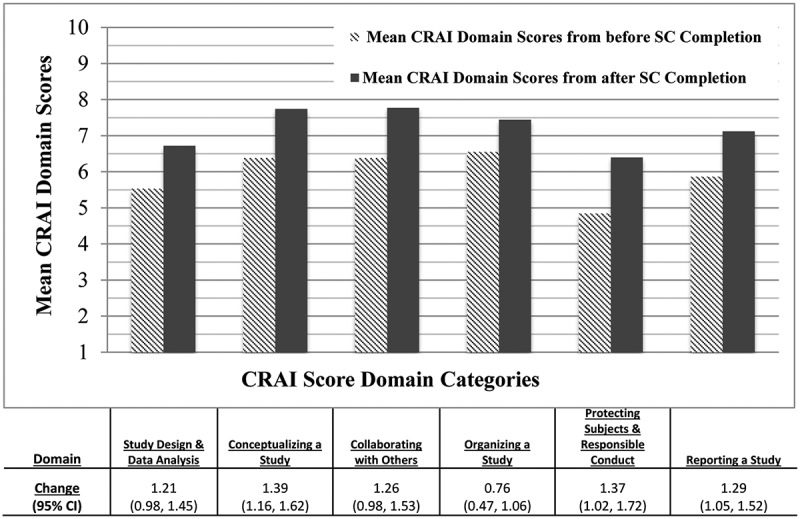
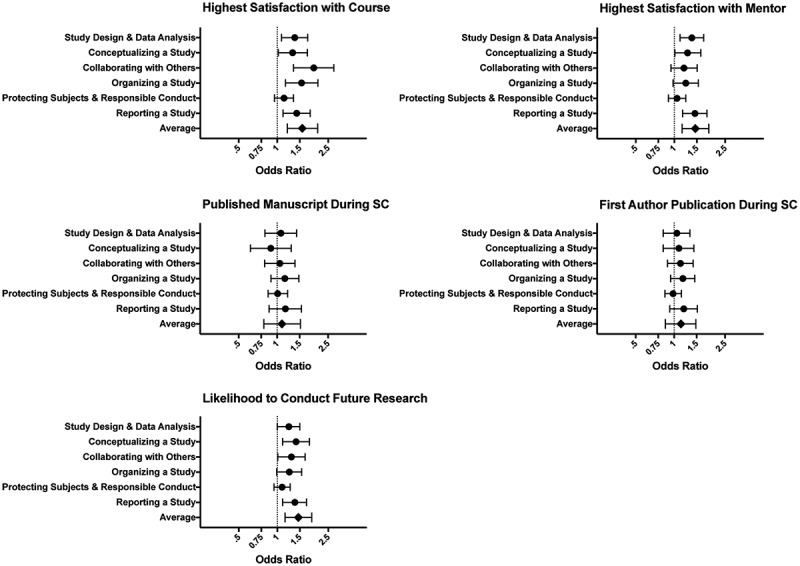
A total of 419 students completed the Scholarly Concentrations program. All 6 CRAI domain scores showed significant improvements in self-efficacy between the pre-Scholarly Concentrations and post-Scholarly Concentrations ratings (range of changes 0.76-1.39, p < 0.05 for all). We found significant associations between post-Scholarly Concentrations self-efficacy ratings and course satisfaction (adjusted OR 1.57 [95% CI 1.20, 2.07]) and mentor satisfaction (OR 1.46 [1.15, 1.86]), as well as students' intent to conduct future research (OR 1.46 [1.15, 1.86]). These results were robust to sensitivity analyses, and pronounced in the group of students without prior research experience.
Our findings suggest that a Scholarly Concentrations program is associated with an increased self-efficacy for research, and these changes in self-efficacy are associated with higher satisfaction in the scholarly experience and increased likelihood of pursuing scholarly work. Other medical schools could use such a tool of self-efficacy to both investigate the overall Scholarly Concentrations experience and understand factors that may increase interest in future physician-scientist pathways.
约翰霍普金斯大学医学院于 2009 年设立了学术集中计划,旨在激发对学术的热情。
我们的研究旨在确定学术集中计划是否会使医学生在进行研究方面的自我效能感发生积极变化,如果是,这是否会导致他们未来对学术生涯的渴望。
我们使用临床研究评估清单-短格式(CRAI-SF)来评估 2014 年至 2017 年期间完成学术集中计划的学生的自我效能感变化。我们计算了六个领域的综合平均分数。我们包括学生发表论文、对整个计划的看法以及未来从事研究职业的可能性等结果。我们使用配对 t 检验和多变量调整逻辑回归分析 CRAI-SF 分数与结果之间的关系。
共有 419 名学生完成了学术集中计划。在学术集中计划之前和之后的评估中,所有 6 个 CRAI 领域的自我效能感评分均显示出显著提高(变化范围为 0.76-1.39,所有 p < 0.05)。我们发现,学术集中计划后的自我效能感评分与课程满意度(调整后的 OR 1.57 [95%CI 1.20, 2.07])和导师满意度(OR 1.46 [1.15, 1.86])之间存在显著关联,以及学生未来从事研究的意愿(OR 1.46 [1.15, 1.86])。这些结果在敏感性分析中是稳健的,并且在没有先前研究经验的学生群体中更为明显。
我们的研究结果表明,学术集中计划与研究自我效能感的提高有关,而这种自我效能感的变化与学术体验的更高满意度和从事学术工作的可能性增加有关。其他医学院校可以使用这种自我效能工具来调查整个学术集中体验,并了解可能增加对未来医师科学家途径兴趣的因素。