H. Tookes is assistant professor, Department of Medicine, University of Miami Miller School of Medicine, Miami, Florida; ORCID: https://orcid.org/0000-0002-2369-360X .
T.S. Bartholomew is a PhD candidate, Department of Public Health Sciences, University of Miami Miller School of Medicine, Miami, Florida; ORCID: https://orcid.org/0000-0002-9384-0812 .
Acad Med. 2021 Feb 1;96(2):213-217. doi: 10.1097/ACM.0000000000003557.
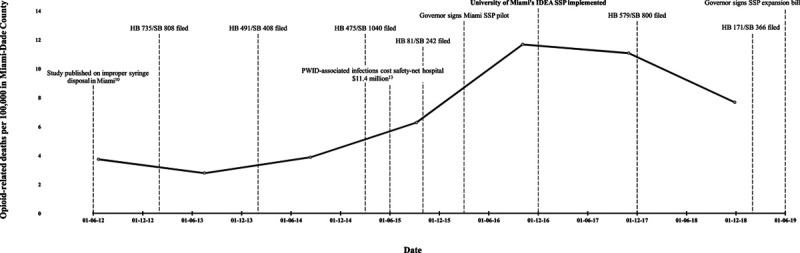
After the closure of pill mills and implementation of Florida's Prescription Drug Monitoring Program in 2010, high demand for opioids was met with counterfeit pills, heroin, and fentanyl. In response, medical students at the University of Miami Miller School of Medicine embarked on a journey to bring syringe services programs (SSPs) to Florida through an innovative grassroots approach. Working with the Florida Medical Association, students learned patient advocacy, legislation writing, and negotiation within a complex political climate. Advocacy over 4 legislative sessions (2013-2016) included committee testimony and legislative visit days, resulting in the authorization of a 5-year SSP pilot. The University of Miami's Infectious Disease Elimination Act (IDEA) SSP opened on December 1, 2016. Students identified an urgent need for expanded health care for program participants and founded a weekly free clinic at the SSP. Students who rotate through the clinic learn medicine and harm reduction through the lens of social justice, with exposure to people who use drugs, sex workers, individuals experiencing homelessness, and other vulnerable populations. The earliest success of the IDEA SSP was the distribution of over 2,000 boxes of nasal naloxone, which the authors believe positively contributed to a decrease in the number of opioid-related deaths in Miami-Dade County for the first time since 2013. The second was the early identification of a cluster of acute human immunodeficiency virus infections among program participants. Inspired by these successes, students from across the state joined University of Miami students and met with legislators in their home districts, wrote op-eds, participated in media interviews, and traveled to the State Capitol to advocate for decisive action to mitigate the opioid crisis. The 2019 legislature passed legislation authorizing SSPs statewide. In states late to adopt SSPs, medical schools have a unique opportunity to address the opioid crisis using this evidence-based approach.
2010 年,药丸工厂关闭,佛罗里达州实施处方药物监测计划后,阿片类药物的高需求导致出现了假冒药丸、海洛因和芬太尼。为应对这一情况,迈阿密大学米勒医学院的医学生们采取了一种创新的基层方法,着手在佛罗里达州推行注射服务项目 (SSP)。学生们与佛罗里达医学协会合作,学习在复杂的政治环境中进行患者宣传、立法起草和谈判。经过 4 届立法会议(2013-2016 年)的倡导,包括委员会证词和立法访问日,最终授权进行为期 5 年的 SSP 试点。迈阿密大学传染病消除法案(IDEA)SSP 于 2016 年 12 月 1 日开放。学生们发现项目参与者对扩大医疗服务的需求迫切,并在 SSP 处成立了每周一次的免费诊所。在该诊所轮转的学生通过社会正义的视角学习医学和减少伤害,接触使用毒品的人、性工作者、无家可归者和其他弱势群体。IDEA SSP 最早的成功是分发了超过 2000 盒鼻用纳洛酮,作者认为这对 2013 年以来迈阿密-戴德县阿片类药物相关死亡人数首次下降起到了积极作用。第二个成功是早期在项目参与者中发现了一组急性人类免疫缺陷病毒感染。受这些成功的启发,来自全州各地的学生与迈阿密大学的学生一起与各自选区的立法者会面,撰写专栏文章,接受媒体采访,并前往州议会大厦为采取果断行动缓解阿片类药物危机进行游说。2019 年立法机构通过了授权全州范围内推行 SSP 的立法。在较晚采用 SSP 的州,医学院校有机会通过这种基于证据的方法来解决阿片类药物危机。