Department of Botany, Institute of Science, Banaras Hindu University, Varanasi, 221005, India.
Sci Rep. 2020 Jun 26;10(1):10470. doi: 10.1038/s41598-020-67368-w.
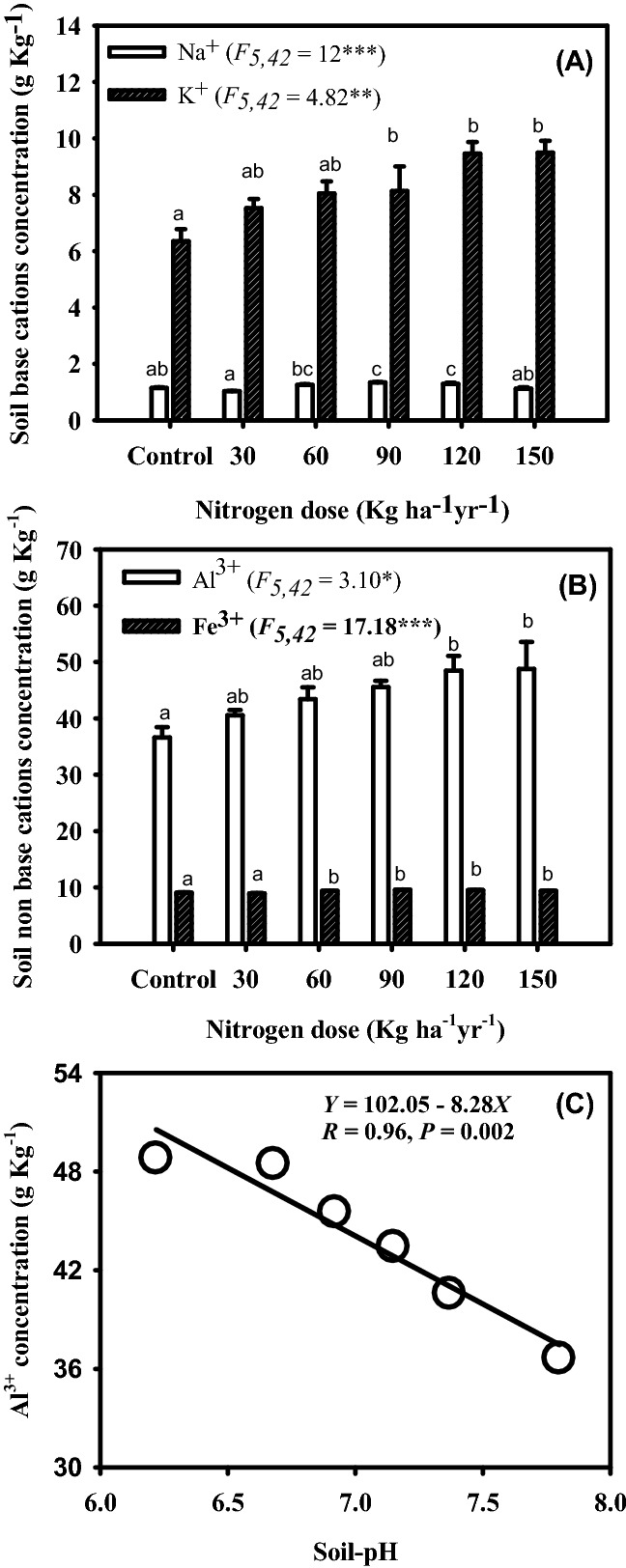
Nitrogen (N) deposition is a serious environmental issue for soil fertility and human wellbeing. Studies on various terrestrial ecosystems yielded fragmented information on soil-N status (microbial biomass- and mineral-N) and dynamics (N-mineralization and -leaching) whereas the holistic view on this issue is relatively unknown. A complete understanding of soil-N status and dynamics in response to N deposition is essential for sustainable management of ecosystem structure and function as needed for human wellbeing. Therefore, we conducted an experiment in the N-limited tropical grassland to explore the question whether N-deposition weakens the soil-N status and dynamics; if yes, then what could be the optimum amount of deposited N and the related controlling mechanism? We undertook a 3-year (2013-2016) experimental N fertilization (control, 30, 60, 90, 120, and 150 kg N ha year) study (using urea as a source of N deposition). The data from a total of 72, 1 × 1 m plots (six treatments with 12 replicates) were collected and properly analysed with statistical software. N deposition caused significant differences in the parameters of soil-N status and dynamics. The responses of microbial biomass-N, N-mineralization, and mineral-N to the N deposition were quadratic (maximum values were in N) whereas N-leaching showed a linear response. Compared to control, N deposition (30-150 kg N) consistently enhanced (29-96%) leaching of N. As a mechanism, acidification induced aluminium toxicity, carbon to nitrogen ratio and litter decomposition governed the soil-N status and dynamics. N deposition over and above 90 kg ha year resulted in a negative feedback to soil N transformation and availability. Hence, N deposition below 90 kg ha year could be a limit for the sustainable functioning of the tropical or similar grasslands.
氮(N)沉积是土壤肥力和人类福祉的一个严重环境问题。对各种陆地生态系统的研究提供了关于土壤-N 状况(微生物生物量和矿物-N)和动态(N 矿化和淋失)的零散信息,而对这个问题的整体看法则相对未知。全面了解土壤-N 状况和对 N 沉积的动态响应对于可持续管理生态系统结构和功能以满足人类福祉的需要至关重要。因此,我们在 N 限制的热带草原进行了一项实验,以探索以下问题:N 沉积是否会削弱土壤-N 状况和动态;如果是这样,那么沉积 N 的最佳量是多少,以及相关的控制机制是什么?我们进行了为期三年(2013-2016 年)的实验 N 施肥(对照、30、60、90、120 和 150 kg N ha-1 年)研究(使用尿素作为 N 沉积的来源)。从总共 72 个 1×1 m 实验小区(六个处理,12 个重复)中收集数据,并使用统计软件进行适当分析。N 沉积导致土壤-N 状况和动态参数的显著差异。微生物生物量-N、N 矿化和矿物-N 对 N 沉积的响应呈二次曲线(N 最大),而 N 淋失呈线性响应。与对照相比,N 沉积(30-150 kg N)一致增强了 N 的淋失(29-96%)。作为一种机制,酸化诱导铝毒性、碳氮比和凋落物分解控制了土壤-N 状况和动态。超过 90 kg ha-1 年的 N 沉积导致土壤 N 转化和有效性的负反馈。因此,低于 90 kg ha-1 年的 N 沉积可能是热带或类似草原可持续功能的限制。