Haraldsson André, Ceberg Sofie, Ceberg Crister, Bäck Sven, Engelholm Silke, Engström Per E
Department Hematology, Oncology and Radiation Physics, Skåne University Hospital, Lund, Sweden.
Medical Radiation Physics, Department of Clinical Sciences, Lund University, Lund, Sweden.
J Appl Clin Med Phys. 2020 Aug;21(8):139-148. doi: 10.1002/acm2.12936. Epub 2020 Jun 26.
In this study, we have quantified the setup deviation and time gain when using fast surface scanning for daily setup/positioning with weekly megavoltage computed tomography (MVCT) and compared it to daily MVCT.
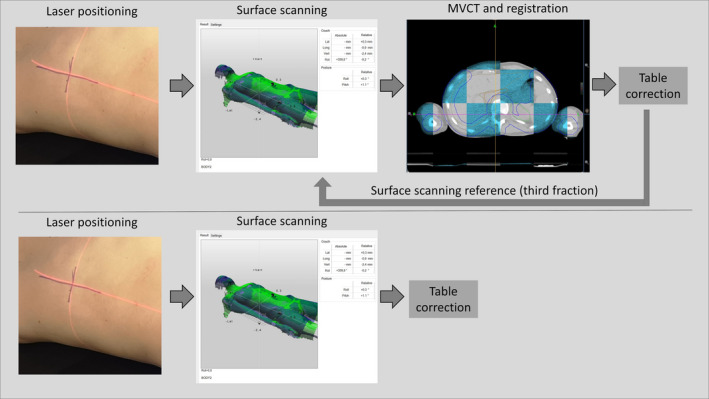
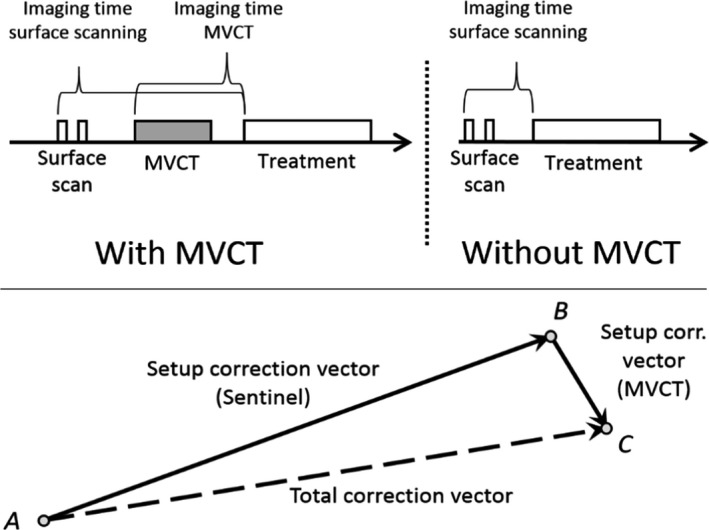
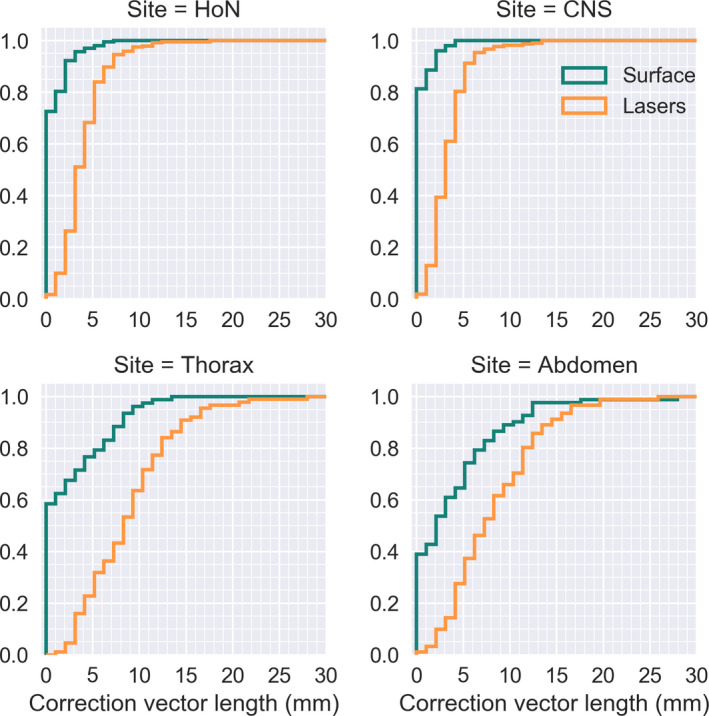
A total of 16 835 treatment fractions were analyzed, treated, and positioned using our TomoTherapy HD (Accuray Inc., Madison, USA) installed with a Sentinel optical surface scanning system (C-RAD Positioning AB, Uppsala, Sweden). Patients were positioned using in-room lasers, surface scanning and MVCT for the first three fractions. For the remaining fractions, in-room laser was used for setup followed by daily surface scanning with MVCT once weekly. The three-dimensional (3D) setup correction for surface scanning was evaluated from the registration between MVCT and the planning CT. The setup correction vector for the in-room lasers was assessed from the surface scanning and the MVCT to planning CT registration. The imaging time was evaluated as the time from imaging start to beam-on.
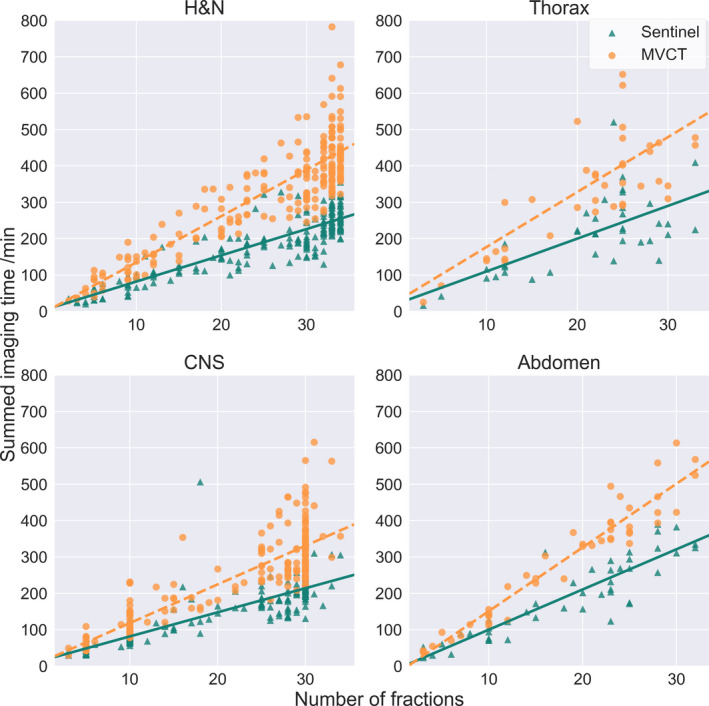
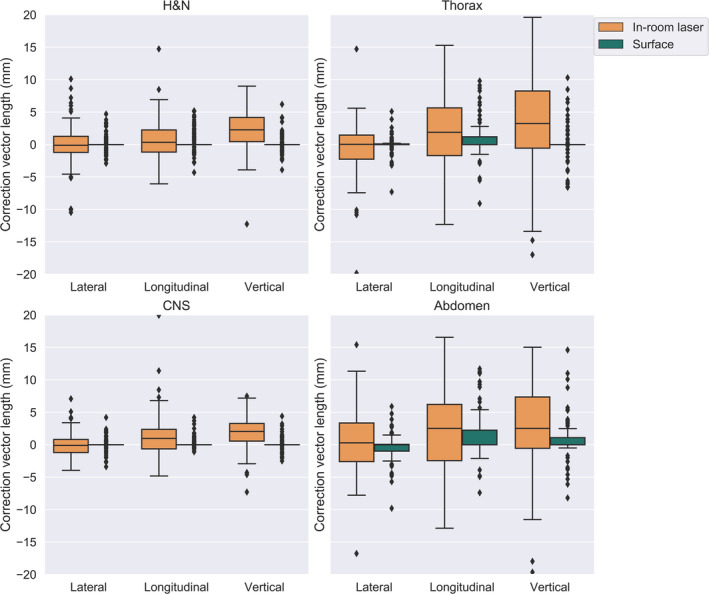
We analyzed 894 TomoTherapy treatment plans from 2012 to 2018. Of all the treatment fractions performed with surface scanning, 90 % of the residual errors were within 2.3 mm for CNS (N = 284), 2.9 mm for H&N (N = 254), 8.7 mm for thorax (N = 144) and 10.9 for abdomen (N = 134) patients. The difference in residual error between surface scanning and positioning with in-room lasers was significant (P < 0.005) for all sites. The imaging time was assessed as total imaging time per treatment plan, modality, and treatment site and found that surface scanning significantly reduced patient on-couch time compared to MVCT for all treatment sites (P < 0.005).
The results indicate that daily surface scanning with weekly MVCT can be used with the current target margins for H&N, CNS, and thorax, with reduced imaging time.
在本研究中,我们对使用快速表面扫描进行每日摆位/定位并每周进行兆伏级计算机断层扫描(MVCT)时的摆位偏差和时间增益进行了量化,并将其与每日MVCT进行比较。
共分析了16835个治疗分次,使用安装了Sentinel光学表面扫描系统(瑞典乌普萨拉C-RAD Positioning AB公司)的TomoTherapy HD(美国麦迪逊Accuray公司)进行治疗和摆位。在前三个分次中,使用室内激光、表面扫描和MVCT对患者进行摆位。对于其余分次,使用室内激光进行摆位,随后每周进行一次每日表面扫描并结合MVCT。通过MVCT与计划CT之间的配准评估表面扫描的三维(3D)摆位校正。根据表面扫描以及MVCT与计划CT的配准评估室内激光的摆位校正向量。将成像时间评估为从成像开始到射束开启的时间。
我们分析了2012年至2018年的894个TomoTherapy治疗计划。在所有使用表面扫描进行的治疗分次中,中枢神经系统(N = 284)患者90%的残余误差在2.3毫米以内,头颈部(N = 254)患者为2.9毫米,胸部(N = 144)患者为8.7毫米,腹部(N = 134)患者为10.9毫米。所有部位表面扫描与使用室内激光摆位的残余误差差异均具有统计学意义(P < 0.005)。成像时间按每个治疗计划、模态和治疗部位的总成像时间进行评估,结果发现与MVCT相比,表面扫描显著缩短了所有治疗部位患者的治疗床上时间(P < 0.005)。
结果表明,每日表面扫描结合每周MVCT可用于目前头颈部、中枢神经系统和胸部的靶区边界设定,同时可缩短成像时间。