Liu Li, Hu Xiaofei, Zhang Yixin, Pan Qi, Zhan Qunling, Tan Ge, Wang Kuiyun, Zhou Jiying
Department of Neurology, The First Affiliated Hospital of Chongqing Medical University, Chongqing, China.
Department of Neurology, Chongqing Renji Hospital, University of Chinese Academy of Sciences, Chongqing, China.
Front Hum Neurosci. 2020 Jun 12;14:227. doi: 10.3389/fnhum.2020.00227. eCollection 2020.
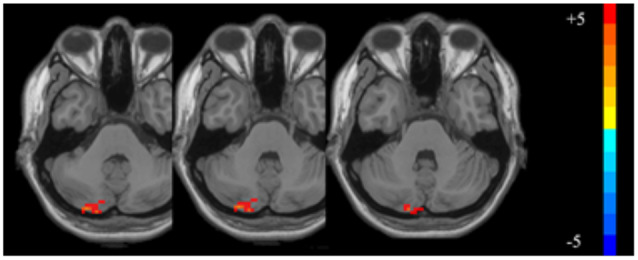
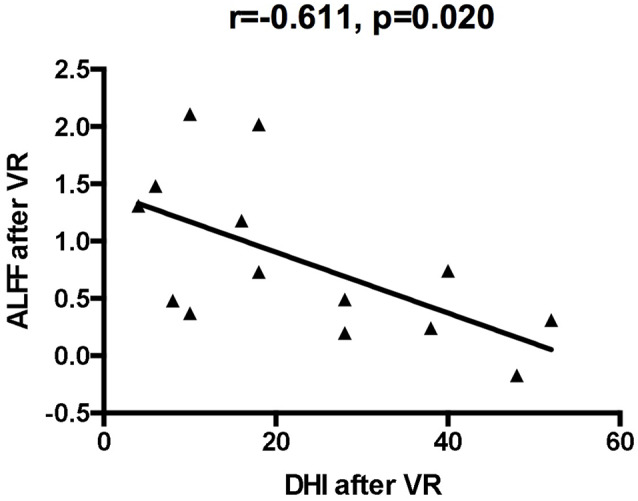
Previous studies have shown that vestibular migraine (VM) is a cerebral disease with recurrent vertigo. Vestibular rehabilitation (VR) is an effective type of physical therapy for minimizing vestibular symptoms, as it improves vestibular compensation in patients with VM. Currently, the cerebral regions that are associated with the pathogenesis of VM are largely unknown. To further understand the underlying mechanisms of VM, we performed resting-state functional magnetic resonance imaging (fMRI) before and after 1 month of VR in 14 patients with VM. The Dizziness Handicap Inventory (DHI), the 36-Item Short-Form Health Survey (SF-36), the Hamilton Depression Scale (HAMD) and the Hamilton Anxiety Scale (HAMA) scores were included as clinical outcomes. The amplitude of low-frequency fluctuation (ALFF) was assessed to characterize spontaneous brain activity. The correlations between the clinical characteristics and ALFF values were assessed. After 1 month of VR training, the DHI scores in patients with VM were significantly lower than those at baseline ( = 0.03), as were the HAMA scores ( = 0.02). We also found that the ALFF values in the left posterior cerebellum of VM patients increased significantly after 1 month of VR training. Moreover, the ALFF values in the left cerebellum were inversely correlated with the patients' DHI scores. Overall, this study showed that VR exercise for 1 month has a positive effect on vestibular symptoms in patients with VM. Asymmetric cerebellar hyperactivity might be a functional compensation for vestibular dysfunction in patients with VM.
先前的研究表明,前庭性偏头痛(VM)是一种伴有反复发作眩晕的脑部疾病。前庭康复训练(VR)是一种有效的物理治疗方法,可将前庭症状降至最低,因为它能改善VM患者的前庭代偿功能。目前,与VM发病机制相关的脑区在很大程度上尚不清楚。为了进一步了解VM的潜在机制,我们对14例VM患者在进行1个月VR训练前后进行了静息态功能磁共振成像(fMRI)检查。将头晕残障量表(DHI)、36项简短健康调查问卷(SF-36)、汉密尔顿抑郁量表(HAMD)和汉密尔顿焦虑量表(HAMA)评分作为临床结果。评估低频振幅(ALFF)以表征自发脑活动。评估临床特征与ALFF值之间的相关性。经过1个月的VR训练后,VM患者的DHI评分显著低于基线水平( = 0.03),HAMA评分也是如此( = 0.02)。我们还发现,VM患者在经过1个月的VR训练后,左后小脑的ALFF值显著增加。此外,左小脑的ALFF值与患者的DHI评分呈负相关。总体而言,本研究表明,1个月的VR训练对VM患者的前庭症状有积极影响。小脑不对称性多动可能是VM患者前庭功能障碍的一种功能代偿。