Acıbadem Mehmet Ali Aydınlar University, School of Medicine, Department of ENT, Istanbul, Turkey.
Acıbadem Kozyatagı Hospital, Neurology Department, Istanbul, Turkey.
Braz J Otorhinolaryngol. 2022 Nov-Dec;88 Suppl 3(Suppl 3):S25-S33. doi: 10.1016/j.bjorl.2021.07.011. Epub 2021 Oct 25.
Vestibular Migraine (VM) is the second most common cause in patients with vertigo. Patients with VM complain about vestibular symptoms during a headache attack or during the period between attacks. Vestibular Rehabilitation (VR), an exercised based therapy to treat dizziness and balance dysfunction has been shown to be effective in vestibular diseases. In this study, we aimed to assess the effect of VR for vestibular symptoms and quality of life in VM patients, and to compare the results with patients with vestibular disorders without migraine.
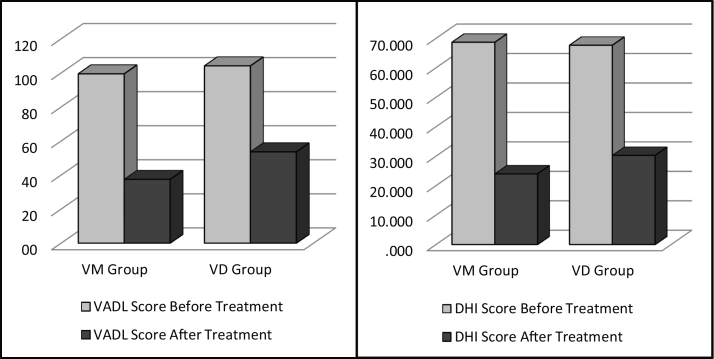
Sixty (60) patients who received VR treatment were divided into two groups: vestibular migraine group (30 patients) and non-migraine vestibular dysfunction group (30 patients). All patients received VR for 18 sessions and the program was completed in 1.5 months. Pre- and post-treatment Dizziness Handicap Inventory (DHI) scores, Vestibular Disorders Activities of Daily Living Scale (VADL) scores, the frequency of dizziness and headache, and Computerized Dynamic Posturography (CDP) scores were assessed and compared retrospectively.
With VR in both the vestibular migraine group and vestibular dysfunction group, DHI score, VADL score, the frequency of dizziness and headache scores significantly impaired. Post-treatment CDP results were higher than pre- treatment results for both patient groups.
With VR, a significant improvement was observed in subjective and objective balance assessment measurement. Vestibular Rehabilitation must be considered in patients who do not benefit from medical therapy or have limited benefit.
Level III (evidence obtained from well-designed controlled trials without randomization).
前庭性偏头痛(VM)是眩晕患者的第二大常见病因。VM 患者在头痛发作期间或发作间期会出现前庭症状。前庭康复(VR)是一种基于运动的治疗方法,可用于治疗头晕和平衡功能障碍,已被证明对前庭疾病有效。在本研究中,我们旨在评估 VR 对 VM 患者前庭症状和生活质量的影响,并将结果与无偏头痛的前庭障碍患者进行比较。
60 名接受 VR 治疗的患者被分为两组:前庭性偏头痛组(30 名患者)和非偏头痛性前庭功能障碍组(30 名患者)。所有患者均接受了 18 次 VR 治疗,治疗计划在 1.5 个月内完成。回顾性评估治疗前后的眩晕残障程度量表(DHI)评分、前庭疾病日常生活量表(VADL)评分、头晕和头痛频率以及计算机动态姿势描记图(CDP)评分,并进行比较。
在 VR 治疗下,前庭性偏头痛组和前庭功能障碍组的 DHI 评分、VADL 评分、头晕和头痛频率均显著降低。治疗后,两组患者的 CDP 结果均高于治疗前。
VR 治疗可显著改善主观和客观平衡评估测量。对于那些对药物治疗无反应或受益有限的患者,必须考虑进行 VR 治疗。
III 级(证据来源于无随机分组的精心设计的对照试验)。