Kreuzer Peter M, Baghai Thomas C, Rupprecht Rainer, Wittmann Markus, Steffling Dagmar, Ziereis Michael, Zowe Marc, Hausner Helmut, Langguth Berthold
Department of Psychiatry and Psychotherapy, Bezirksklinikum, University of Regensburg, Regensburg, Germany.
Clinic of Psychiatry, Psychosomatic Medicine and Psychotherapy, Wöllershof, Germany.
Front Psychiatry. 2020 Jun 11;11:550. doi: 10.3389/fpsyt.2020.00550. eCollection 2020.
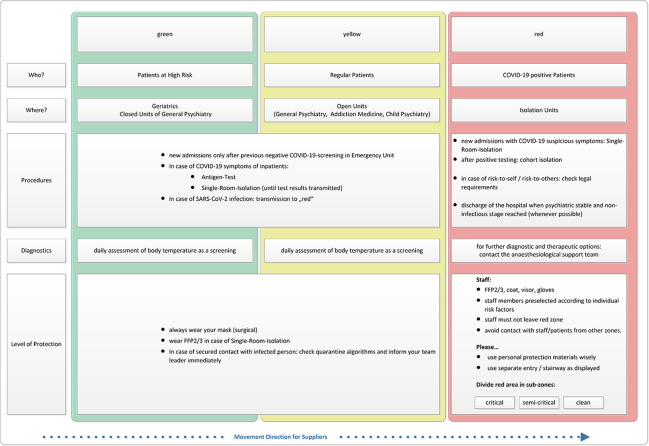
The pandemic spread of the corona virus SARS-CoV-2 has even-handedly shattered national and international health systems and economies almost in an instant. As numbers of infections and COVID-19-related deaths rise from day to day, fears and uncertainties on how to deal with this unknown threat are extremely present both for individuals and societies as a whole. In this manuscript, we aim to exemplarily describe the bullet points concerning (a) the internal risk management, (b) the organizational and structural changes, and (c) the communicational strategies applied in a Psychiatric University Hospital in the Southern part of Germany. The authors are well aware about the fact that almost none of these considerations may be considered as evidence-based at the moment. However, the authors trust that these reflections and experiences may be useful as an orientation for similar risk constellations in other afflicted countries due to the temporal delay of the pandemic course.
新型冠状病毒SARS-CoV-2的大流行几乎在瞬间就平等地冲击了国内和国际卫生系统及经济。随着感染人数和与COVID-19相关的死亡人数与日俱增,个人和整个社会对于如何应对这一未知威胁的恐惧和不确定性都极为强烈。在本手稿中,我们旨在示例性地描述有关(a)内部风险管理、(b)组织和结构变革以及(c)德国南部一家大学精神病医院所采用的沟通策略的要点。作者深知目前几乎所有这些考量都不能被视为基于证据的。然而,作者相信,由于疫情发展的时间延迟,这些思考和经验可能会为其他受灾国家类似的风险情况提供有用的指导方向。