Lee Hung-Maan, Shen E-Chin, Shen John T, Fu Earl, Chiu Hsien-Chung, Hsia Yi-Jan
Department of Orthopedics, Hualien Tzu Chi Hospital, Buddhist Tzu Chi Medical Foundation, Hualien, Taiwan, ROC.
School of Medicine, Tzu Chi University, Hualien, Taiwan, ROC.
J Dent Sci. 2020 Jun;15(2):141-146. doi: 10.1016/j.jds.2020.03.011. Epub 2020 Apr 18.
BACKGROUND/PURPOSE: Platelet-rich fibrin (PRF) can be obtained by centrifuging fresh blood in the absence of anticoagulants. Varying the centrifugation speeds may produce tougher and richer concentrated growth factors (CGF). This study examines tensile strength, growth factor content, and the potential of CGF and PRF in promoting periodontal cell proliferation.
Blood (40 mL/subject) was collected from 44 healthy subjects. PRF and CGF were prepared by centrifuging at 3000 rpm and switching speeds ranging within 3000 rpm, respectively. Fibrin strip was prepared and its tensile strength was measured. Transforming growth factor beta 1 (TGF-β1), platelet-derived growth factor BB (PDGF-BB), and epidermal growth factor (EGF) in the residual serum and fibrin clots were determined by enzyme-linked immunosorbent assay, and their effects on the proliferation of hFOB1.19 osteoblasts and human gingival fibroblasts were evaluated by 3-(4,5-dimethylthiazol-2-yl)-2,5-diphenyl tetrazolium bromide assay.
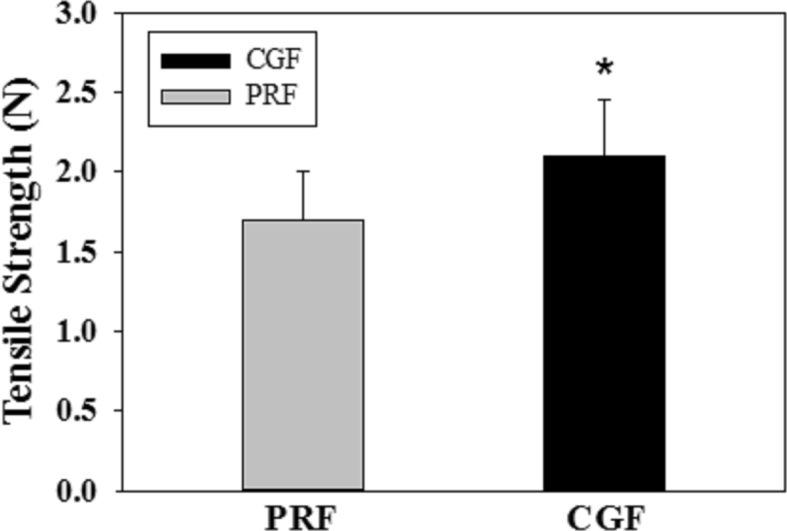
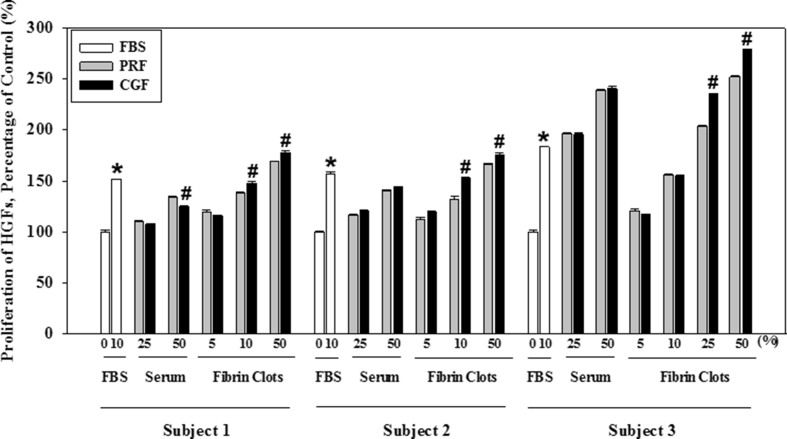
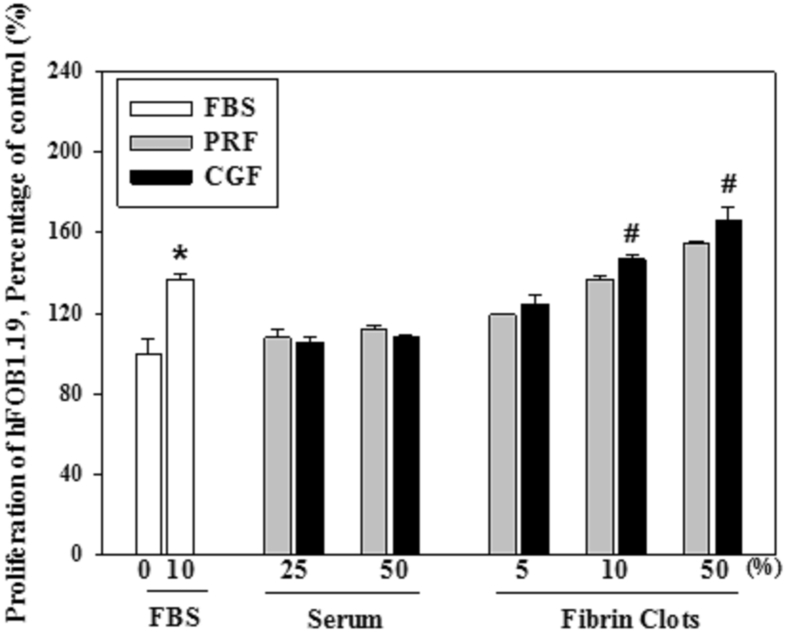
Compared with PRF, tensile strength of CGF was significantly higher. Concentrations and amounts of PDGF-BB and EGF in CGF were significantly higher than those in PRF. Osteoblast number was significantly higher in the cultures with fetal bovine serum (FBS, 10%) and with PRF or CGF fibrin clots (5%, 10%, and 50%) compared to that without FBS. Moreover, osteoblast number in CGF, regardless of the preparation of 10% and 50%, was significantly greater than that in PRF. Similar findings were also observed for gingival fibroblasts among the various subjects.
Varying centrifugation speeds can modify the tensile strength and biological activities of platelet fibrin clots.
背景/目的:富血小板纤维蛋白(PRF)可通过在无抗凝剂的情况下离心新鲜血液获得。改变离心速度可能会产生更坚韧、更丰富的浓缩生长因子(CGF)。本研究检测CGF和PRF的拉伸强度、生长因子含量以及它们促进牙周细胞增殖的潜力。
从44名健康受试者采集血液(40毫升/受试者)。分别通过以3000转/分钟离心以及在3000转/分钟范围内切换速度制备PRF和CGF。制备纤维蛋白条并测量其拉伸强度。通过酶联免疫吸附测定法测定残余血清和纤维蛋白凝块中转化生长因子β1(TGF-β1)、血小板衍生生长因子BB(PDGF-BB)和表皮生长因子(EGF),并通过3-(4,5-二甲基噻唑-2-基)-2,5-二苯基溴化四氮唑法评估它们对hFOB1.19成骨细胞和人牙龈成纤维细胞增殖的影响。
与PRF相比,CGF的拉伸强度显著更高。CGF中PDGF-BB和EGF的浓度及含量显著高于PRF。与无胎牛血清(FBS)相比,在含有胎牛血清(10%)以及PRF或CGF纤维蛋白凝块(5%、10%和50%)的培养物中,成骨细胞数量显著更高。此外,无论10%和50%的哪种制备方式,CGF中的成骨细胞数量均显著多于PRF。在不同受试者的牙龈成纤维细胞中也观察到类似结果。
改变离心速度可改变血小板纤维蛋白凝块的拉伸强度和生物学活性。