Lee Yu-Hsuan, Huang Yu-Shu, Chen I-Chia, Lin Po-Yen, Chuang Li-Chuan
Department of Pediatric Dentistry, Chang Gung Memorial Hospital at Linkou, Taoyuan, Taiwan.
Department of Child Psychiatry and Sleep Center, Chang Gung Memorial Hospital and University, Taoyuan, Taiwan.
J Dent Sci. 2020 Jun;15(2):193-199. doi: 10.1016/j.jds.2019.09.005. Epub 2019 Nov 9.
BACKGROUND/PURPOSE: Pediatric obstructive sleep apnea (OSA) might be a serious cause of neurocognitive deficits, behavioral changes, and craniofacial disharmony in children at very young age with mild type of OSA. This study aims to examine the effect of mild OSA on craniofacial morphology as well as dental arch morphology and characteristics in preschool children.
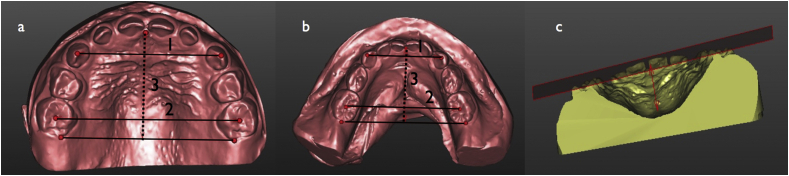
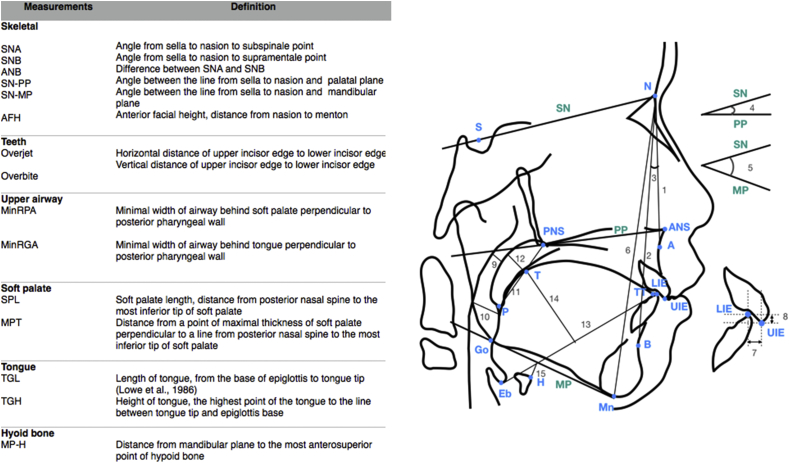
The test group comprised 16 preschool children (11 boys, 5 girls; mean age: 5.14 years old; mean AHI: 2.02) with confirmed polysomnographic diagnosis of mild OSA. Ten control subjects also underwent polysomnography (5 boys, 5 girls; mean age: 5.18 years old; median AHI: 0.43). Lateral cephalometric radiographs and dental arch impressions were obtained and measured. A survey on characteristics and quality of life (OSA-18) was filled out by study participants' caregivers.
For craniofacial morphology, a significant increase in ANB angle, a decrease in SNB angle, and larger overjet size were seen in the group with mild OSA, compared with the control group. More frequent sleep disturbances and mood swing were also found in children with mild OSA, based on the OSA-18 assessment.
Preschool children with mild OSA present the following: skeletal Class II pattern with a more retrognathic mandible, increased overjet size, and more pronounced symptoms in the domains of sleep and emotion. Dental arch constriction is not a typical feature in our sample of Asian preschool children with mild OSA.
背景/目的:小儿阻塞性睡眠呼吸暂停(OSA)可能是导致幼儿轻度OSA出现神经认知缺陷、行为改变和颅面不协调的严重原因。本研究旨在探讨轻度OSA对学龄前儿童颅面形态以及牙弓形态和特征的影响。
试验组包括16名经多导睡眠图确诊为轻度OSA的学龄前儿童(11名男孩,5名女孩;平均年龄:5.14岁;平均呼吸暂停低通气指数:2.02)。10名对照受试者也接受了多导睡眠图检查(5名男孩,5名女孩;平均年龄:5.18岁;呼吸暂停低通气指数中位数:0.43)。获取并测量了头颅侧位X线片和牙弓印模。研究参与者的照顾者填写了一份关于特征和生活质量(OSA-18)的调查问卷。
对于颅面形态,与对照组相比,轻度OSA组的ANB角显著增加,SNB角减小,覆盖增大。根据OSA-18评估,轻度OSA儿童还出现更频繁的睡眠障碍和情绪波动。
患有轻度OSA的学龄前儿童表现出以下情况:骨骼II类错牙合模式,下颌后缩更明显,覆盖增大,睡眠和情绪方面的症状更明显。在我们的亚洲轻度OSA学龄前儿童样本中,牙弓狭窄不是典型特征。