State Key Laboratory of Agricultural Microbiology, College of Veterinary Medicine, Huazhong Agricultural University, Wuhan 430070, China.
Key Laboratory of Preventive Veterinary Medicine in Hubei Province, Cooperative Innovation Center for Sustainable Pig Production, Wuhan 430070, China.
Sci Adv. 2020 Jun 19;6(25):eaaz5764. doi: 10.1126/sciadv.aaz5764. eCollection 2020 Jun.
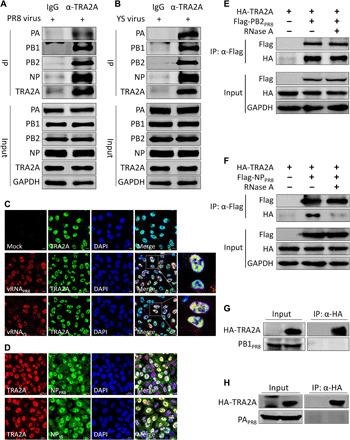
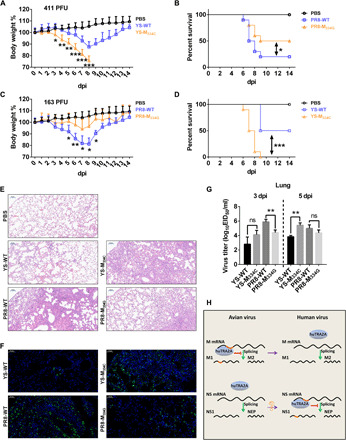
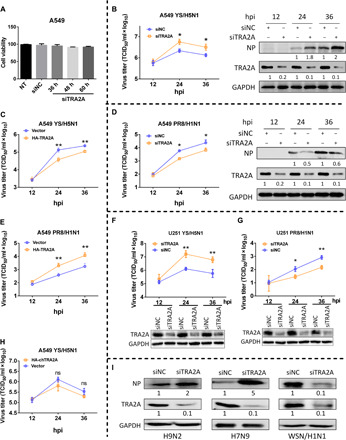
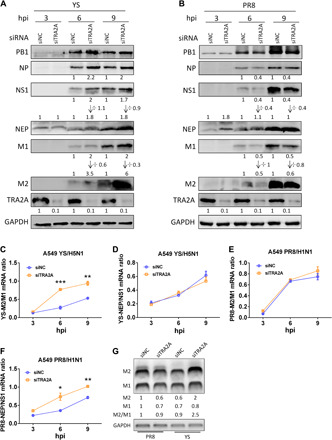
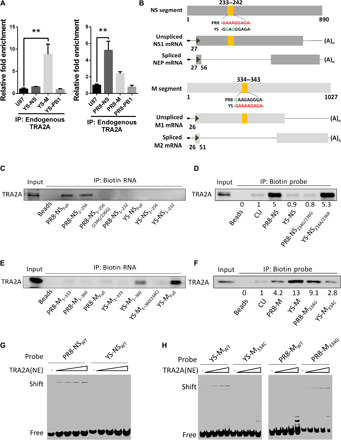
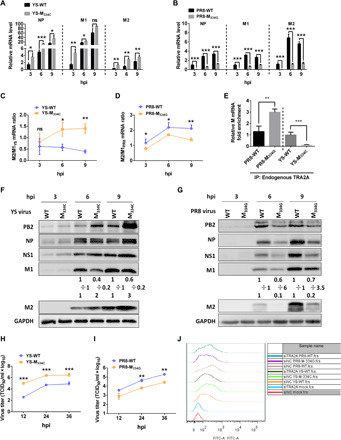
Several avian influenza A viruses (IAVs) have adapted to mammalian species, including humans. To date, the mechanisms enabling these host shifts remain incompletely understood. Here, we show that a host factor, human TRA2A (huTRA2A), inhibits avian IAV replication, but benefits human IAV replication by altered regulation of viral messenger RNA (mRNA) splicing. huTRA2A depresses mRNA splicing by binding to the intronic splicing silencer motif in the M mRNA of representative avian YS/H5N1 or in the NS mRNA of representative human PR8/H1N1 virus, leading to completely opposite effects on replication of the human and avian viruses in vitro and in vivo. We also confirm that the M-334 site and NS-234/236 sites are critical for TRA2A binding, mRNA splicing, viral replication, and pathogenicity. Our results reveal the underlying mechanisms of adaptation of avian influenza virus to human hosts, and suggest rational strategies to protect public health.
几种禽流感病毒(IAV)已经适应了哺乳动物物种,包括人类。迄今为止,这些宿主转移的机制仍不完全清楚。在这里,我们表明一种宿主因子,人 TRA2A(huTRA2A),通过改变病毒信使 RNA(mRNA)剪接的调节来抑制禽源 IAV 复制,但有利于人源 IAV 复制。huTRA2A 通过结合代表性禽源 YS/H5N1 的 M mRNA 或代表性人源 PR8/H1N1 病毒的 NS mRNA 中的内含子剪接沉默基序,抑制 mRNA 剪接,导致体外和体内人源和禽源病毒复制产生完全相反的效果。我们还证实 M-334 位点和 NS-234/236 位点对于 TRA2A 结合、mRNA 剪接、病毒复制和致病性至关重要。我们的研究结果揭示了禽流感病毒适应人类宿主的潜在机制,并为保护公众健康提供了合理的策略。