Gates Open Res. 2020 Mar 4;3:1564. doi: 10.12688/gatesopenres.13074.2. eCollection 2019.
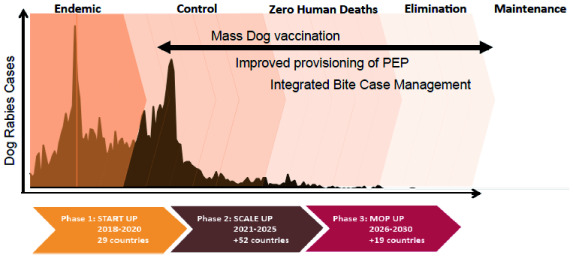
Dog-mediated rabies continues to kill tens of thousands of people every year in low- and middle-income countries despite being an entirely vaccine-preventable disease. WHO and partners have launched a global campaign to reach zero human deaths from dog-mediated rabies by 2030. The primary tools for reaching this target are mass dog vaccination to interrupt transmission in domestic dog populations that maintain infection, appropriate post-exposure prophylaxis (PEP) for rabies-exposed persons to prevent the fatal onset of disease, together with education to support their effective uptake. Models have been developed to assess the feasibility, impact and cost-effectiveness of these measures. From these models, we argue that the 2030 target of zero human rabies deaths is achievable, but will require concerted effort, engagement and investment. A proposed Gavi investment in human rabies vaccines has potential to drive progress towards the 2030 target; however, concomitant investment is needed to scale up mass dog vaccination or this target will be missed. Predicted economic benefits of mass dog vaccination vary according to national PEP provisioning and healthcare access. Integrated Bite Case Management can enhance surveillance and rationalize PEP use, but needs adapting to and integrating within local health systems and international reporting systems to improve PEP accountability, monitor impacts and support verification of disease freedom. Modelling approaches need refining to project realistic and geographically specific timelines for achieving targets. Model iterations informed by data on the implementation of interventions can be used to evaluate progress and guide future strategies. Critically such models are needed to advocate for investment, since the greatest risk to the 'Zero by 30' strategy is the limited long-term cross-sectoral or targeted financing to support countries to deliver and sustain mass dog vaccination.
尽管犬传狂犬病完全可以通过疫苗预防,但在低收入和中等收入国家,每年仍有数十万人死于该病。世卫组织及其合作伙伴发起了一项全球运动,目标是到2030年实现因犬传狂犬病导致的人类死亡数为零。实现这一目标的主要手段包括大规模犬类疫苗接种,以阻断在家养犬群中维持感染的传播途径;为接触狂犬病的人提供适当的暴露后预防措施(PEP),以防止疾病致命发作;同时开展教育,以支持这些措施的有效实施。已开发出模型来评估这些措施的可行性、影响和成本效益。基于这些模型,我们认为到2030年实现人类狂犬病死亡数为零的目标是可以实现的,但需要各方齐心协力、积极参与并进行投资。全球疫苗免疫联盟(Gavi)对人用狂犬病疫苗的一项拟议投资有可能推动朝着2030年目标取得进展;然而,需要同时进行投资以扩大大规模犬类疫苗接种规模,否则将无法实现这一目标。大规模犬类疫苗接种预计带来的经济效益因各国PEP的提供情况和医疗保健可及性而异。综合咬伤病例管理可以加强监测并合理使用PEP,但需要适应并融入当地卫生系统和国际报告系统,以提高PEP的问责制、监测影响并支持对无病状态的核查。需要完善建模方法,以预测实现目标的现实且具有地理针对性的时间表。根据干预措施实施数据进行的模型迭代可用于评估进展情况并指导未来战略。至关重要的是,需要此类模型来倡导投资,因为“30·30”战略面临的最大风险是长期跨部门或定向融资有限,无法支持各国开展并维持大规模犬类疫苗接种。