Nilsen Per, Bernhardsson Susanne
Department of Medical and Health Sciences, Division of Community Medicine, Linköping University, SE-581 83, Linköping, Sweden.
Närhälsan Research and Development Primary Health Care, Region Västra Götaland, Gothenburg, Sweden.
BMC Health Serv Res. 2019 Mar 25;19(1):189. doi: 10.1186/s12913-019-4015-3.
The relevance of context in implementation science is reflected in the numerous theories, frameworks, models and taxonomies that have been proposed to analyse determinants of implementation (in this paper referred to as determinant frameworks). This scoping review aimed to investigate and map how determinant frameworks used in implementation science were developed, what terms are used for contextual determinants for implementation, how the context is conceptualized, and which context dimensions that can be discerned.
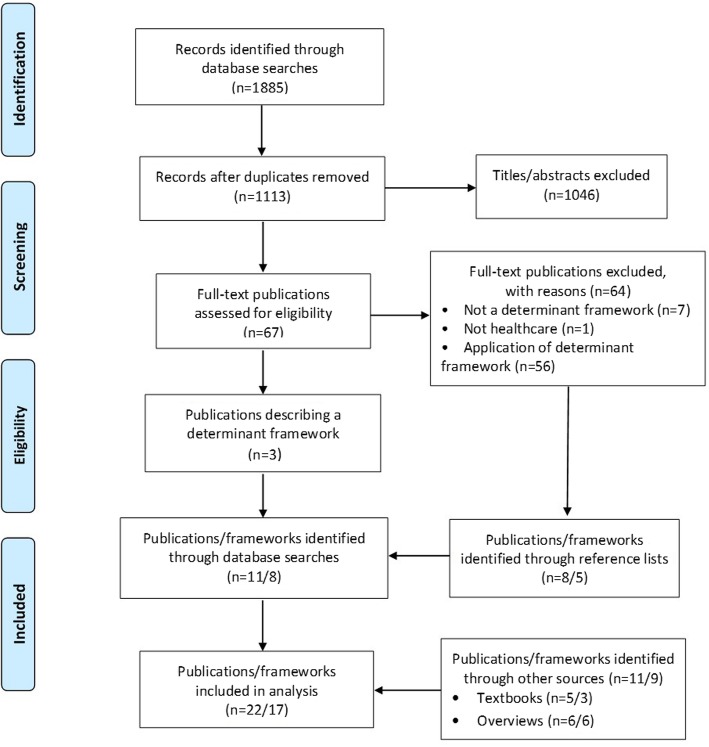
A scoping review was conducted. MEDLINE and EMBASE were searched from inception to October 2017, and supplemented with implementation science text books and known published overviews. Publications in English that described a determinant framework (theory, model, taxonomy or checklist), of which context was one determinant, were eligible. Screening and inclusion were done in duplicate. Extracted data were analysed to address the study aims. A qualitative content analysis with an inductive approach was carried out concerning the development and core context dimensions of the frameworks. The review is reported according to the PRISMA guidelines.
The database searches yielded a total of 1113 publications, of which 67 were considered potentially relevant based on the predetermined eligibility criteria, and retrieved in full text. Seventeen unique determinant frameworks were identified and included. Most were developed based on the literature and/or the developers' implementation experiences. Six of the frameworks explicitly referred to "context", but only four frameworks provided a specific definition of the concept. Instead, context was defined indirectly by description of various categories and sub-categories that together made up the context. Twelve context dimensions were identified, pertaining to different aggregation levels. The most widely addressed context dimensions were organizational support, financial resources, social relations and support, and leadership.
The findings suggest variation with regard to how the frameworks were developed and considerable inconsistency in terms used for contextual determinants, how context is conceptualized, and which contextual determinants are accounted for in frameworks used in implementation science. Common context dimensions were identified, which can facilitate research that incorporates a theory of context, i.e. assumptions about how different dimensions may influence each other and affect implementation outcomes. A thoughtful application of the concept and a more consistent terminology would enhance transparency, simplify communication among researchers, and facilitate comparison across studies.
实施科学中情境的相关性体现在众多为分析实施决定因素而提出的理论、框架、模型和分类法中(本文中称为决定因素框架)。本范围综述旨在调查和梳理实施科学中使用的决定因素框架是如何开发的,用于实施情境决定因素的术语有哪些,情境是如何被概念化的,以及可以辨别出哪些情境维度。
进行了一项范围综述。检索了从创刊到2017年10月的MEDLINE和EMBASE数据库,并补充了实施科学教科书和已知的已发表综述。纳入以英文描述的、将情境作为一个决定因素的决定因素框架(理论、模型、分类法或清单)的出版物。筛选和纳入工作由两人独立进行。对提取的数据进行分析以实现研究目的。针对框架的开发和核心情境维度进行了归纳式定性内容分析。本综述按照PRISMA指南进行报告。
数据库检索共得到1113篇出版物,其中67篇根据预先设定的纳入标准被认为可能相关,并获取了全文。确定并纳入了17个独特的决定因素框架。大多数是基于文献和/或开发者的实施经验开发的。其中六个框架明确提及“情境”,但只有四个框架对该概念给出了具体定义。相反,情境是通过描述构成情境的各种类别和子类别来间接定义的。确定了十二个情境维度,涉及不同的聚合层次。涉及最广泛的情境维度是组织支持、财务资源、社会关系与支持以及领导力。
研究结果表明,这些框架的开发方式存在差异,用于情境决定因素的术语、情境的概念化方式以及实施科学中使用的框架所涵盖的情境决定因素存在相当大的不一致性。确定了常见的情境维度,这有助于开展纳入情境理论的研究,即关于不同维度如何相互影响并影响实施结果的假设。对该概念进行深思熟虑的应用并采用更一致的术语将提高透明度,简化研究人员之间的交流,并便于跨研究进行比较。