Intensive Care Unit, London Bridge Hospital, London, UK.
School of Health and Social Care, London South Bank University, London, UK.
Nurs Crit Care. 2022 Nov;27(6):784-795. doi: 10.1111/nicc.12524. Epub 2020 Jun 29.
Targeted temperature management is the modern term for therapeutic hypothermia, where cooling is induced by intensive care clinicians to achieve body temperatures below 36°C. Its use in acute liver failure to improve refractory intracranial hypertension and patient outcomes is not supported by strong quality evidence.
This systematic review aims to determine if targeted temperature management improves patient outcome as opposed to normothermia in acute liver failure.
A computerized and systematic search of six academic and medical databases was conducted using the following keywords: "acute liver failure", "fulminant hepatic injury", "targeted temperature management", "therapeutic hypothermia", and "cooling". Broad criteria were applied to include all types of primary observational studies, from case reports to randomized controlled trials. Standardized tools were used throughout to critically appraise and extract data.
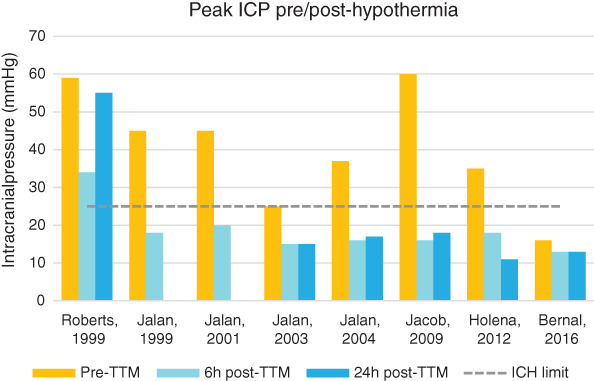
Nine studies published between 1999 and 2016 were included. Early observational studies suggest a benefit of targeted temperature management in the treatment of refractory intracranial hypertension and in survival. More recent controlled studies do not show such a benefit in the prevention of intracranial hypertension. All studies revealed that the incidence of coagulopathy is not higher in patients treated with targeted temperature management. There remains some uncertainty regarding the increased risk of infection and dysrhythmias. Heterogeneity was found between study types, design, sample sizes, and quality.
Although it does not significantly improve survival, targeted temperature management is efficient in treating episodes of intracranial hypertension and stabilizing an unstable critical care patient without increasing the risk of bleeding. It does not, however, prevent intracranial hypertension. Data heterogeneity may explain the contradictory findings.
Controlled studies are needed to elucidate the true clinical benefit of targeted temperature management in improving patient outcome.
目标温度管理是治疗性低温的现代术语,其中通过重症监护临床医生诱导冷却以实现体温低于 36°C。它在急性肝衰竭中用于改善难治性颅内高压和患者结局的应用并没有得到高质量证据的支持。
本系统评价旨在确定与正常体温相比,目标温度管理是否能改善急性肝衰竭患者的预后。
使用以下关键词对六个学术和医学数据库进行了计算机化和系统搜索:“急性肝衰竭”、“暴发性肝损伤”、“目标温度管理”、“治疗性低温”和“冷却”。应用广泛的标准纳入了所有类型的原发性观察性研究,从病例报告到随机对照试验。整个过程都使用标准化工具进行批判性评估和提取数据。
纳入了 1999 年至 2016 年期间发表的 9 项研究。早期观察性研究表明,目标温度管理在治疗难治性颅内高压和生存方面有一定益处。最近的对照研究并未显示在预防颅内高压方面有这样的益处。所有研究都表明,接受目标温度管理治疗的患者凝血功能障碍的发生率并不更高。在感染和心律失常风险增加方面仍存在一些不确定性。研究类型、设计、样本量和质量之间存在异质性。
尽管目标温度管理并没有显著提高生存率,但它在治疗颅内高压发作和稳定不稳定的重症监护患者方面非常有效,而不会增加出血风险。它并不能预防颅内高压。数据异质性可能解释了相互矛盾的发现。
需要进行对照研究来阐明目标温度管理在改善患者预后方面的真正临床益处。