Division of Landscape Ecology and Landscape Planning, Research Centre of Biosystems, Land Use and Nutrition (IFZ), Justus-Liebig-University Giessen, Giessen, Germany.
Department of Landscape Ecology, Institute for Natural Resource Conservation, Kiel University, Kiel, Germany.
PLoS One. 2020 Jun 30;15(6):e0234936. doi: 10.1371/journal.pone.0234936. eCollection 2020.
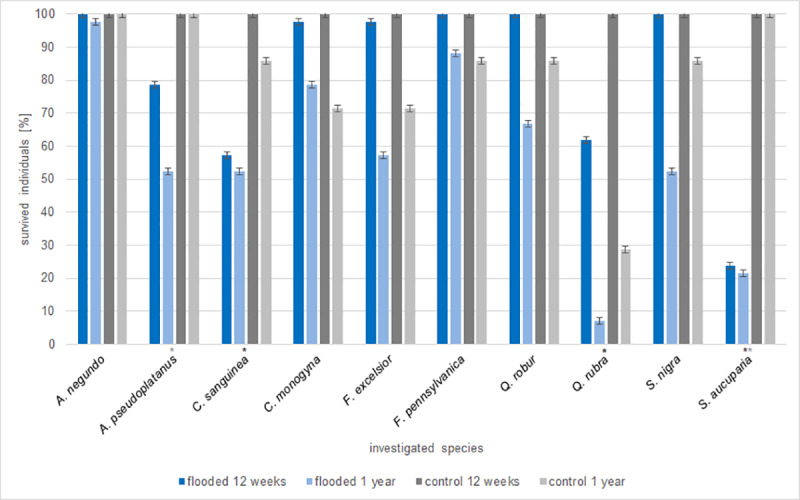
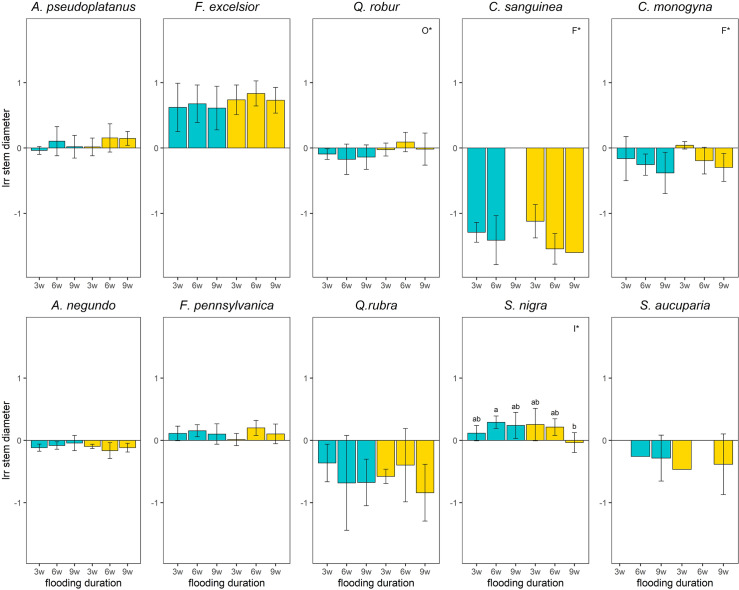
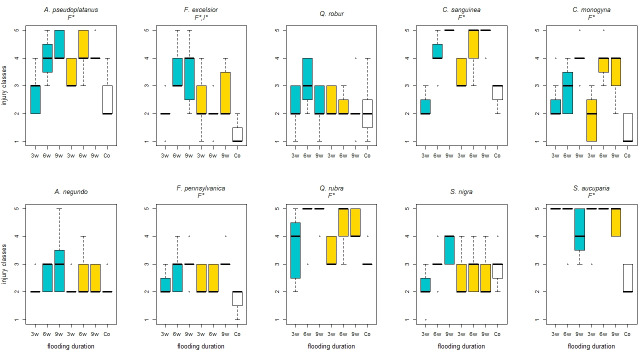
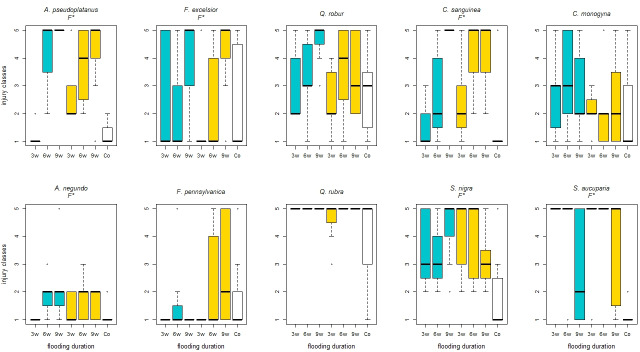
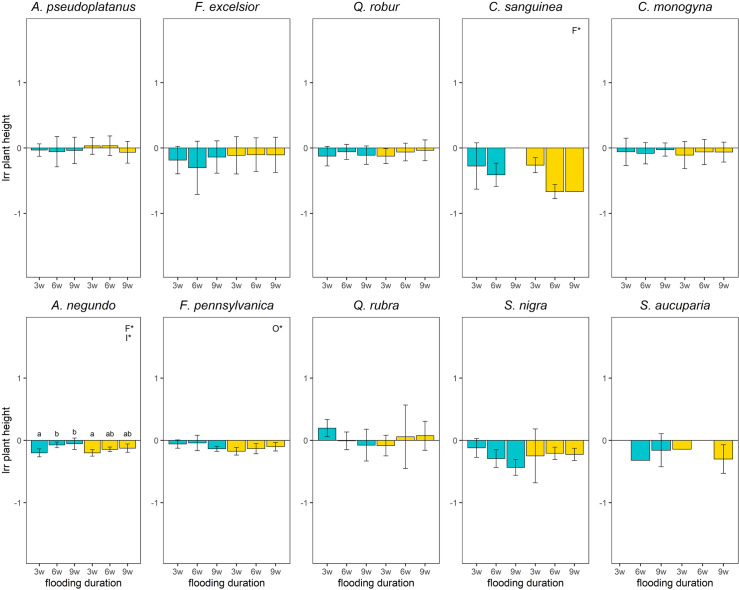
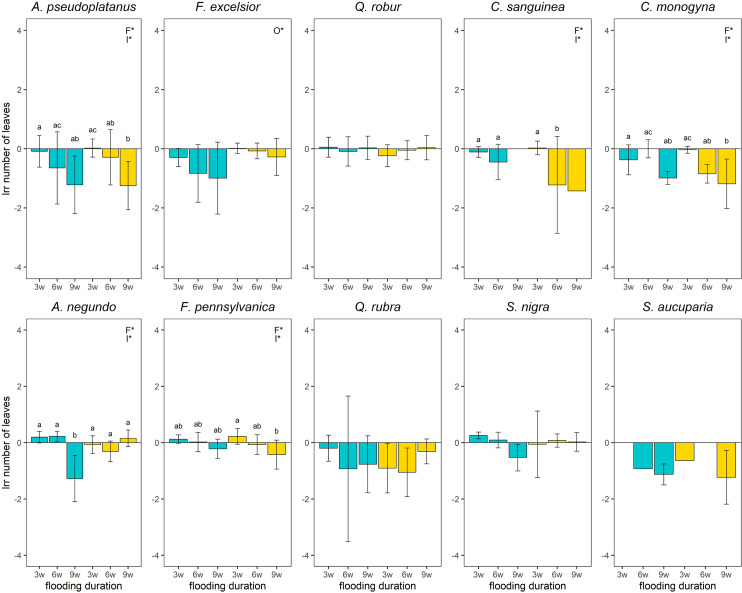
Alluvial floodplain forests have been reduced drastically in many parts of Europe, due to deforestation, the transformation to settlement and expansion of agricultural areas. Although they have been heavily modified for centuries, generalized frameworks for their management are scarce and the complex interactions between the physical environment and biological processes are often not fully understood. As the zonation of woody species in floodplains is mainly determined by hydrological conditions, flooding tolerance can be regarded as a key factor for the successful establishment of woody species. Furthermore, the oxygen level of the flooding water might affect the responses to flooding. We examined the influence of flooding duration in combination with oxygen supply by aeration on the foliar injury and growth of six-week-old saplings of ten woody species, under controlled common garden conditions. Six of them are considered to be flooding tolerant whereas four are intolerant. In addition, seven are native whereas three are non-native species. During the experiment, the saplings were exposed to partial flooding of different durations (k = 3; three, six and nine weeks) and oxygen levels (k = 2; aerated and not aerated). For comparison, we included an unflooded control. We recorded foliar injury, plant height, number of leaves and stem diameter. We also included a long-term recovery period. Whereas foliar injury decreased for most species with increasing flooding duration, the typical floodplain forest species, classified as flooding tolerant developed better. The differences in species response to flooding could be most likely explained by their ability to react to the resulting stress in morphological, physiological and metabolic terms irrespective whether they are native or not. In addition, the inclusion of a recovery period seems to be important for the assessment of flooding tolerance.
在欧洲的许多地方,由于森林砍伐、向定居点的转变以及农业区的扩张,冲积洪泛平原森林已经大大减少。尽管它们已经被人为改造了几个世纪,但针对它们的管理的通用框架仍然很少,并且物理环境和生物过程之间的复杂相互作用通常还没有被完全理解。由于洪泛平原木本物种的分带主要取决于水文条件,因此耐水淹能力可以被视为木本物种成功建立的关键因素。此外,洪水的含氧量可能会影响对洪水的响应。我们在受控的常规花园条件下,检查了结合充气供氧来改变水淹持续时间对 10 种木本植物 6 周龄幼树的叶片损伤和生长的影响。其中 6 种被认为是耐水淹的,而 4 种是不耐水淹的。此外,其中 7 种是本地种,3 种是外来种。在实验过程中,幼树分别经历了不同持续时间(k = 3;三、六和九周)和含氧量(k = 2;充气和不充气)的部分水淹。作为比较,我们还包括了一个未被水淹的对照。我们记录了叶片损伤、植物高度、叶片数量和茎直径。我们还包括了一个长期恢复期。虽然随着水淹持续时间的增加,大多数物种的叶片损伤都有所减少,但被归类为耐水淹的典型洪泛平原森林物种生长得更好。物种对洪水的反应差异最有可能归因于它们在形态、生理和代谢方面应对由此产生的压力的能力,而与它们是本地种还是外来种无关。此外,恢复期的纳入似乎对评估耐水淹能力很重要。