Mobile Health Unit, Faculty of Medicine and Life Sciences, Hasselt University, 3500 Hasselt, Belgium.
Future Health Department, Ziekenhuis Oost-Limburg, 3600 Genk, Belgium.
Sensors (Basel). 2020 Jun 26;20(12):3601. doi: 10.3390/s20123601.
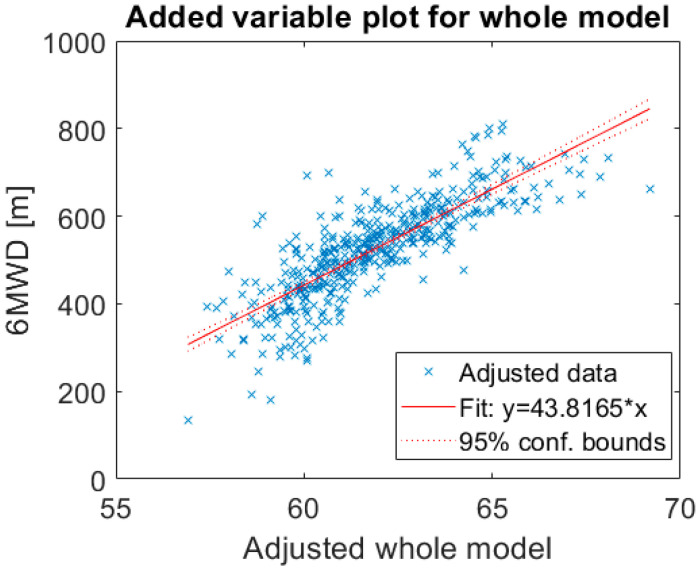
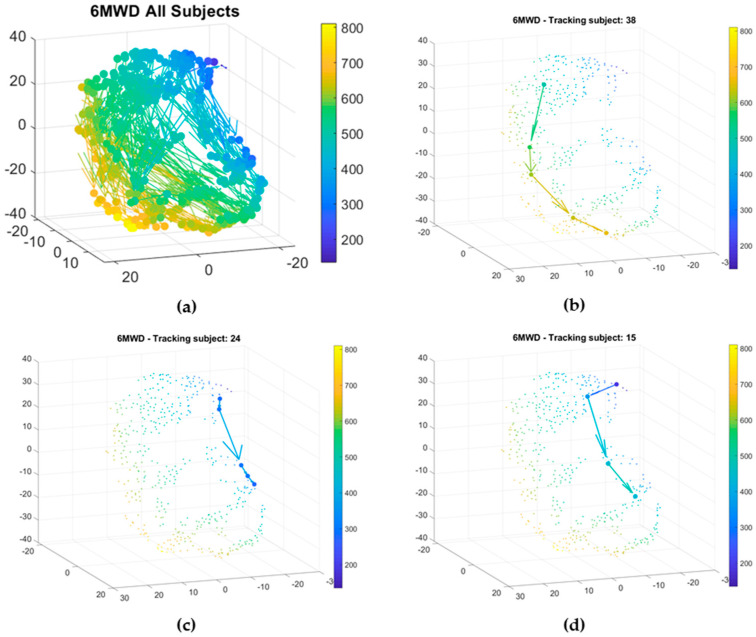
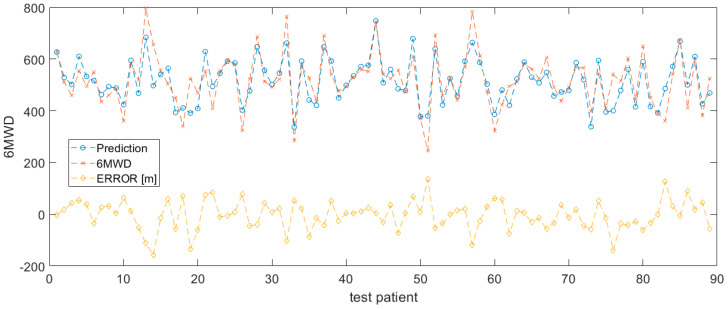
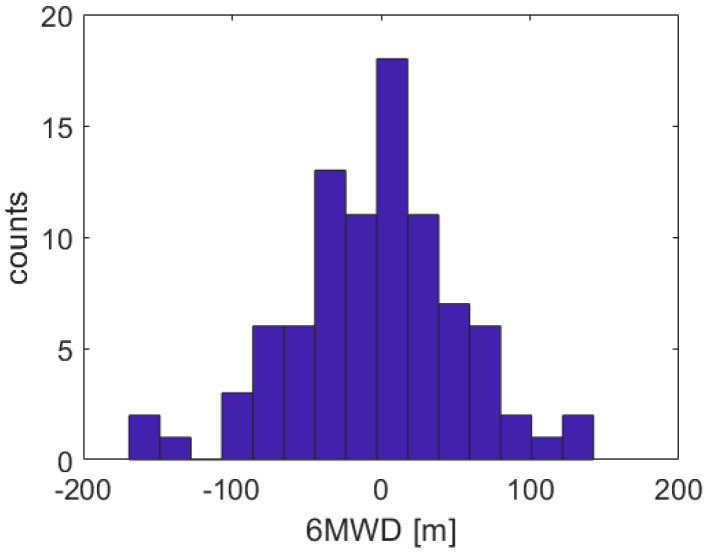
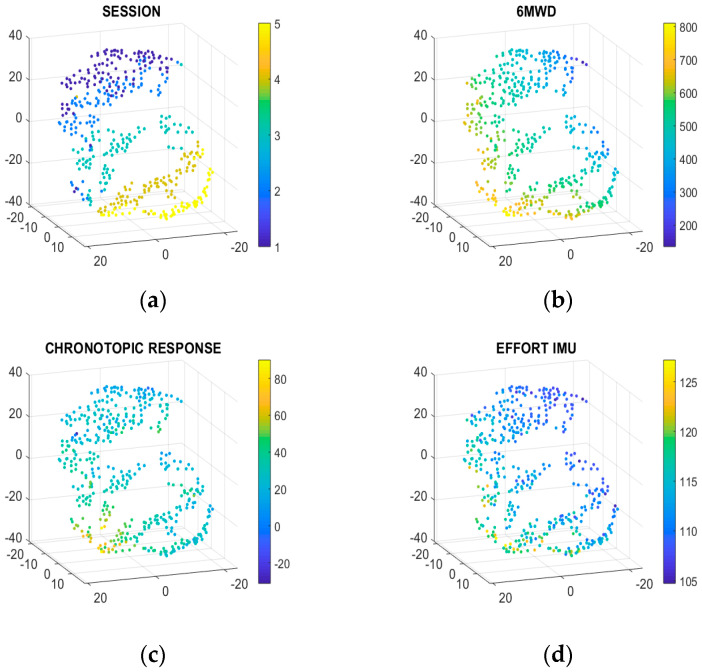
Cardiovascular diseases (CVD) are often characterized by their multifactorial complexity. This makes remote monitoring and ambulatory cardiac rehabilitation (CR) therapy challenging. Current wearable multimodal devices enable remote monitoring. Machine learning (ML) and artificial intelligence (AI) can help in tackling multifaceted datasets. However, for clinical acceptance, easy interpretability of the AI models is crucial. The goal of the present study was to investigate whether a multi-parameter sensor could be used during a standardized activity test to interpret functional capacity in the longitudinal follow-up of CR patients. A total of 129 patients were followed for 3 months during CR using 6-min walking tests (6MWT) equipped with a wearable ECG and accelerometer device. Functional capacity was assessed based on 6MWT distance (6MWD). Linear and nonlinear interpretable models were explored to predict 6MWD. The t-distributed stochastic neighboring embedding (t-SNE) technique was exploited to embed and visualize high dimensional data. The performance of support vector machine (SVM) models, combining different features and using different kernel types, to predict functional capacity was evaluated. The SVM model, using chronotropic response and effort as input features, showed a mean absolute error of 42.8 m (±36.8 m). The 3D-maps derived using the t-SNE technique visualized the relationship between sensor-derived biomarkers and functional capacity, which enables tracking of the evolution of patients throughout the CR program. The current study showed that wearable monitoring combined with interpretable ML can objectively track clinical progression in a CR population. These results pave the road towards ambulatory CR.
心血管疾病(CVD)通常具有多因素的复杂性。这使得远程监测和门诊心脏康复(CR)治疗具有挑战性。目前的可穿戴多模态设备可以实现远程监测。机器学习(ML)和人工智能(AI)可以帮助处理多方面的数据。然而,为了获得临床认可,AI 模型的易于解释性至关重要。本研究的目的是探讨多参数传感器是否可以在标准化活动测试期间使用,以在 CR 患者的纵向随访中解释功能能力。共有 129 名患者在 CR 期间使用配备可穿戴心电图和加速度计设备的 6 分钟步行测试(6MWT)进行了 3 个月的随访。功能能力基于 6MWT 距离(6MWD)进行评估。探讨了线性和非线性可解释模型来预测 6MWD。利用 t 分布随机邻域嵌入(t-SNE)技术来嵌入和可视化高维数据。评估了支持向量机(SVM)模型的性能,该模型结合了不同的特征并使用不同的核类型来预测功能能力。使用变时反应和努力作为输入特征的 SVM 模型显示出 42.8m(±36.8m)的平均绝对误差。使用 t-SNE 技术得出的 3D 地图可视化了传感器衍生生物标志物与功能能力之间的关系,这使得可以跟踪患者在整个 CR 计划中的演变。本研究表明,可穿戴监测与可解释 ML 相结合可以客观地跟踪 CR 人群中的临床进展。这些结果为门诊 CR 铺平了道路。