Data First Consulting, Inc., Sebastopol, CA 95472, USA.
Centro de Investigación en Enfermedades Infecciosas, Instituto Nacional de Enfermedades Respiratorias, Mexico City 14080, Mexico.
Viruses. 2020 Jun 27;12(7):694. doi: 10.3390/v12070694.
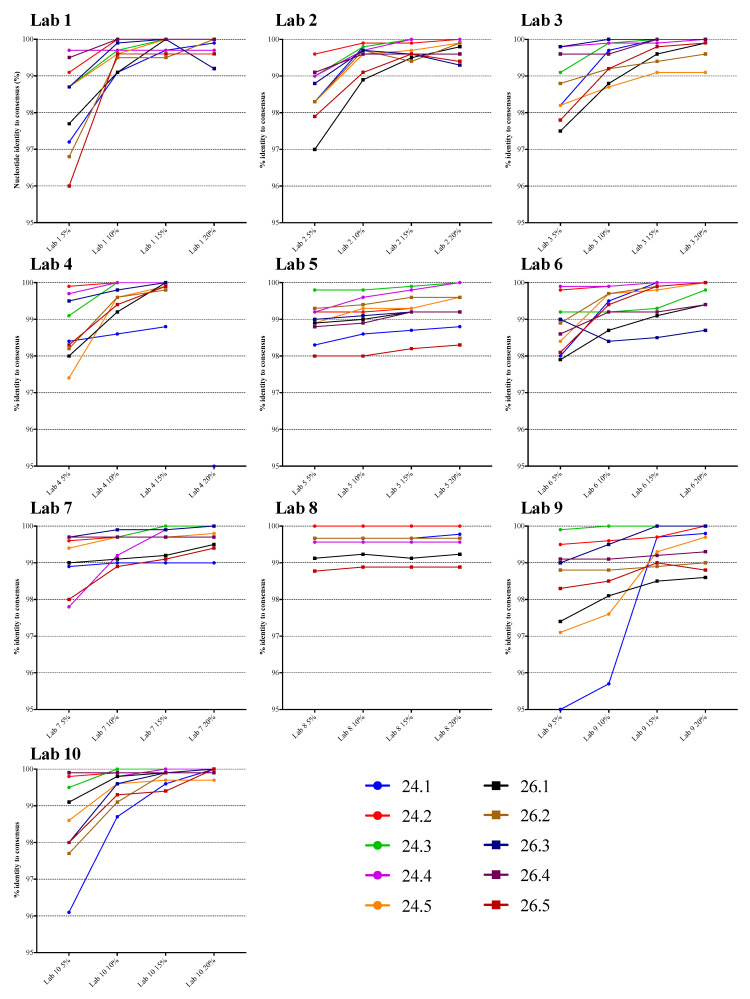
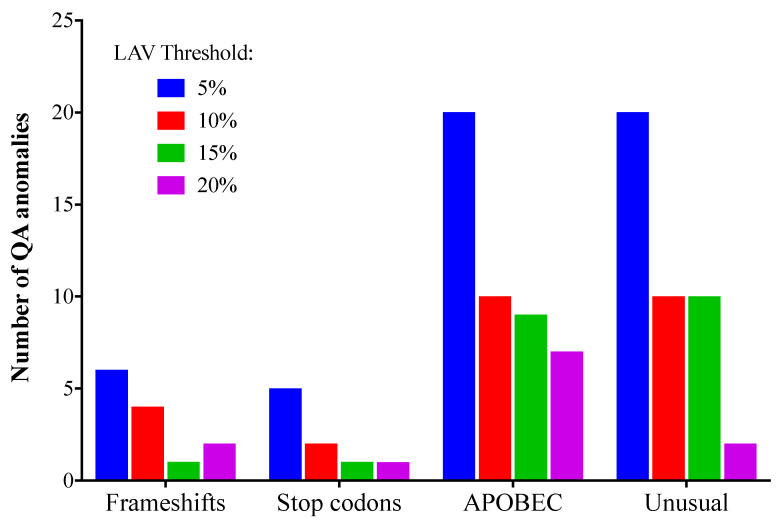
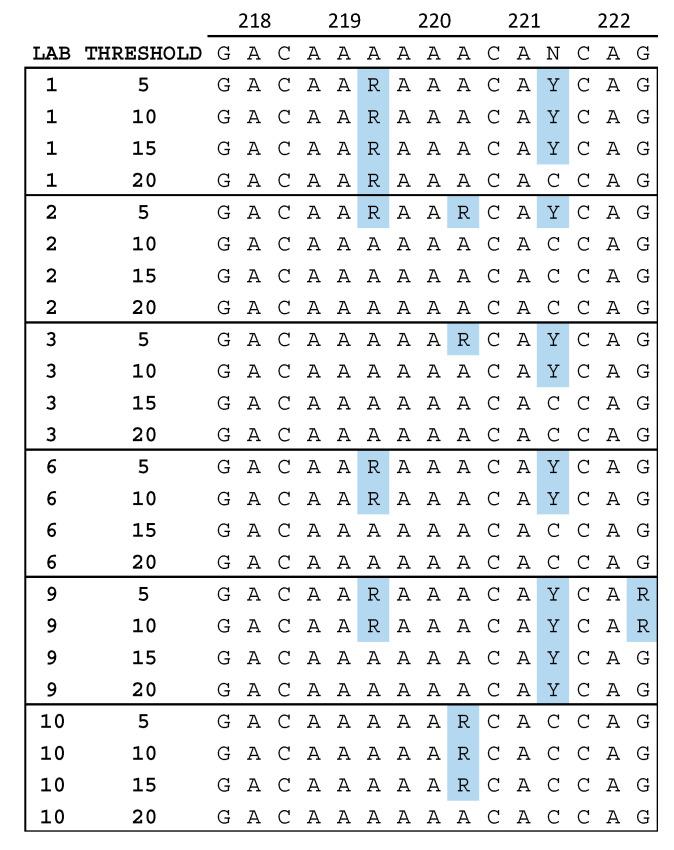
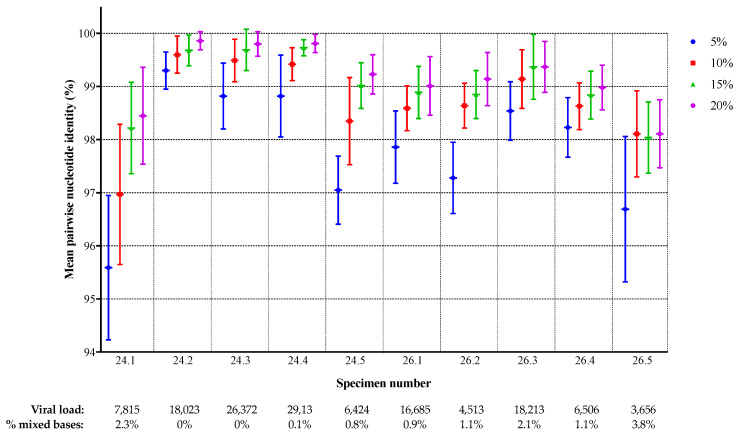
Next-generation sequencing (NGS) is increasingly used for HIV-1 drug resistance genotyping. NGS methods have the potential for a more sensitive detection of low-abundance variants (LAV) compared to standard Sanger sequencing (SS) methods. A standardized threshold for reporting LAV that generates data comparable to those derived from SS is needed to allow for the comparability of data from laboratories using NGS and SS. Ten HIV-1 specimens were tested in ten laboratories using Illumina MiSeq-based methods. The consensus sequences for each specimen using LAV thresholds of 5%, 10%, 15%, and 20% were compared to each other and to the consensus of the SS sequences (protease 4-99; reverse transcriptase 38-247). The concordance among laboratories' sequences at different thresholds was evaluated by pairwise sequence comparisons. NGS sequences generated using the 20% threshold were the most similar to the SS consensus (average 99.6% identity, range 96.1-100%), compared to 15% (99.4%, 88.5-100%), 10% (99.2%, 87.4-100%), or 5% (98.5%, 86.4-100%). The average sequence identity between laboratories using thresholds of 20%, 15%, 10%, and 5% was 99.1%, 98.7%, 98.3%, and 97.3%, respectively. Using the 20% threshold, we observed an excellent agreement between NGS and SS, but significant differences at lower thresholds. Understanding how variation in NGS methods influences sequence quality is essential for NGS-based HIV-1 drug resistance genotyping.
下一代测序(NGS)越来越多地用于 HIV-1 耐药基因型分析。与标准 Sanger 测序(SS)方法相比,NGS 方法在检测低丰度变异体(LAV)方面具有更高的灵敏度。需要建立一个报告 LAV 的标准化阈值,以便能够比较使用 NGS 和 SS 的实验室的数据,同时产生与 SS 数据可比的数据。我们使用基于 Illumina MiSeq 的方法在十个实验室中对十份 HIV-1 样本进行了测试。使用 LAV 阈值为 5%、10%、15%和 20%的每个样本的共识序列与其他样本的共识序列和 SS 序列(蛋白酶 4-99;逆转录酶 38-247)进行了比较。通过两两序列比较评估了不同阈值下实验室序列之间的一致性。与 SS 共识相比,使用 20%阈值生成的 NGS 序列最相似(平均同一性为 99.6%,范围为 96.1-100%),与 15%(99.4%,88.5-100%)、10%(99.2%,87.4-100%)或 5%(98.5%,86.4-100%)相比。使用 20%、15%、10%和 5%阈值的实验室之间的平均序列同一性分别为 99.1%、98.7%、98.3%和 97.3%。使用 20%的阈值,我们观察到 NGS 和 SS 之间具有极好的一致性,但在较低的阈值下存在显著差异。了解 NGS 方法的变化如何影响序列质量对于基于 NGS 的 HIV-1 耐药基因型分析至关重要。