Department of Psychiatry, Hospital Gregorio Marañón; Medical School, Universidad Complutense de Madrid, Doctor Esquerdo 46, 28007, Madrid, Spain.
Adult Psychiatry Service and Geneva Penal Medicine Division, Geneva University Hospitals, Puplinge, Switzerland.
BMC Psychiatry. 2020 Jun 30;20(1):339. doi: 10.1186/s12888-020-02756-0.
Determining the mental capacity of psychiatric patients for making healthcare related decisions is crucial in clinical practice. This meta-review of review articles comprehensively examines the current evidence on the capacity of patients with a mental illness to make medical care decisions.
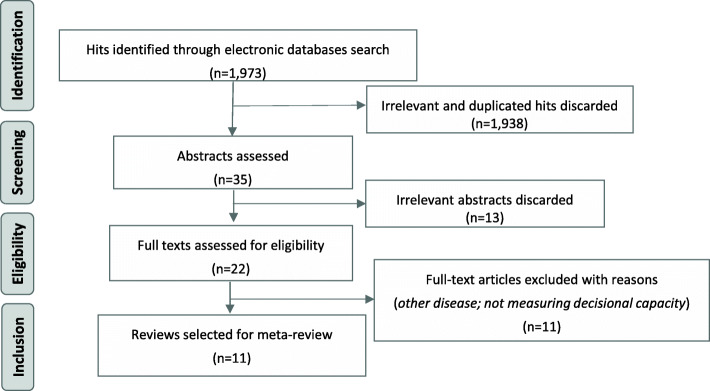
Systematic review of review articles following PRISMA recommendations. PubMed, Scopus, CINAHL and PsycInfo were electronically searched up to 31 January 2020. Free text searches and medical subject headings were combined to identify literature reviews and meta-analyses published in English, and summarising studies on the capacity of patients with serious mental illnesses to make healthcare and treatment related decisions, conducted in any clinical setting and with a quantitative synthesis of results. Publications were selected as per inclusion and exclusion criteria. The AMSTAR II tool was used to assess the quality of reviews.
Eleven publications were reviewed. Variability on methods across studies makes it difficult to precisely estimate the prevalence of decision-making capacity in patients with mental disorders. Nonetheless, up to three-quarters of psychiatric patients, including individuals with serious illnesses such as schizophrenia or bipolar disorder may have capacity to make medical decisions in the context of their illness. Most evidence comes from studies conducted in the hospital setting; much less information exists on the healthcare decision making capacity of mental disorder patients while in the community. Stable psychiatric and non-psychiatric patients may have a similar capacity to make healthcare related decisions. Patients with a mental illness have capacity to judge risk-reward situations and to adequately decide about the important treatment outcomes. Different symptoms may impair different domains of the decisional capacity of psychotic patients. Decisional capacity impairments in psychotic patients are temporal, identifiable, and responsive to interventions directed towards simplifying information, encouraging training and shared decision making. The publications complied satisfactorily with the AMSTAR II critical domains.
Whilst impairments in decision-making capacity may exist, most patients with a severe mental disorder, such as schizophrenia or bipolar disorder are able to make rational decisions about their healthcare. Best practice strategies should incorporate interventions to help mentally ill patients grow into the voluntary and safe use of medications.
在临床实践中,确定精神病患者做出与医疗保健相关决策的能力至关重要。本综述综述了评估患有精神疾病的患者做出医疗保健决策能力的现有证据。
根据 PRISMA 建议对综述文章进行系统综述。电子检索了 PubMed、Scopus、CINAHL 和 PsycInfo,截至 2020 年 1 月 31 日。通过自由文本搜索和医学主题词相结合,确定了以英文发表的文献综述和荟萃分析,以及总结了在任何临床环境中对严重精神疾病患者进行医疗和治疗相关决策能力的研究,并且对结果进行了定量综合。根据纳入和排除标准选择出版物。使用 AMSTAR II 工具评估综述的质量。
共审查了 11 篇文献。由于研究方法的变异性,很难准确估计精神障碍患者决策能力的患病率。尽管如此,高达四分之三的精神病患者,包括患有精神分裂症或双相情感障碍等严重疾病的患者,在其疾病背景下可能有能力做出医疗决策。大多数证据来自医院环境中的研究;关于精神障碍患者在社区中的医疗保健决策能力的信息则要少得多。稳定的精神和非精神障碍患者可能具有相似的能力做出与医疗相关的决策。精神障碍患者有能力判断风险回报情况,并充分决定重要的治疗结果。不同的症状可能会损害精神病患者决策能力的不同领域。精神障碍患者的决策能力障碍是暂时的、可识别的,并且可以通过干预措施来改善,这些干预措施旨在简化信息、鼓励培训和共同决策。发表的文献符合 AMSTAR II 的关键标准。
尽管可能存在决策能力受损的情况,但大多数患有严重精神障碍(如精神分裂症或双相情感障碍)的患者能够对其医疗保健做出合理的决策。最佳实践策略应包括干预措施,以帮助精神病患者自愿且安全地使用药物。