Sokołowski Andrzej, Tyburski Ernest, Sołtys Anna, Karabanowicz Ewa
Department of Neurology, Memory and Aging Center, UCSF Weill Institute for Neurosciences, University of California SanFrancisco, San Francisco, USA1.
Faculty of Psychology, University of Warsaw, Warsaw, Poland2.
Adv Cogn Psychol. 2020 Apr 9;16(2):92-102. doi: 10.5709/acp-0288-1. eCollection 2020.
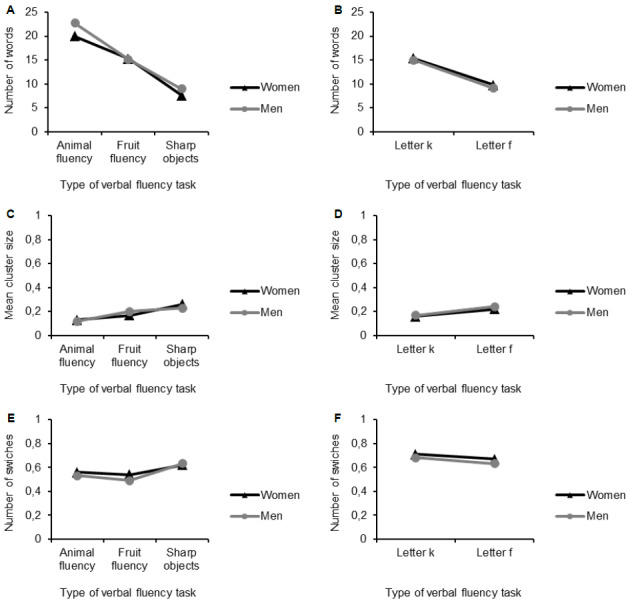
Verbal fluency tasks have been used as tools to measure various cognitive processes, such as executive functions, memory, and language. Sex differences in verbal fluency performance have been mostly investigated in population studies. Little of this research has focused on young adults. The goal of this study was to assess the impact of sex and task category on word production and verbal strategies (i.e., cluster size and switches) in young adults. The phonemic (letter "k", letter "f") and semantic (animals, fruits, sharp objects) fluency measures were used. Men and women were compared in terms of the number of produced words and the use of verbal strategies (number of switches and mean cluster size controlled for produced words). Results revealed subtle sex differences in verbal fluency in young adults. Men performed slightly better in semantic fluency, producing more words, while there were no sex differences in verbal strategies. There were also no sex differences in word production and verbal strategies in the phonemic fluency tasks. Furthermore, there were differences in the number of produced words, mean cluster sizes, and switches between semantic tasks as well as between phonemic tasks. These results can be interpreted in the context of potential differences in mental lexicon and social roles. Moreover, our results suggest that assessment of verbal strategies and overall word production may be important in the context of sex differences in verbal fluency among young adults as well as in neuropsychological diagnosis.
言语流畅性任务已被用作测量各种认知过程的工具,如执行功能、记忆和语言。言语流畅性表现中的性别差异大多在人群研究中进行了调查。这项研究很少关注年轻人。本研究的目的是评估性别和任务类别对年轻人单词生成和言语策略(即聚类大小和转换)的影响。使用了音素(字母“k”、字母“f”)和语义(动物、水果、尖锐物体)流畅性测量方法。比较了男性和女性在生成单词数量和言语策略使用方面的差异(控制生成单词数量后的转换次数和平均聚类大小)。结果显示年轻人在言语流畅性方面存在细微的性别差异。男性在语义流畅性方面表现略好,生成的单词更多,而在言语策略方面没有性别差异。在音素流畅性任务中,单词生成和言语策略也没有性别差异。此外,语义任务之间以及音素任务之间在生成单词数量、平均聚类大小和转换方面存在差异。这些结果可以在心理词典和社会角色潜在差异的背景下进行解释。此外,我们的结果表明,在年轻人言语流畅性的性别差异背景下以及神经心理学诊断中,评估言语策略和总体单词生成可能很重要。