Department of Neurosurgery, Karolinska University Hospital, Stockholm, Sweden.
Department of Clinical Neuroscience, Karolinska Institutet, Bioclinicum J5:20, 171 64, Solna, Stockholm, Sweden.
Neurocrit Care. 2021 Apr;34(2):635-656. doi: 10.1007/s12028-020-01037-8.
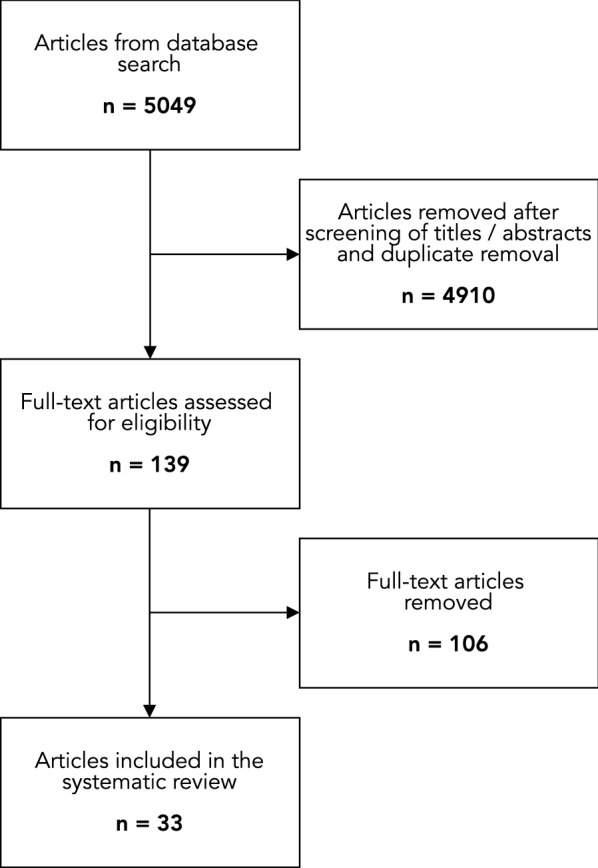
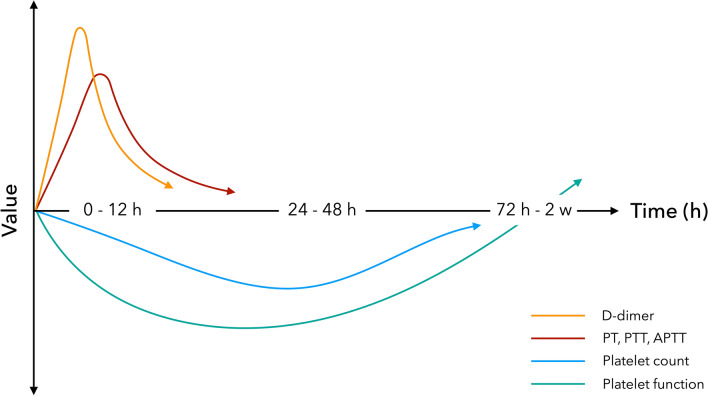
Almost two-thirds of patients with severe traumatic brain injury (TBI) develop some form of hemostatic disturbance, which contributes to poor outcome. While the initial head injury often leads to impaired clot formation, TBI is also associated with an increased risk of thrombosis. Most likely there is a progression from early bleeding to a later prothrombotic state. In this paper, we systematically review the literature on the time course of hemostatic disruptions following TBI. A MEDLINE search was performed for TBI studies reporting the trajectory of hemostatic assays over time. The search yielded 5,049 articles, of which 4,910 were excluded following duplicate removal as well as title and abstract review. Full-text assessment of the remaining articles yielded 33 studies that were included in the final review. We found that the first hours after TBI are characterized by coagulation cascade dysfunction and hyperfibrinolysis, both of which likely contribute to lesion progression. This is then followed by platelet dysfunction and decreased platelet count, the clinical implication of which remains unclear. Later, a poorly defined prothrombotic state emerges, partly due to fibrinolysis shutdown and hyperactive platelets. In the clinical setting, early administration of the antifibrinolytic agent tranexamic acid has proved effective in reducing head-injury-related mortality in a subgroup of TBI patients. Further studies evaluating the time course of hemostatic disruptions after TBI are warranted in order to identify windows of opportunity for potential treatment options.
约三分之二的严重创伤性脑损伤 (TBI) 患者会出现某种形式的止血紊乱,这会导致不良预后。虽然初始头部损伤通常会导致凝血形成受损,但 TBI 也与血栓形成风险增加有关。很可能是从早期出血进展到后期的促血栓状态。本文系统地回顾了 TBI 后止血紊乱时间过程的文献。对报告止血检测随时间变化轨迹的 TBI 研究进行了 MEDLINE 检索。该检索产生了 5049 篇文章,其中 4910 篇在重复去除以及标题和摘要审查后被排除。对剩余文章的全文评估产生了 33 项研究,这些研究被纳入最终综述。我们发现,TBI 后的最初几个小时以凝血级联功能障碍和纤维蛋白溶解亢进为特征,这两者都可能导致病变进展。随后是血小板功能障碍和血小板计数减少,其临床意义尚不清楚。后来,出现了一种定义不明确的促血栓状态,部分原因是纤维蛋白溶解关闭和血小板过度活跃。在临床环境中,早期使用抗纤维蛋白溶解剂氨甲环酸已被证明可有效降低 TBI 患者亚组的头部损伤相关死亡率。进一步研究评估 TBI 后止血紊乱的时间过程对于确定潜在治疗选择的机会窗口是必要的。