Rafael Ricardo de Mattos Russo, Neto Mercedes, Depret Davi Gomes, Gil Adriana Costa, Fonseca Mary Hellem Silva, Souza-Santos Reinaldo
Universidade do Estado do Rio de Janeiro, Faculdade de Enfermagem, Rio de Janeiro, RJ, Brazil.
Scholarship holder at the Universidade do Estado do Rio de Janeiro, Centro de Estudos e Pesquisas em Saúde Coletiva (CEPESC), Rio de Janeiro, RJ, Brazil.
Rev Lat Am Enfermagem. 2020 Jun 26;28:e3344. doi: 10.1590/1518-8345.4475.3344. eCollection 2020.
to analyze the relationship between per capita income and the cumulative incidence of COVID-19 in the neighborhoods of the city of Rio de Janeiro, RJ, Brazil.
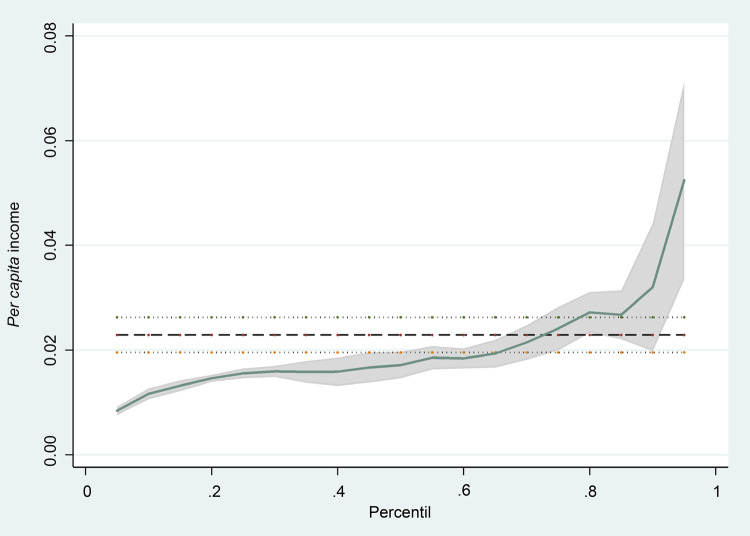
an ecological study using neighborhoods as units of analysis. The cumulative incidence rate per 100,000 inhabitants and the median of potential confounding variables (sex, race, and age) were calculated. Multiple analysis included quantile regression, estimating the regression coefficients of the variable income for every five percentiles from the 10th to 90th percentiles to verify the relationship between income and incidence.
the city's rate was 36.58 new cases per 100,000 inhabitants. In general, the highest rates were observed in the wealthiest regions. Multiple analysis was consistent with this observation since the per capita income affected all percentiles analyzed, with a median regression coefficient of 0.02 (p-value <0.001; R2 32.93). That is, there is an increase of R$ 0.02 in the neighborhood's per capita income for every unit of incidence.
cumulative incident rates of COVID-19 are influenced by one's neighborhood of residency, suggesting that access to testing is uneven.
分析巴西里约热内卢市各社区人均收入与新冠病毒病累计发病率之间的关系。
采用以社区为分析单位的生态学研究。计算每10万居民的累计发病率以及潜在混杂变量(性别、种族和年龄)的中位数。多因素分析包括分位数回归,估计从第10百分位数到第90百分位数每五个百分点的收入变量的回归系数,以验证收入与发病率之间的关系。
该市发病率为每10万居民36.58例新发病例。总体而言,在最富裕地区观察到最高发病率。多因素分析与这一观察结果一致,因为人均收入影响所有分析的百分位数,中位数回归系数为0.02(p值<0.001;R2 32.93)。也就是说,发病率每增加一个单位,社区人均收入增加0.02雷亚尔。
新冠病毒病的累计发病率受居住社区的影响,这表明检测机会不均等。