Stein Eye Institute, David Geffen School of Medicine at UCLA, Los Angeles, CA, United States of America.
Ophthalmic Oncology Service, Memorial Sloan-Kettering Cancer Center, New York, NY, United States of America.
PLoS One. 2020 Jul 1;15(7):e0235016. doi: 10.1371/journal.pone.0235016. eCollection 2020.
Intravitreal melphalan injections are commonly used in the treatment for intraocular retinoblastoma. This study compares retinal toxicity and ocular survival between two formulations, with and without propylene glycol (Alkeran vs. Evomela, respectively).
A retrospective cohort study of retinoblastoma patients who received intravitreal injections of Alkeran and Evomela at 30 μg from September 2012 to January 2019 at a single tertiary care center were enrolled. Retinal toxicity was measured using electroretinogram (ERG) and compared using a multivariate analysis of 338 injections in 101 eyes of 96 patients. Ocular survival of 163 eyes in 150 patients was compared across formulations using Cox proportional hazards model. Eyes were censored at the time a patient received a dose other than 30 μg.
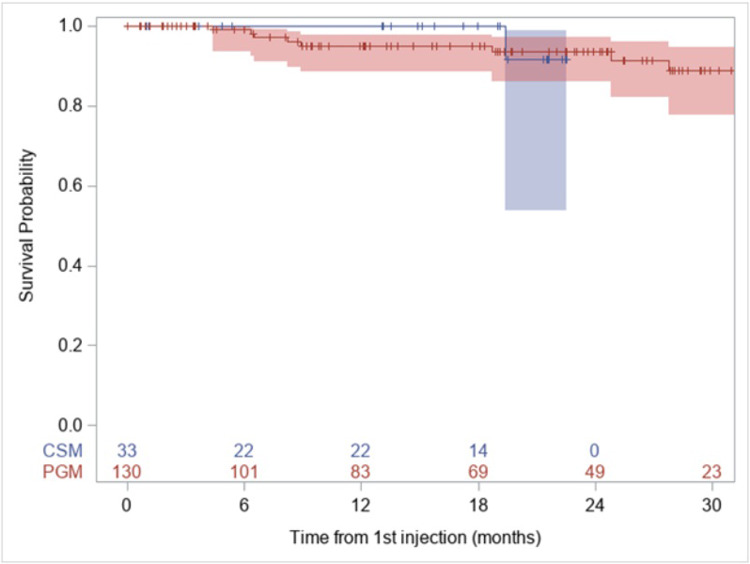
Overall, ERG decline (mean, 95% CI) for each injection was -5.58 μV (-7.17, -3.99). No significant differences in ERG decrement were found between Alkeran (with alcohol) -5.52uV (-6.99, -4.05). and Evomela (without alcohol) -5.65uV (-8.31 to -2.98) formulations (p = 0.93). Ocular survival at 24 months was 93.6% (95% CI 86.2, 97.1) with alcohol and 91.7% (95% CI 53.9, 98.8) without alcohol. The hazard ratio (HR) for without vs with alcohol was 0.50 (95% CI 0.06 to 4.07); no significant difference in ocular survival was found between formulations (p = 0.52).
No differences were found in retinal toxicity and ocular survival between 30 μg intravitreal injections of Alkeran or Evomela for intraocular retinoblastoma. Given the increased stability of Evomela, intravitreal treatment could be expanded to centers without the ability to supply Alkeran due to its shorter safety window; however, Alkeran is less expensive. For those with existing infrastructure, Alkeran is a comparable, cost-effective alternative.
玻璃体内注射马法兰常用于治疗眼内视网膜母细胞瘤。本研究比较了两种制剂(含丙二醇的 Alkeran 和不含丙二醇的 Evomela)的视网膜毒性和眼存活率。
回顾性队列研究纳入了 2012 年 9 月至 2019 年 1 月期间,在一家三级医疗中心接受 30μg 玻璃体内注射 Alkeran 和 Evomela 的视网膜母细胞瘤患者。使用视网膜电图(ERG)测量视网膜毒性,并通过对 96 例患者的 101 只眼的 338 次注射进行多变量分析进行比较。使用 Cox 比例风险模型比较两种制剂的 163 只眼的眼存活率。当患者接受 30μg 以外的剂量时,将眼进行删失。
总体而言,每次注射的 ERG 下降(平均值,95%CI)为-5.58μV(-7.17,-3.99)。Alkeran(含酒精)-5.52μV(-6.99,-4.05)和 Evomela(不含酒精)-5.65μV(-8.31 至-2.98)制剂之间的 ERG 下降无显著差异(p=0.93)。含酒精的眼存活率为 24 个月时为 93.6%(95%CI 86.2,97.1),无酒精的眼存活率为 91.7%(95%CI 53.9,98.8)。无酒精与含酒精的风险比(HR)为 0.50(95%CI 0.06 至 4.07);两种制剂的眼存活率无显著差异(p=0.52)。
玻璃体内注射 30μg Alkeran 或 Evomela 治疗眼内视网膜母细胞瘤,在视网膜毒性和眼存活率方面无差异。鉴于 Evomela 的稳定性增加,如果由于安全窗口较短而无法供应 Alkeran,则可以将眼内治疗扩展到没有供应能力的中心;然而,Alkeran 的价格更低。对于那些已经具备基础设施的机构,Alkeran 是一种具有成本效益的替代药物。