University of Utrecht, Institute for Risk Assessment Sciences, Utrecht, The Netherlands.
Julius Center for Health Sciences and Primary Care, University Medical Center Utrecht (UMCU), Utrecht, The Netherlands.
PLoS One. 2020 Jul 1;15(7):e0234845. doi: 10.1371/journal.pone.0234845. eCollection 2020.
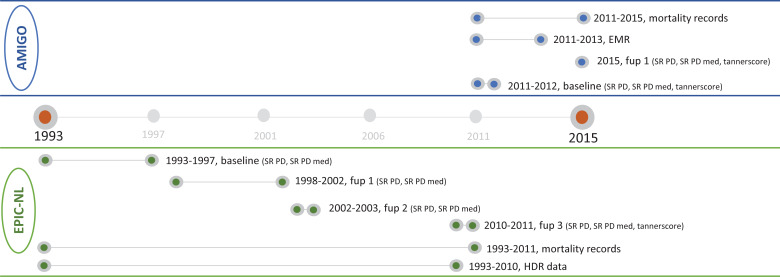
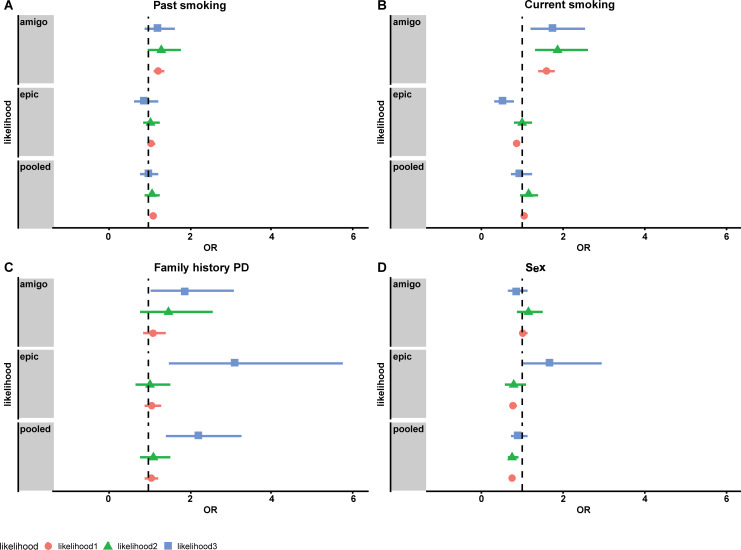
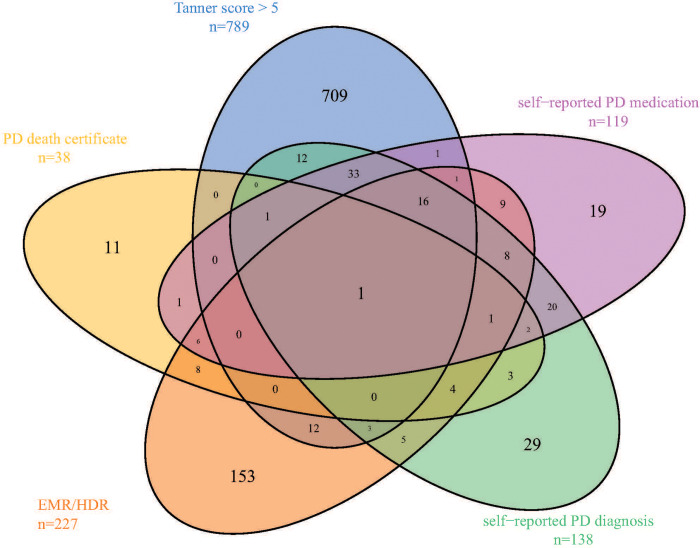
Epidemiological evidence from prospective cohort studies on risk factors of Parkinson's disease (PD) is limited as case ascertainment is challenging due to a lack of registries and the disease course of PD. The objective of this study was to create a case ascertainment method for PD within two prospective Dutch cohorts based on multiple sources of PD information. This method was validated using clinical records from the general practitioners (GPs). Face validity of the case ascertainment was tested for three etiological factors (smoking, sex and family history of PD). In total 54825 participants were included from the cohorts AMIGO and EPIC-NL. Sources of PD information included self-reported PD, self-reported PD medication, a 9 item screening questionnaire (Tanner), electronical medical records, hospital discharge data and mortality records. Based on these sources we developed a likelihood score with 4 categories (no PD, unlikely PD, possible PD, likely PD). For the different sources of PD information and for the likelihood score we present the agreement with GP-validated cases. Risk of PD for established factors was studied by logistic regression as exact diagnose dates were not always available. Based on the algorithm, we assigned 346 participants to the likely PD category. GP validation confirmed 67% of these participants in EPIC-NL, but only 12% in AMIGO. PD was confirmed in only 3% of the participants with a possible PD classification. PD case ascertainment by mortality records (91%), EMR ICPC (82%) and self-reported information (62-69%) had the highest confirmation rates. The Tanner PD screening questionnaire had a lower agreement (18%). Risk estimates for smoking, family history and sex using all likely PD cases were comparable to the literature for EPIC-NL, but not for smoking in AMIGO. Using multiple sources of PD evidence in cohorts remains important but challenging as performance of sources varied in validity.
前瞻性队列研究对帕金森病(PD)危险因素的流行病学证据有限,因为缺乏登记处和 PD 疾病的过程,因此病例确定具有挑战性。本研究的目的是基于 PD 的多个信息来源,在两个前瞻性荷兰队列中创建 PD 的病例确定方法。该方法使用来自全科医生(GP)的临床记录进行了验证。使用三个病因因素(吸烟,性别和 PD 家族史)对病例确定的表面有效性进行了测试。总共从 AMIGO 和 EPIC-NL 队列中纳入了 54825 名参与者。PD 信息来源包括自我报告的 PD,自我报告的 PD 药物,9 项筛查问卷(Tanner),电子病历,住院数据和死亡率记录。基于这些来源,我们开发了一个具有 4 个类别的可能性评分(无 PD,不太可能 PD,可能 PD,很可能 PD)。对于不同的 PD 信息来源和可能性评分,我们均展示了与 GP 验证病例的一致性。由于并非总是可以获得确切的诊断日期,因此通过逻辑回归研究了 PD 的风险因素。基于该算法,我们将 346 名参与者分配到可能 PD 类别。在 EPIC-NL 中,GP 验证证实了其中 67%的参与者,而在 AMIGO 中仅证实了 12%的参与者。在可能 PD 分类的参与者中,仅确认了 3%的 PD。死亡率记录(91%),EMR ICPC(82%)和自我报告信息(62-69%)的 PD 病例确定具有最高的确认率。Tanner PD 筛查问卷的一致性较低(18%)。使用所有可能 PD 病例进行的吸烟,家族史和性别的风险估计值与 EPIC-NL 的文献值相当,但在 AMIGO 中,吸烟则不然。在队列中使用 PD 的多个信息来源仍然很重要,但具有挑战性,因为来源的有效性各不相同。