Sarapultseva Maria, Yarushina Maria, Kritsky Igor, Ibragimov Roman, Sarapultsev Alexey
Department of Pediatric Dentistry, Medical Firm Vital EVV, Ekaterinburg, Russia.
Institute of Immunology and Physiology, Ural Branch, Russian Academy of Sciences, Ekaterinburg, Russia.
Eur J Dent. 2020 Oct;14(4):621-625. doi: 10.1055/s-0040-1714035. Epub 2020 Jul 1.
Children's dental fear may lead to an avoidance of seeking dental care or disruptive behavior during treatment. The study was aimed to evaluate the prevalence and scores of dental fear and anxiety (DFA) among Russian children of different ages with an experience of dental treatment.
The cross-sectional study included 371 children aged 2 to 17 years. Study participants were divided into three groups according to their age: 112 "preschool children" aged 2 to 5 years, 137 "school children" aged 6 to 11 years, and 122 "adolescents" aged 12 to 18 years. The questionnaires were distributed at reception areas of the dental clinic to parents of children aged 2 to 5 years and to the older children themselves.
Data analysis was performed using SPSS version 15.0. The parametric tests were used (one-way ANOVA, Student's t-test, and Pearson's correlation) because of the expected sample of more than 100 observations. The chi-square test was used for categorical variables.
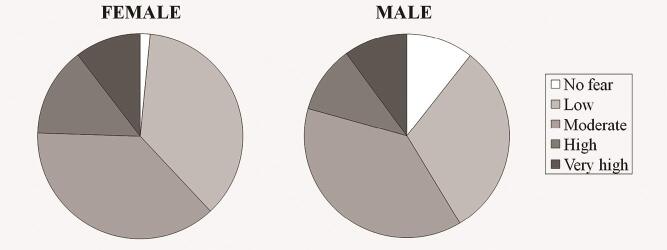
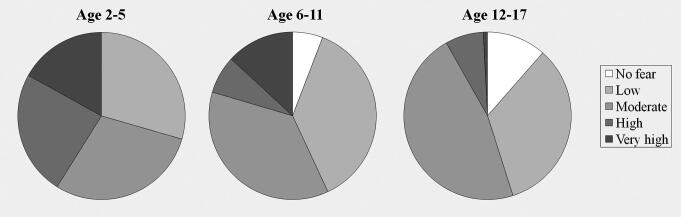
The data have shown that 93.8% of the Russian child population visiting dental offices suffer mostly from moderate (11.85) levels of DFA. DFA was more often revealed in girls and among the youngest children aged 2 to 5 years.
According to the obtained results, children were more afraid of "tooth drilling" and an "injection of local anesthetic" than other factors mentioned in the questionnaires. Fear of dental treatment is common among Russian children, and the factors associated with it differ with the gender and age of the child.
儿童的牙科恐惧可能导致其避免寻求牙科护理或在治疗期间出现破坏性行为。本研究旨在评估有牙科治疗经历的不同年龄段俄罗斯儿童的牙科恐惧和焦虑(DFA)患病率及得分情况。
这项横断面研究纳入了371名年龄在2至17岁的儿童。研究参与者根据年龄分为三组:112名2至5岁的“学龄前儿童”、137名6至11岁的“学龄儿童”和122名12至18岁的“青少年”。问卷在牙科诊所的接待区分发给2至5岁儿童的家长以及年龄较大的儿童本人。
使用SPSS 15.0版本进行数据分析。由于预期样本量超过100例观察对象,因此使用了参数检验(单因素方差分析、学生t检验和皮尔逊相关性分析)。卡方检验用于分类变量。
数据显示,前往牙科诊所就诊的俄罗斯儿童中有93.8%主要患有中度(11.85)水平的DFA。DFA在女孩以及2至5岁的最小儿童中更为常见。
根据所得结果,与问卷中提到的其他因素相比,儿童更害怕“牙齿钻孔”和“局部麻醉注射”。牙科治疗恐惧在俄罗斯儿童中很常见,并且与之相关的因素因儿童的性别和年龄而异。