Gao Shuo, Lu Jiaxuan, Li Pei, Yu Dongsheng, Zhao Wei
Department of Pediatric Dentistry, Hospital of Stomatology, Guanghua School of Stomatology, Guangdong Provincial Key Laboratory of Stomatology, Sun Yat-Sen University, Guangzhou, China.
Department of Pediatric Dentistry, Hospital of Stomatology, Guanghua School of Stomatology, Guangdong Provincial Key Laboratory of Stomatology, Sun Yat-Sen University, Guangzhou, China
BMJ Open. 2021 Apr 16;11(4):e043647. doi: 10.1136/bmjopen-2020-043647.
Dental anxiety remains widespread among children, may continue into adulthood and affect their oral health-related quality of life and clinical management. The aim of the study was to explore the trend of children's dental anxiety over time and potential risk factors.
Longitudinal study.
Children aged between 5 and 12 years were investigated with the Chinese version of face version of Children's Fear Survey Schedule-Dental Subscale (CFSS-DS) and Frankl Behavior Rating scale from 2008 to 2017, and influential factors were explored.
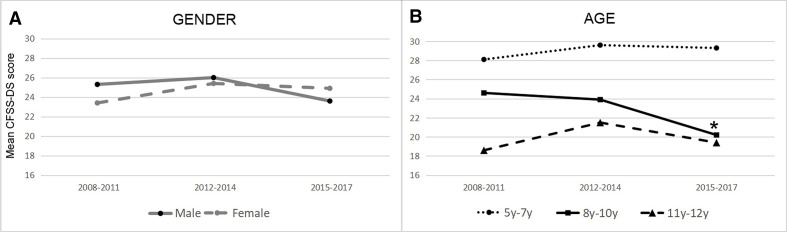
Clinical data were available from 1061 children, including 533 (50.2%) male participants and 528 (49.8%) female participants. The total CFSS-DS scores ranged from 16 to 66, with a mean of 24.8±10.3. The prevalence of dental anxiety is 11.59%. No significant differences in total CFSS-DS scores between girls and boys were found. According to the Frankl scale, 238 children were allocated to the uncooperative group and the remaining 823 children were allocated to the cooperative group. Scores of CFSS-DS were negatively correlated with the clinical behaviour level of Frankl. Children aged 11-12 years old had significantly decreased scores compared with other age groups, and there was a decline in the scores of the group aged 8-10 years old over time. The factor analysis divided 15 items of CFSS-DS into four factors, and the total scores of 'less invasive oral procedures' items belonging to factor III decreased significantly over time in the group aged 8-10 years old.
Age is a significant determinant for children's dental anxiety, and dental anxiety outcomes have improved for Chinese children aged 8-10 years. This study is one of the few reports on changes of children's dental anxiety in a new era of information, but the results may be extrapolated to other populations with caution.
牙科焦虑症在儿童中仍然普遍存在,可能持续到成年,并影响他们与口腔健康相关的生活质量和临床管理。本研究的目的是探讨儿童牙科焦虑症随时间的变化趋势和潜在风险因素。
纵向研究。
2008年至2017年期间,采用中文版儿童恐惧调查表-牙科分量表(CFSS-DS)和弗兰克尔行为评定量表对5至12岁的儿童进行调查,并探讨影响因素。
共有1061名儿童提供了临床数据,其中男性参与者533名(50.2%),女性参与者528名(49.8%)。CFSS-DS总分在16至66分之间,平均分为24.8±10.3。牙科焦虑症的患病率为11.59%。未发现女孩和男孩在CFSS-DS总分上有显著差异。根据弗兰克尔量表,238名儿童被分配到不合作组,其余823名儿童被分配到合作组。CFSS-DS得分与弗兰克尔临床行为水平呈负相关。11-12岁儿童的得分与其他年龄组相比显著下降,8-10岁组的得分随时间下降。因子分析将CFSS-DS的15个项目分为四个因子,属于因子III的“侵入性较小的口腔操作”项目的总分在8-10岁组中随时间显著下降。
年龄是儿童牙科焦虑症的一个重要决定因素,8-10岁中国儿童的牙科焦虑症结果有所改善。本研究是新时代信息时代为数不多的关于儿童牙科焦虑症变化的报告之一,但结果外推至其他人群时需谨慎。