Department of Microbiology, University of Alabama at Birmingham, Birmingham, United States of America.
Boehringer Ingelheim, Saint Joseph, United States of America.
Lupus. 2020 Aug;29(9):1095-1105. doi: 10.1177/0961203320935976. Epub 2020 Jul 1.
BACKGROUND/OBJECTIVE: Type-I interferons contribute to pathogenesis in systemic lupus erythematosus, including nephritis. Interferons consist of a family of 16 proteins yet are often characterized in patients without knowledge of the specific interferon subtypes involved. Different interferons may function in the kidneys, and other organs, relative to what is often measured in patient blood. Moreover, antibodies to interferons may potentially modulate systemic or organ-specific interferon activity. The aim of this study was to characterize global interferon activity levels and identify autoantibodies to the 12 interferon α subtypes in patient serum and urine.
Interferon activity levels in serum and urine were measured using an interferon bioassay. Anti-interferon and anti-cytokine autoantibodies were measured by ELISA. Serum and urine samples were also characterized for their ability to neutralize the biological activity of exogenously added interferons.
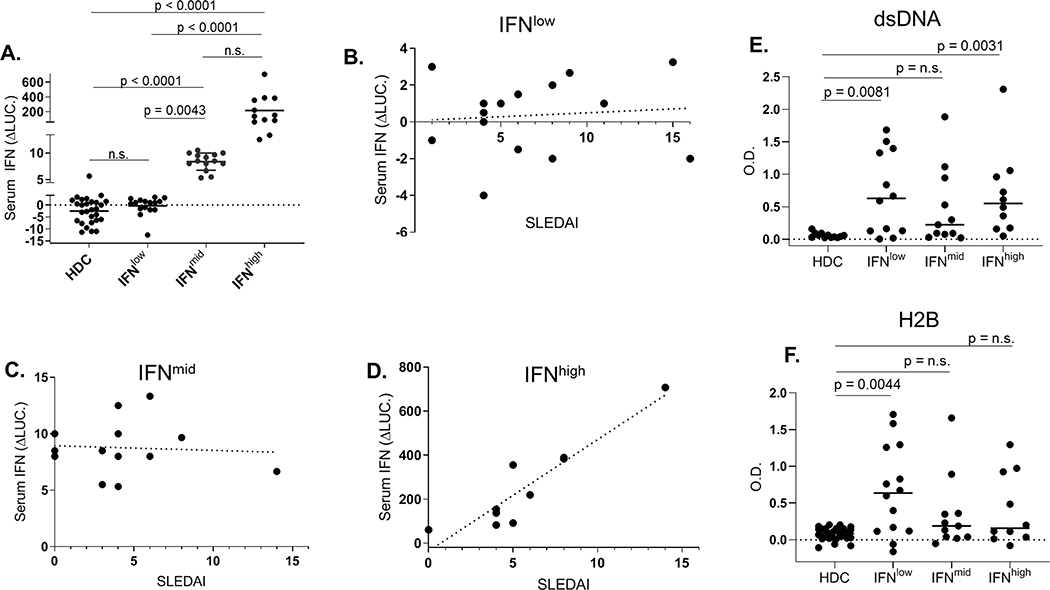
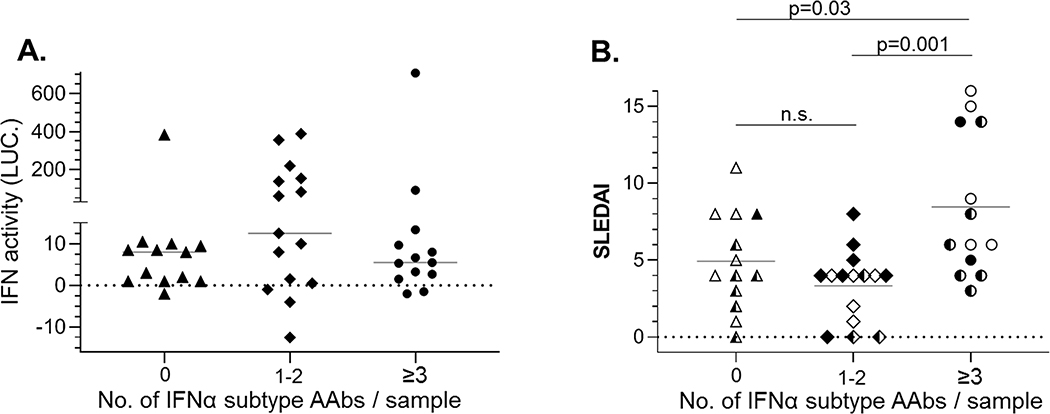
Serum interferon activity was increased in 62% of systemic lupus erythematosus patient samples, relative to healthy donor controls, whereas binding interferon α autoantibodies to at least one interferon α subtype were found in 68% of the samples evaluated. High Systemic Lupus Erythematosus Disease Activity Index scores were significantly ( = 0.001) associated with patient samples containing interferon α autoantibodies to three or more interferon α subtypes in their serum. Interferon α autoantibodies that potently block interferon activity were rare (∼5% of samples), but collectively bound to all 12 interferon α subtypes. Urine interferon activity and interferon α autoantibody profiles did not correlate with their serum counterparts, suggesting immune responses in systemic lupus erythematosus kidneys can be distinct from those measured in serum. Analysis of autoantibodies to 15 additional cytokines in serum identified higher frequencies of granulocyte-macrophage colony-stimulating factor and interleukin 17A autoantibodies, suggesting these signaling pathways may potentially contribute, with interferons, to systemic lupus erythematosus pathogenesis.
The measurement of autoantibodies to multiple interferon subtypes in serum and urine may provide an alternative method for following interferon-mediated systemic lupus erythematosus disease activity. The results suggest autoantibodies might be used for patient monitoring and/or identifying additional cytokine signaling pathways that are functioning in different systemic lupus erythematosus patients.
背景/目的:I 型干扰素参与红斑狼疮的发病机制,包括肾炎。干扰素由 16 种蛋白质组成,但在没有涉及特定干扰素亚型的知识的情况下,通常在患者中进行特征描述。不同的干扰素可能在肾脏和其他器官中发挥作用,而不是在患者血液中经常测量的那样。此外,干扰素的抗体可能潜在地调节全身或器官特异性干扰素活性。本研究旨在描述全身性干扰素活性水平,并鉴定患者血清和尿液中 12 种干扰素α亚型的自身抗体。
使用干扰素生物测定法测量血清和尿液中的干扰素活性水平。通过 ELISA 测量抗干扰素和抗细胞因子自身抗体。还对血清和尿液样本进行了表征,以确定其中和外源性添加干扰素的生物学活性的能力。
与健康供体对照相比,62%的系统性红斑狼疮患者样本的血清干扰素活性增加,而在评估的样本中,有 68%发现至少有一种干扰素α亚型的结合干扰素α自身抗体。高系统性红斑狼疮疾病活动指数评分与血清中含有三种或更多干扰素α亚型的干扰素α自身抗体的患者样本显著相关(=0.001)。能有效阻断干扰素活性的干扰素α自身抗体很少见(约 5%的样本),但共同结合了所有 12 种干扰素α亚型。尿液干扰素活性和干扰素α自身抗体谱与血清对应物不相关,这表明系统性红斑狼疮肾脏中的免疫反应可能与血清中测量的反应不同。对血清中 15 种其他细胞因子自身抗体的分析确定了更高频率的粒细胞-巨噬细胞集落刺激因子和白细胞介素 17A 自身抗体,这表明这些信号通路可能与干扰素一起,有助于系统性红斑狼疮的发病机制。
在血清和尿液中测量多种干扰素亚型的自身抗体可能提供一种替代方法来监测干扰素介导的系统性红斑狼疮疾病活动。结果表明,自身抗体可用于患者监测和/或鉴定在不同系统性红斑狼疮患者中起作用的其他细胞因子信号通路。