Lemos Mariantonia, Vásquez Andrés Miguel, Román-Calderón Juan Pablo
. Universidad Eafit, Medellín, Colombia Universidad EAFIT Universidad Eafit Medellín Colombia.
Int J Psychol Res (Medellin). 2019 Jan-Jun;12(1):18-27. doi: 10.21500/20112084.3627.
To examine the relationship between the components of emotional dependency (ED) with anxious, depressive, and impulsive symptomatology.
98 university students (68% women, age M = 20.2 years, ED = 2.19) responded to the ED Questionnaire (EDQ) (Lemos & Londoño, 2006), the Beck Depression Inventory II (Beck, Steer, & Brown, 2011), the Beck Anxiety Inventory (Beck & Steer, 2011), and the short version of the Barratt Impulsiveness Scale BIS-15S (Spinella, 2007).
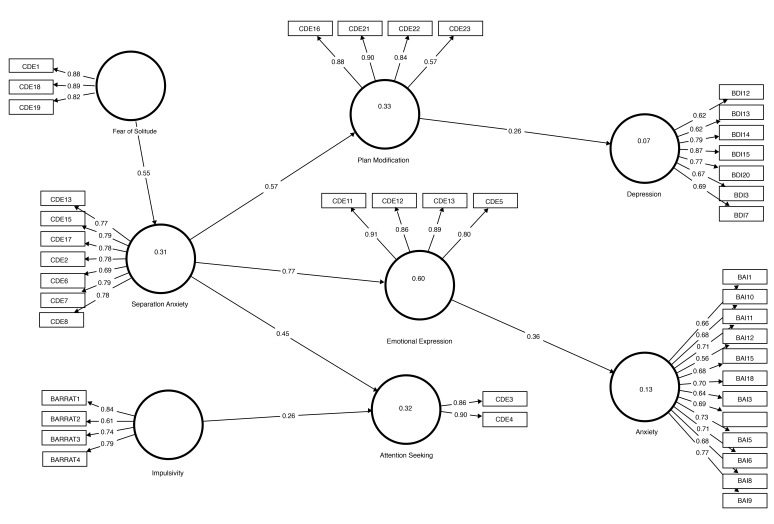
The structural model indicated that a fear of being alone is associated with separation anxiety, which in turn gives rise to plan modification (PM), search for emotional expression (SEE) and attention-seeking (AS). We found that PM was associated with depression, SEE with anxiety, and that impulsivity could lead to AS.
These results identify potential therapeutic targets in people with ED.
探讨情感依赖(ED)各成分与焦虑、抑郁及冲动症状之间的关系。
98名大学生(68%为女性,平均年龄M = 20.2岁,情感依赖程度ED = 2.19)完成了情感依赖问卷(EDQ)(莱莫斯和伦敦尼奥,2006年)、贝克抑郁量表第二版(贝克、斯泰尔和布朗,2011年)、贝克焦虑量表(贝克和斯泰尔,2011年)以及巴拉特冲动性量表简版BIS - 15S(斯皮内拉,2007年)。
结构模型表明,对孤独的恐惧与分离焦虑相关,而分离焦虑又会引发计划修改(PM)、寻求情感表达(SEE)和寻求关注(AS)。我们发现,计划修改与抑郁相关,寻求情感表达与焦虑相关,冲动性可能导致寻求关注。
这些结果确定了情感依赖人群潜在的治疗靶点。