Hubert Department of Global Health, Rollins School of Public Health, Emory University, Atlanta, Georgia, United States of America.
The Aurum Institute, Johannesburg, South Africa.
PLoS One. 2020 Jul 2;15(7):e0235178. doi: 10.1371/journal.pone.0235178. eCollection 2020.
South Africa is home to the world's largest HIV epidemic. Throughout the world, incarcerated individuals have a higher prevalence of HIV than the general public, and South Africa has one of the highest rates of incarceration in sub-Saharan Africa. In spite of this, little has been published about the burden of HIV and how care is delivered in South African correctional facilities.
To estimate the prevalence of people living with HIV and identify initiation and retention in the HIV cascade of care across five correctional facilities.
Cross-sectional retrospective analysis of 30,571 adult inmates who participated in a tuberculosis screening and HIV counseling and testing campaign in South African correctional facilities (January 1, 2014-January 31, 2015). Descriptive statistics were used to estimate the proportion and 95% confidence intervals of HIV. Proportions of persons retained and lost at each step in the HIV cascade of care under this intervention were calculated. Poisson regression with robust variance estimates were used, and clustering by facility was accounted for in all analyses.
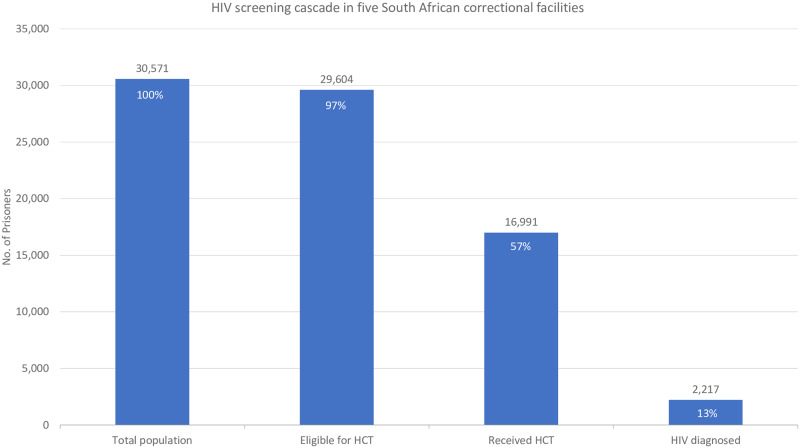
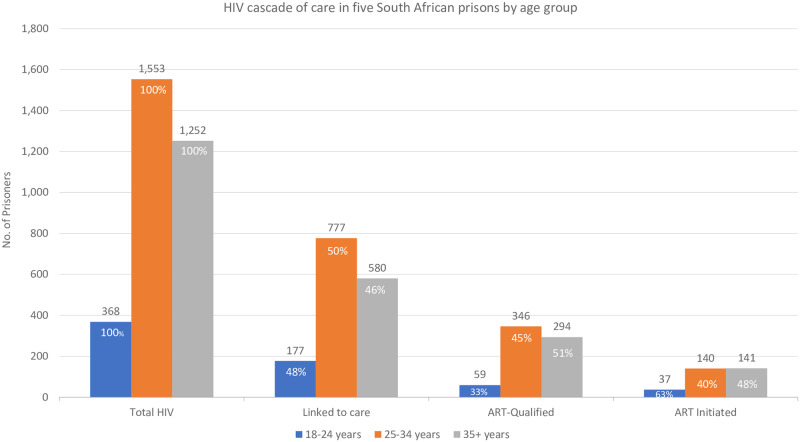
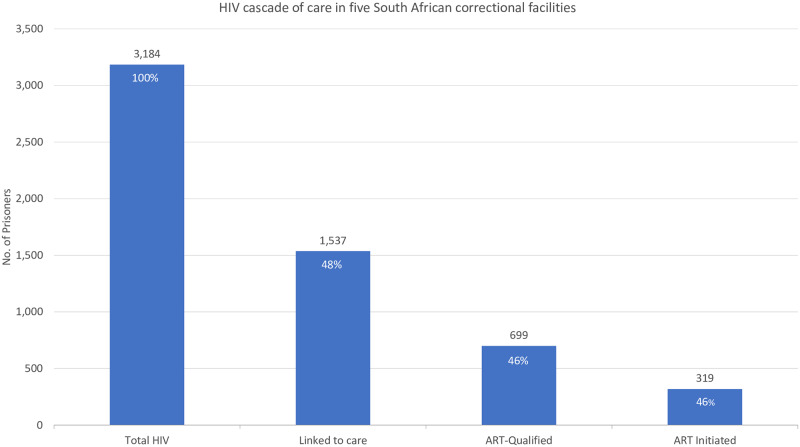
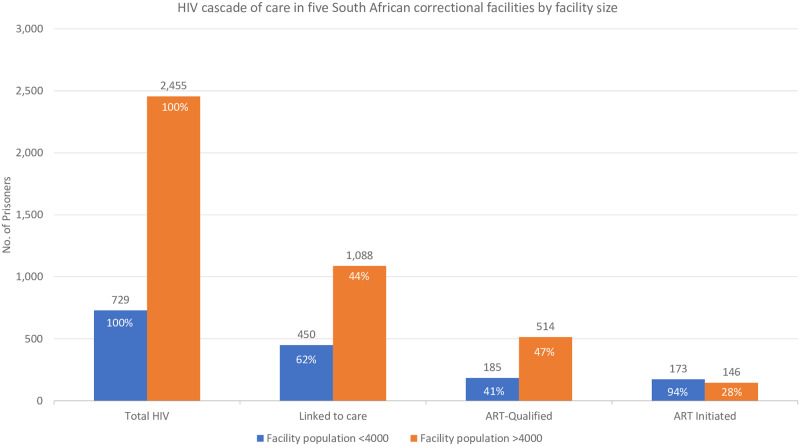
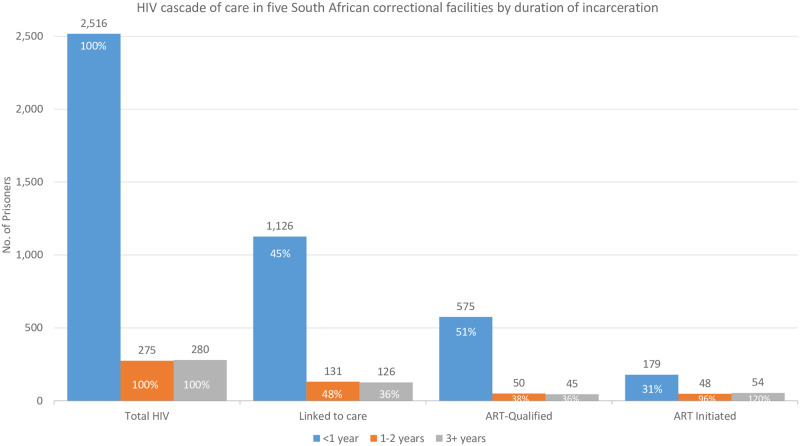
Results of the screening campaign found previously undiagnosed HIV among 13.0% of those consenting to screening, with a total estimated HIV prevalence of 17.7% (n = 3,184, 95% CI: 17.2-18.3%) in the sample. When examining the overall cascade of care, 48.3% of those with HIV initiated care, and overall 45.6% of persons who entered care qualified for ART initiated treatment. A Poisson regression accounting for clustering by facility found HIV high risk groups within the population such as women (aRR = 1.72, 95% CI: 1.57, 1.89), those over 35 years of age (aRR = 2.43, 95% CI: 1.53, 3.85), and people incarcerated less than one year (aRR = 1.41, 95% CI: 1.19, 1.67).
In this setting, routine screening is recommended, and measures are needed to ensure that persons diagnosed are adequately linked to and retained in care.
南非是世界上 HIV 疫情最严重的国家。在全球范围内,被监禁者的 HIV 感染率高于普通人群,而南非是撒哈拉以南非洲监禁率最高的国家之一。尽管如此,关于 HIV 的负担以及南非惩教设施中如何提供护理的信息却很少见诸于文献。
估计南非五所惩教设施中 HIV 感染者的流行率,并确定 HIV 护理的启动和保留情况。
对南非惩教设施中参加结核病筛查和 HIV 咨询及检测活动的 30571 名成年囚犯(2014 年 1 月 1 日至 2015 年 1 月 31 日)进行横断面回顾性分析。采用描述性统计方法估计 HIV 的比例和 95%置信区间。计算在这种干预措施下,HIV 护理连续体中每个步骤保留和流失的人数比例。采用稳健方差估计的 Poisson 回归,在所有分析中都考虑了设施的聚类。
筛查活动的结果发现,在同意筛查的人群中,有 13.0%的人以前未被诊断出 HIV,样本中总的 HIV 流行率为 17.7%(n=3184,95%CI:17.2-18.3%)。当检查整个护理连续体时,48.3%的 HIV 感染者开始接受治疗,总体上有 45.6%的进入治疗的人符合接受抗逆转录病毒治疗的条件。考虑到设施聚类的 Poisson 回归发现,人群中存在 HIV 高危群体,如女性(ARR=1.72,95%CI:1.57,1.89)、年龄超过 35 岁的人(ARR=2.43,95%CI:1.53,3.85)和入狱不到一年的人(ARR=1.41,95%CI:1.19,1.67)。
在这种情况下,建议进行常规筛查,并需要采取措施确保诊断出的人能够充分地与护理相衔接并得到保留。