M-Sense Research Group, Department of Electrical and Biomedical Engineering, University of Vermont, Burlington, VT, United States.
Department of Neurological Sciences, University of Vermont, Burlington, VT, United States.
Gait Posture. 2020 Jul;80:361-366. doi: 10.1016/j.gaitpost.2020.06.014. Epub 2020 Jun 20.
Approximately half of the 2.3 million people with multiple sclerosis (PwMS) will fall in any three-month period. Currently clinicians rely on self-report measures or simple functional assessments, administered at discrete time points, to assess fall risk. Wearable inertial sensors are a promising technology for increasing the sensitivity of clinical assessments to accurately predict fall risk, but current accelerometer-based approaches are limited.
Will metrics derived from wearable accelerometers during a 30-second chair stand test (30CST) correlate with clinical measures of disease severity, balance confidence and fatigue in PwMS, and can these metrics be used to accurately discriminate fallers from non-fallers?
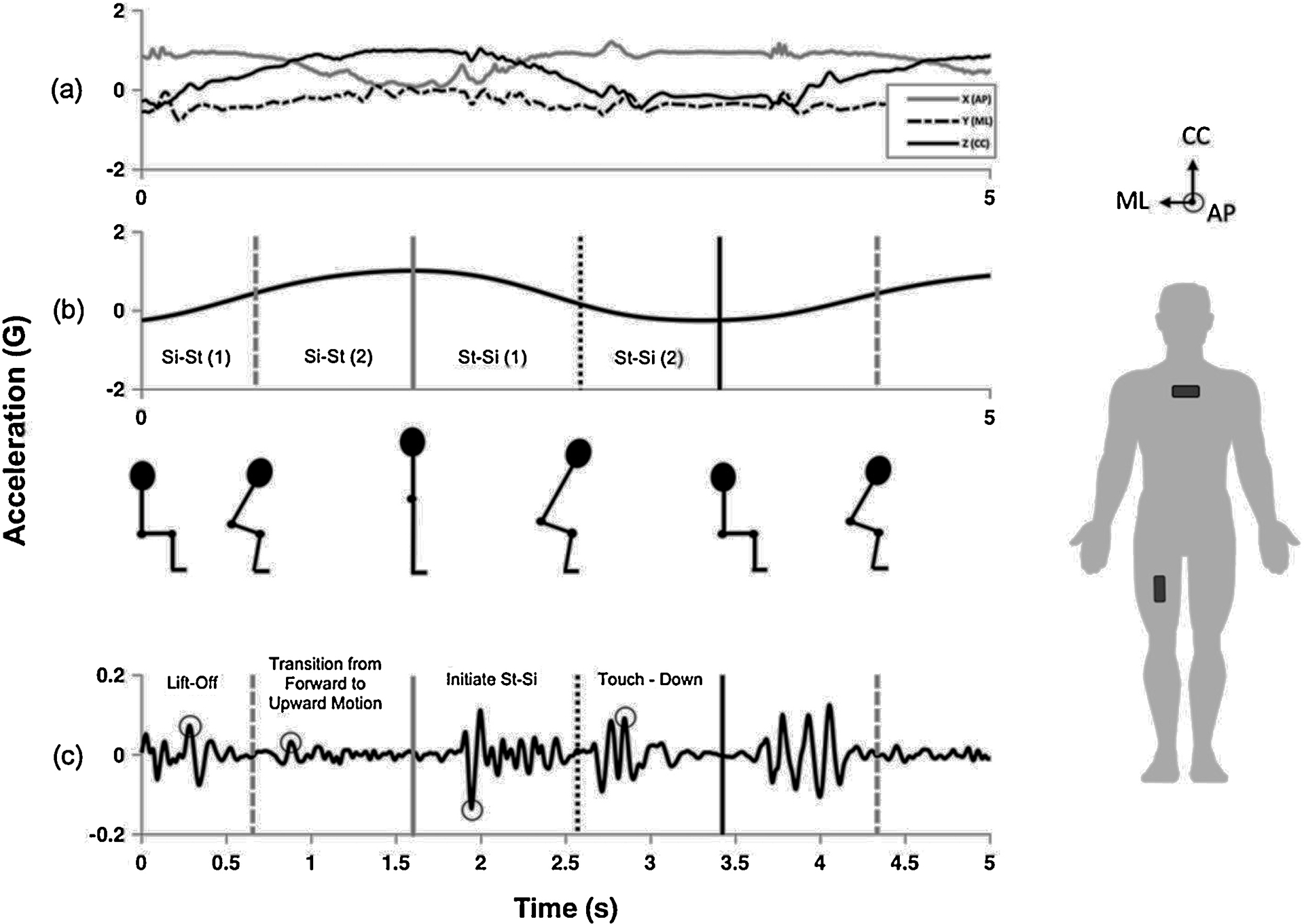
Thirty-eight PwMS (21 fallers) completed self-report outcome measures then performed the 30CST while triaxial acceleration data were collected from inertial sensors adhered to the thigh and chest. Accelerometer metrics were derived for the sit-to-stand and stand-to-sit transitions and relationships with clinical metrics were assessed. Finally, the metrics were used to develop a logistic regression model to classify fall status.
Accelerometer-derived metrics were significantly associated with multiple clinical metrics that capture disease severity, balance confidence and fatigue. Performance of a logistic regression for classifying fall status was enhanced by including accelerometer features (accuracy 74%, AUC 0.78) compared to the standard of care (accuracy 68%, AUC 0.74) or patient reported outcomes (accuracy 71%, AUC 0.75).
Accelerometer derived metrics were associated with clinically relevant measures of disease severity, fatigue and balance confidence during a balance challenging task. Inertial sensors could feasibly be utilized to enhance the accuracy of functional assessments to identify fall risk in PwMS. Simplicity of these accelerometer-based metrics could facilitate deployment for community-based monitoring.
约有一半的 230 万多发性硬化症患者(PwMS)会在任意三个月期间跌倒。目前,临床医生依靠自我报告的措施或简单的功能评估,在离散的时间点进行评估,以评估跌倒风险。可穿戴惯性传感器是一种很有前途的技术,可以提高临床评估的敏感性,从而更准确地预测跌倒风险,但目前基于加速度计的方法存在局限性。
在 30 秒椅立测试(30CST)期间,从可穿戴加速度计中得出的指标是否与 PwMS 的疾病严重程度、平衡信心和疲劳的临床指标相关,并且这些指标是否可以准确区分跌倒者和非跌倒者?
38 名 PwMS(21 名跌倒者)完成了自我报告的结果测量,然后在惯性传感器贴在大腿和胸部上时进行了 30CST。从三轴加速度数据中得出了从坐下到站起和从站到站起的过渡的加速度计指标,并评估了与临床指标的关系。最后,使用这些指标来开发逻辑回归模型以对跌倒状态进行分类。
加速度计得出的指标与多个临床指标显著相关,这些指标可以捕捉疾病严重程度、平衡信心和疲劳。与标准护理(准确性 68%,AUC 0.74)或患者报告的结果(准确性 71%,AUC 0.75)相比,通过包含加速度计特征,逻辑回归的跌倒状态分类准确性得到了提高(准确性 74%,AUC 0.78)。
在平衡挑战任务中,加速度计得出的指标与疾病严重程度、疲劳和平衡信心的临床相关指标相关。惯性传感器可以用于增强功能评估的准确性,以识别 PwMS 的跌倒风险。这些基于加速度计的指标的简单性可以促进其在社区监测中的应用。